
A pet birthday reminder is a small, friendly prompt, and for a pet business it is one of the easiest reasons to get in touch with a client without selling anything. The catch is that most birthday reminder tools are built for owners, not for businesses with hundreds of animals on the books. The practical answer is to record each pet's birthday once, keep it with the rest of the client record, and let your normal reminder routine carry it. That is the approach this guide sets out: what to capture, when to send, what to say, and how to handle the pets whose birthdays nobody knows.
Owners search for "pet birthday reminders" and find calendar apps and ecards. You are reading from the other side of the counter. Your clients already trust you with their dog, cat or horse, so a reminder from you is welcome in a way that a generic marketing email is not.
TL;DR
- Capture the birthday at the first booking, along with a flag for whether it is exact or estimated.
- Store it in the pet's own record, not in your head or a paper diary, so every staff member sees it.
- Send one message about a week out for a simple greeting, and a month out only when there is something to book.
- For rescues with no known date, record the vet's or rescue's estimate and a separate adoption (gotcha) day.
- Keep birthday messages separate from health reminders such as vaccinations, which follow the vet's schedule.
Table of Contents
- Why a birthday reminder suits a pet business
- What to capture at booking
- When pets have no known birthday
- How owners set their own reminders
- When to send: matching the reminder to the effort
- Keep birthdays and health reminders apart
- What to say, and what to suggest
- Running it without adding admin
- Common mistakes
- Where this fits in your software
- Our view on birthday reminders
- FAQ
- Sources
Why a birthday reminder suits a pet business
An appointment reminder says "we need you." A birthday reminder says "we know your animal." That difference matters for groomers, boarders, dog walkers, trainers, mobile vets, equine professionals and behaviourists, whose work depends on repeat visits and on the owner feeling that their animal is more than a slot in the diary.
Owners treat the date seriously. A 2025 Australian survey reported in the press found that 64 per cent of Australians say their pet's birthday is just as important as a human's, according to the coverage of that research, so a message that marks the day lands with people who care about it. You do not need to build a party service around that. A short note and, where it suits, a reason to book is enough.
Three practical benefits follow:
- A natural reason to contact lapsed clients. A greeting is easier to send than "it has been a while since your last groom."
- Information you can use at the appointment. Knowing a dog is turning one, or turning twelve, changes how you talk about coat, joints, handling time and rest breaks.
- A consistent record. One date per pet, in one place, means nobody has to ask the owner again.
What to capture at booking
The best time to ask for a birthday is when the pet is first added to your system, since the owner is already typing in the name, breed and any handling notes. Keep it to a few fields:
- Birth date (day, month and year if known).
- Exact or estimated. A simple yes or no that stops anyone treating a guess as a medical fact.
- Adoption or gotcha day, if the owner volunteers it.
- A note on the source, for example "estimated by rescue at adoption."
That last note is not fussy. One pet-reminder guide advises marking an approximate age as approximate and adding a note such as "estimated by rescue at adoption" so the uncertainty stays visible later, which is exactly what your next receptionist will need (LifeDates).
If you run mobile visits or a multi-staff team, this record has to live somewhere everyone can open it. Our article on one timeline per pet and 7 day reminders covers how to keep notes tied to the animal rather than scattered across messages and spreadsheets.
When pets have no known birthday
A large share of your clients will own rescues, rehomed animals or horses bought second-hand. Their birthday is a best guess, and the way you record it should reflect that.
Use the vet's or rescue's estimate
If an owner does not know the date, the first step is to ask the breeder, the rescue or their vet. Research from the WALTHAM Petcare Science Institute notes that for a puppy with an unknown birth date, you can ask the breeder or have a veterinarian estimate the age, and that estimated dates should be treated with caution when following growth, because a week or two can change how growth is read (WALTHAM). The American Kennel Club adds that age affects diet, exercise and healthcare needs, and that vets often look at the teeth, with adult teeth in place by about six months and wear, staining and tartar building with age (AKC).
You are not the one to assign a medical age. If a client asks how old their dog is, the answer is to have their vet look. What you record is whatever the vet or rescue gave them.
Pick a notional date and keep it fixed
One guide to rescue birthdays suggests subtracting the estimated age from today's date to get a notional birth date, then keeping that date consistent, since it is a convention and does not need to be right to the day (CalcuPaw). A dog estimated at four years on 19 October 2026 would be given a birth date of 19 October 2022. The point is consistency: the same date every year, flagged as estimated.
Keep two dates
The same guide recommends holding a notional birthday for age records and a separate gotcha day for the adoption, labelled so reminders do not get confused. Another approach is to treat a birthday as answering "how old is my pet?" and the adoption anniversary as answering "how long have we been together?", so one should not replace the other (LifeDates). Many owners will happily celebrate the day they brought the animal home, and an Australian veterinary hospital makes the same point: if the date is unknown, celebrate the day you met (Woofpurnay Veterinary Hospital).

For your records, that means two optional fields per pet. Marking both costs you ten seconds at intake and gives you two chances a year to say hello.
How owners set their own reminders
Some clients will ask how to remember the date themselves, and it helps to have a one-line answer. Phone calendars handle it well. In Google Calendar on Android, you create an event, choose Birthday, add a name and date, and save. The app then reminds you a week before and on the day, and you can add or remove other notifications (Google Calendar Help). Dedicated pet apps do the same with photo profiles and countdowns.
That is useful for owners, but it does nothing for you. Their reminder prompts them to celebrate. Yours prompts you to contact them, and only you can attach a booking to it. That is why the record belongs in your system.
When to send: matching the reminder to the effort
A good rule from pet reminder guides is to choose the earliest reminder that matches the effort involved. One guide splits it like this: a month ahead for booking a gathering or something personalised, a week ahead for buying treats or planning a walk, a day ahead to check plans, and on the day as a final prompt to celebrate (LifeDates).
For a business, translate that into your own work:
| Lead time | Use it for | Example |
|---|---|---|
| About one month | Anything that needs a booking: a birthday groom, a boarding stay, a walk package, a behaviour check-in | "Milo turns three next month. Want to book his birthday groom?" |
| About one week | A greeting with an optional offer | "Happy early birthday to Bella, from all of us." |
| On the day | A short, warm message and nothing else | "Happy birthday, Max!" |
Most businesses will want just one touch a year per pet. Sending three would turn a courtesy into noise. Pick the one that fits your service:
- Groomers: a month ahead, because coat work needs a slot.
- Boarders: a month ahead for holidays and school-break stays, since those dates fill first.
- Dog walkers: a week ahead, as a greeting with a possible extra walk.
- Trainers and behaviourists: a week ahead, as a milestone check-in that often prompts a follow-up session.
- Mobile vets and equine professionals: on the day or a week ahead, as a greeting only, kept apart from clinical reminders.
Keep birthdays and health reminders apart
This is the one place where mixing things up causes real harm. A birthday can be a nice moment to ask whether the owner's records are current, but it should not decide a medical schedule. Owners should follow the dates and intervals their vet gives them for examinations, vaccinations, parasite control and medication (LifeDates).
If you are a clinic, run vaccination and check-up reminders as their own stream, driven by the clinical record. Our guide on pet vaccination reminders clinics can run covers that side. Birthdays sit alongside it as a warmer, optional message.
What to say, and what to suggest
Keep the message short, use the pet's name, and mention the owner only if you know them well. A few starting points:
- "Happy birthday to Poppy! We hope she gets an extra treat today."
- "Rex turns five this month. If you would like to give him a fresh groom for the occasion, you can book online in a minute."
- "Happy gotcha day to Luna. It is a year since she came home, and we are glad she chose us for her grooming."
If you want to add a suggestion, keep it safe. The ASPCA recommends options such as a small playdate with toys, treats and water bowls, homemade pet-friendly treats, a new toy or a donation to a local shelter in the pet's name, and quality cuddle time. It also advises owners to talk to their vet before offering new foods if the pet is on a specialised diet (ASPCA). That last point is worth repeating if you suggest a treat: say "check with your vet if your pet is on a special diet."
A word on tone. Animals do not know what a birthday is. One US animal group points out that pets respond to the energy, treats, toys and attention around a celebration, so quiet treats, play or a new toy often beat a loud party (Pawrpose). Your message should therefore be about the owner's moment with the pet, not an elaborate event. For a birthday groom or a boarding stay, that means a calm, unhurried visit.
If an owner does want a small party, the Australian vet hospital cited earlier suggests keeping the group small, not inviting pets the birthday animal has never met, supervising closely, and providing shade and water if outdoors. Those are good lines for a short seasonal note, though you do not need to host anything yourself.
Running it without adding admin
The reason birthday reminders fail in small businesses is that they depend on someone remembering to check a list. A diary that lives on paper, a spreadsheet tab or the owner's memory will be fine for a month and then quietly stop.
The fix is to attach the date to the pet's record and run it through the same system that already handles your appointments. Our platform includes a customer management CRM and automated customer reminders, so appointment reminders go out without you chasing them, and you can keep each pet's details with the client. You can read how auto reminders work, and how reminders can arrive in the channel clients actually read in our piece on WhatsApp appointment reminders.
A workable routine looks like this:
- At intake, record the birth date, the exact-or-estimated flag and the gotcha day in the pet's notes.
- Once a month, scan the upcoming month for birthdays and gotcha days.
- Send the message in the format you chose above.
- Link to your booking page if the message is a rebooking prompt, so the client can reply with a booking rather than a phone call.
- Note the response on the pet's record, so the next year's message can build on this one.
The rebooking step is where the real value sits. When the message includes a link to online booking, the client can choose a time straight away, and if you take payment at booking, a deposit helps protect the slot you have just filled. For more on keeping the diary tidy once bookings arrive, see our guides to preventing double booking and online rescheduling for clients.
Common mistakes
- Asking for the birthday too late. If you wait until the client has been with you for a year, you have missed one cycle already.
- Treating an estimate as a fact. An unflagged guess will eventually clash with the vet's records.
- Sending too many touches. One birthday message a year is a courtesy. Three is spam.
- Mixing health and celebration. Keep vaccination and check-up reminders separate and follow the vet's intervals.
- Overlooking horses and other species. Equine clients and owners of small animals value the greeting just as much, and the same fields work.
- Forgetting the human. The owner's name and preferred contact channel belong in the same record.
Where this fits in your software
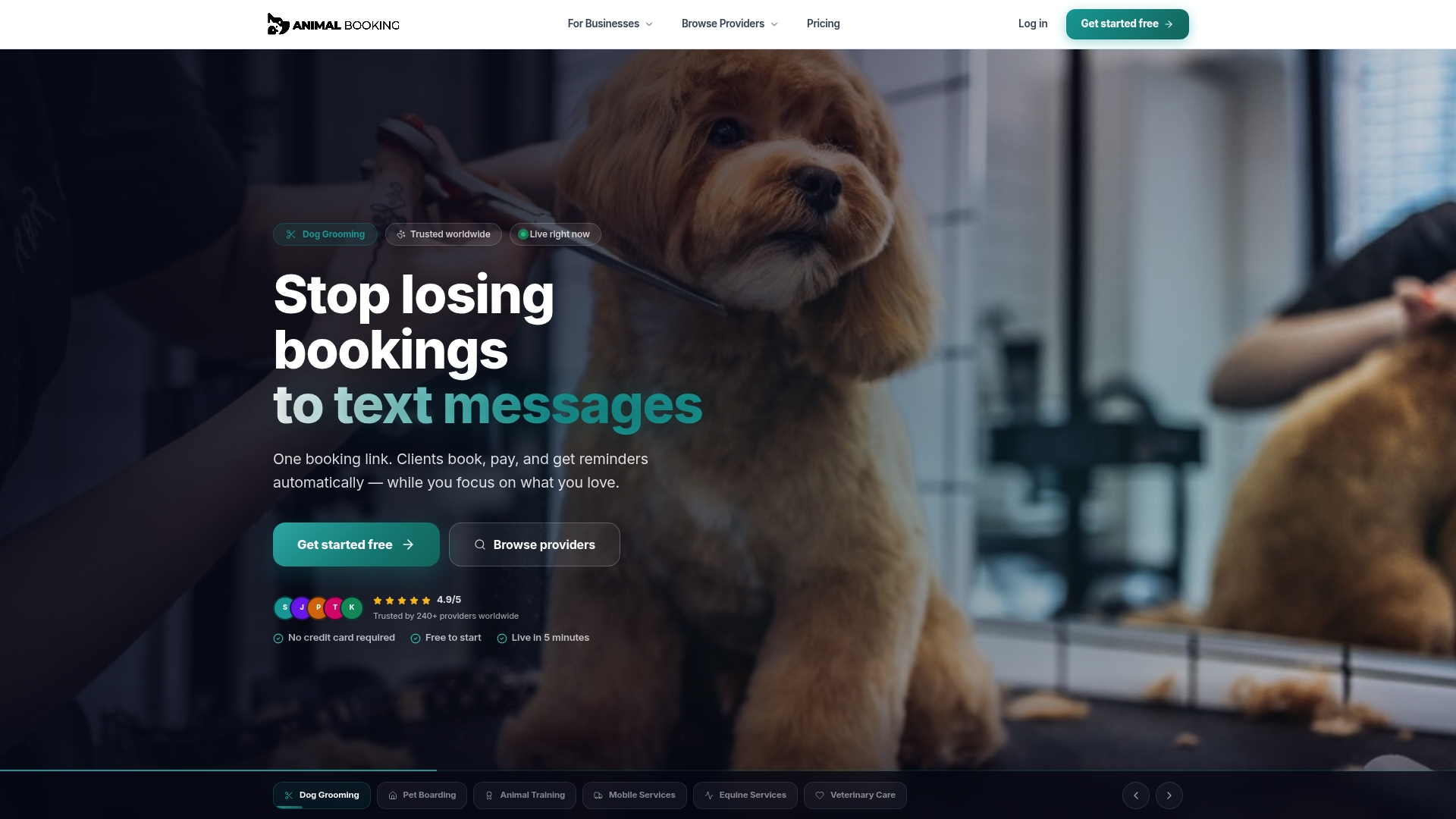
If you are still running reminders by text and a spreadsheet, the birthday routine is a good reason to move to one place. Animal Booking is online booking and scheduling software for pet service providers: dog groomers, boarders, trainers, vets, equine professionals and mobile pet businesses. It covers payments, automated customer reminders, recurring, instant and manual bookings, online payment deposits, a customer CRM, analytics, multi-staff support and embeddable booking forms. Our positioning is a setup that takes 10 to 15 minutes to go live, and a fully branded booking website on your own domain.
The Independent plan is $49 per month, Teams is $149 per month and Pro is $299 per month. Starter has no published price. Platform fees of 3%, 2%, 1.5% or 1% apply to payments processed through the system. Full details are on the pricing page and the platform fee page. If you want a branded page to link from your birthday messages, see the booking website feature.
For a mobile business, the diary side matters as much as the reminders. Our notes on appointment buffer time, assigning staff to appointments and running late message templates show how to keep a birthday-month rush under control.
Our view on birthday reminders
We think of a birthday message as the lightest version of what a booking platform is for: keeping the relationship with the client moving between appointments.
Pet businesses lose time to missed appointments, manual scheduling and messages that live in too many places. The same habits that cut no-shows, such as automated reminders and one clear record per client, are the ones that make a birthday greeting effortless. If the reminder is automatic and the booking link is one tap away, the greeting can become a rebooking without extra work from you.
Our advice is to start small. Capture the date at intake, mark it as exact or estimated, keep it with the client's record, and send one friendly message a year. Our formula is designed to save you time on exactly this kind of routine work, so that your attention stays with the animals in front of you.
AnimalBooking
FAQ
How far ahead should a pet business send a birthday reminder?
Match the lead time to what you are asking. About a month ahead suits anything that needs a booking, such as a groom or a boarding stay. A week ahead suits a greeting with an optional offer, and the day itself suits a short message with no pitch. One touch per pet per year is plenty.
What if a client does not know their pet's birthday?
Record the age estimated by their vet or the rescue, turn it into a consistent notional date, and flag it as estimated. Also ask for a gotcha day, the day the animal came home, which many owners are happy to celebrate. Leave any real age questions to their vet.
Can a birthday reminder replace vaccination or check-up reminders?
No. Keep them separate. Health reminders should follow the dates and intervals set by the pet's vet, while a birthday message is a friendly extra. A birthday can simply prompt an owner to check their records are current.
What can I suggest for a safe birthday celebration?
Simple ideas work best: a new toy, a favourite walk, a small playdate or quiet cuddle time. If you mention treats, add that owners should check with their vet first if the pet is on a special diet, as the ASPCA advises.
Do I need to message every client?
No. Start with the clients who book regularly, plus any whose last visit was some months ago. A birthday greeting to a lapsed client is a gentle way to reopen the conversation, and you can extend the routine to everyone once it is running smoothly.
Sources
- Manage birthdays on your calendar, Google Calendar Help
- Pet Birthday Reminder App for iPhone, LifeDates
- Puppy Growth Charts, WALTHAM Petcare Science Institute
- How Old Is My Dog?, American Kennel Club
- How to Pick a Birthday for a Rescue Pet, CalcuPaw
- 9 Fun ways to celebrate your pet's birthday, Woofpurnay Veterinary Hospital
- Fun Ways to Safely Celebrate Your Pet's Birthday, ASPCA
- Pet Birthday Parties: Do Animals Get Their Birthday, Pawrpose