
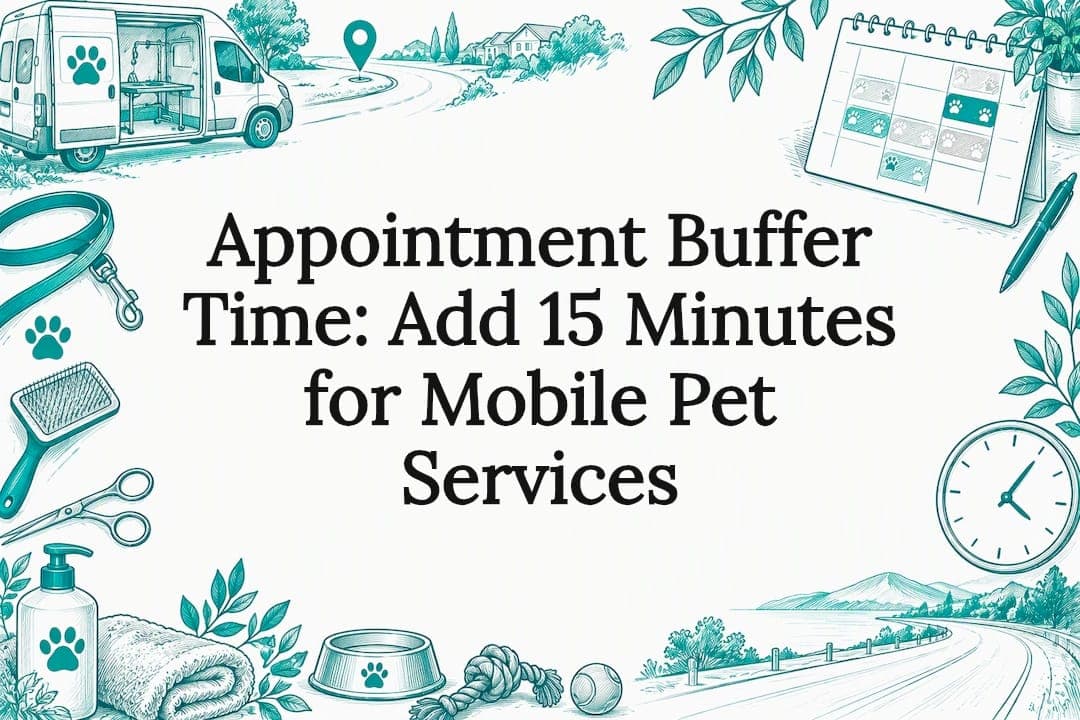
Appointment buffer time is a deliberate gap added before or after a booking so your calendar stays realistic instead of back-to-back. You should use it, because without a buffer, one late finish cascades into every appointment after it. Most scheduling software treats the service duration plus the buffer as a single occupied block, so clients simply cannot book into that cushion.
TL;DR:
- Buffer times are treated as occupied blocks in scheduling software, often invisible to clients, but essential for realistic appointment spacing.
- Using a 10 to 15-minute buffer after standard services prevents scheduling cascades caused by delays and allows for cleanup or note-taking.
- Mobile services should include longer buffers, around 15 to 20 minutes, to account for travel, parking, and unpacking, directly impacting capacity and revenue.
- Setting buffers dynamically based on the specific task, such as longer buffers for full groomings and minimal for quick trims, improves schedule accuracy.
- Regularly monitoring late finishes, schedule gaps, and staff feedback helps refine buffer durations to optimize on-time performance and client satisfaction.
Table of Contents
- What buffer time is and how scheduling software handles it
- Benefits of using buffer time
- When to use before buffers, after buffers and pet-service examples
- How to set buffer time in scheduling software
- Recommended buffer durations and rules of thumb
- Monitoring performance and iterating buffer settings
- How a purpose-built booking platform helps apply buffers correctly
- A practitioner's take on realistic scheduling
- Try buffer time built into your booking platform
- FAQ
- Sources
What buffer time is and how scheduling software handles it
Buffer time is the padding you add around a booked service so the calendar blocks out more time than the appointment itself takes. Scheduling engines do not treat the buffer as a separate event. They add it to the service length and occupy the whole span, which is why a client searching for an opening never sees a gap that is actually reserved for cleanup or travel.

Microsoft's own documentation describes exactly this mechanic: buffers are configured on a service's details page with separate before and after toggles, and a booking needs enough free time for the appointment plus the buffer before it will show as available. A 60-minute appointment with a 15-minute pre-appointment buffer needs a 75-minute open block to appear as bookable at all.
That has a practical effect on what clients can select:
- A client browsing your online booking page sees only genuinely free slots, never the buffer itself.
- Two services cannot be booked back-to-back if the gap between them is smaller than the required buffer.
- Changing a buffer setting can immediately hide slots that were previously bookable, which is worth testing before you publish the change.
The buffer is invisible to the person booking, but it is doing real work behind the scenes: it is the difference between a calendar that looks full and one that actually runs on time.
Benefits of using buffer time
The instinct to skip buffers comes from treating them as wasted capacity. In practice, they prevent the kind of schedule cascade where one appointment running ten minutes long pushes every booking that day into overtime. A groomer who finishes a tricky dog late, then walks straight into the next client with no gap, ends up rushing the second appointment too, and the problem compounds through the afternoon.
Buffers also create room for the parts of the job that do not fit neatly into a "service," including cleanup between clients, writing notes on a pet's behaviour or coat condition, and a short break so staff are not working flat out for eight hours straight.
For mobile providers the stakes are higher again. Inadequate buffers between jobs cost mobile groomers real money, according to routing guidance for mobile pet groomers, which points to extra driving time between appointments as a direct drag on daily capacity and weekly revenue when buffers do not account for travel.

When to use before buffers, after buffers and pet-service examples
Before and after buffers solve different problems, so the choice depends on what happens immediately next to the appointment rather than on habit.
- Use an after-buffer for cleanup, disinfecting equipment, or writing up notes while the details are fresh.
- Use a before-buffer when a service needs setup time, such as laying out grooming tools or prepping a treatment room before a vet consult.
- Mobile services need both travel and parking time factored in, since arriving late to the next job has the same effect as running over on the current one.
- A quick nail trim or a routine follow-up call may need little to no buffer, since there is nothing to clean up and nothing to set up for.
A mobile dog groomer driving between suburban appointments is the clearest case for a combined buffer: the van needs to be packed down, driven to the next address, and unpacked again, and mobile grooming route planning advice notes that practitioners commonly add around 15 minutes for travel and cleanup in many grooming scenarios to avoid falling behind as the day goes on.
Pro Tip: Match the buffer to the mess, not the clock: a bath and full groom needs more after-buffer than a quick nail trim, even if both are booked for the same length of time.
How to set buffer time in scheduling software
Buffer settings usually live on the same screen as the service itself, not in a separate global menu, so start there rather than hunting through account-wide preferences.
- Open the specific service you want to adjust and look for a buffer or padding option, typically near the duration and pricing fields.
- Choose whether you need a before-buffer, an after-buffer, or both, since most platforms let you set them independently.
- Enter the number of minutes for each buffer, starting conservative rather than guessing high.
- Save the service and immediately open your own booking page as a test, checking which slots are now available for that service.
- Try to book a slot that should now be blocked by the buffer, to confirm the setting is actually being enforced rather than just displayed.
- Repeat the test for any staff member assigned to that service, since staff-specific availability can sometimes override service-level defaults.
If buffers do not seem to be taking effect, check three common culprits: the toggle may be enabled at the account level but not on the individual service, the before/after selection may be set the wrong way round, and a staff member's personal availability settings may be overriding the service default. Vendor documentation on buffer behaviour flags this kind of override as a common source of confusion, which is why testing the actual booking flow matters more than trusting the settings screen alone.
Recommended buffer durations and rules of thumb
There is no single correct buffer length, but a few starting points make trial and error faster.
- For typical in-salon or in-clinic services, 10 to 15 minutes after the appointment covers most cleanup and note-taking.
- Mobile services generally need longer buffers to account for travel and parking, often closer to 15 to 20 minutes depending on the route.
- Longer or messier sessions, such as a full groom with a bath, usually need more after-buffer than a quick trim, even though the service itself might only be marginally longer.
- Short, low-mess appointments can often run with a minimal or even zero buffer without causing problems.
The simplest way to see the impact is to compare two versions of the same day. A groomer with six 45-minute appointments back-to-back has zero room for a dog that takes longer than expected, and a single delay pushes every later appointment back by the same amount. The same six appointments with a 15-minute after-buffer built in take longer on paper, but they are far more likely to actually run on schedule, which matters more to most clients than squeezing in one extra booking.
Monitoring performance and iterating buffer settings
Buffer settings are not a set-and-forget decision. A few signals tell you when it is time to revisit them.
- Watch for repeated late finishes on a specific service, which usually means the buffer is too short rather than the staff member being slow.
- Look for empty gaps that show up consistently in the schedule, which can mean a buffer is longer than it needs to be.
- Ask staff directly whether they feel rushed between appointments, since they notice the squeeze before it shows up in any report.
- Change one service's buffer at a time and give it two to four weeks before drawing conclusions, rather than adjusting several services at once and losing track of what caused what.
- Track on-time finish rate, overall schedule utilisation, and revenue per available hour as the three numbers that tell you whether a buffer change helped or hurt.
Small, staged changes make it far easier to tell whether a longer buffer actually fixed the rushing, or whether a shorter one is quietly costing you bookings without anyone noticing.
How a purpose-built booking platform helps apply buffers correctly
Buffer settings work best when the platform treats them as part of availability logic rather than a manual calendar block you have to remember to add. Our smart calendar and online booking tools at Animal Booking build the buffer into the same calculation as the service itself, so a booked slot and its buffer disappear from availability together, with no separate step required. We also pair that with auto reminders to cut down on the no-shows that throw a carefully buffered day off course in the first place, and we report that providers switching from manual scheduling see meaningfully fewer missed appointments and a revenue lift per booking once buffers and reminders are working together.
A practitioner's take on realistic scheduling
Start with a buffer that feels slightly too generous, not the bare minimum you think you can get away with. Loop your staff into the decision, since they feel the squeeze between appointments before any report shows it. Run a new buffer for two full weeks before deciding whether to keep it, because a single bad day tells you nothing.
— AnimalBooking
Try buffer time built into your booking platform
We built Animal Booking so buffer settings, reminders, and route-aware scheduling work together instead of needing separate tools stitched together. Setting up a service with the buffer you want takes minutes, not an afternoon of fiddling with calendar blocks.
- Set before and after buffers per service, with the calendar enforcing them automatically.
- Send automated reminders that reduce the no-shows a tight schedule cannot absorb.
- Configure mobile-friendly scheduling for groomers and other travelling providers through our mobile pet groomers setup.
Plans start with Independent at $49 per month, with Teams and Pro available for larger operations, all detailed on our pricing page.
FAQ
What does buffer time mean in bookings?
Buffer time is a gap automatically added before or after a booked appointment so the scheduling system blocks out more time than the service itself takes. It prevents clients from booking into the minutes you need for cleanup, travel, or prep work.
What does buffer mean in scheduling?
In scheduling software, a buffer is padding added to a service's duration that the calendar treats as occupied, the same as the appointment itself. It is invisible to anyone browsing available times, but it stops overlapping bookings from being possible.
What is the buffer time?
Buffer time refers to the extra minutes set aside around an appointment for tasks like cleanup, note-taking, or travel between jobs. It is configured per service, often with separate settings for before and after the appointment, as described in Microsoft's buffer time documentation.
What does a buffer day mean?
A buffer day is a similar concept applied to an entire day rather than a single appointment, usually left lightly booked or unbooked to absorb overruns, admin, or unexpected jobs. It serves the same purpose as appointment-level buffers, just at a larger scale.
How much buffer time should I add between appointments?
A common starting point is 10 to 15 minutes after a typical service, with longer buffers for mobile travel or messier sessions like a full groom with a bath. The right number depends on the service, so it is worth testing a setting for a couple of weeks and adjusting from there.