
A booking call to action (CTA) is the button, link or line of text that tells a visitor exactly what to do next: book, request a time or ask for a quote. A booking CTA prompts the visitor to take the next step, such as booking an appointment. The best ones say plainly what happens when you click, match how your business actually accepts clients, and sit where a pet owner is ready to act. This guide gives you the wording, placement and testing habits for groomers, boarders, vets, trainers, behaviourists and dog walkers.
TL;DR
- Name the real action. "Book now" means instant confirmation; "Request a time" means you approve first. Say which one it is.
- Use one clear primary button on the first screen of every service page, repeated after the proof and the price.
- Keep the first step short. Ask for the essentials, then collect the rest after the client agrees to book.
- Emergency contact and routine booking are different journeys. Keep them visibly separate.
- Measure it with your website analytics and change one thing at a time.
Table of Contents
- What a booking CTA actually has to do
- How to write the button text
- Wording by type of animal business
- Where to place a booking CTA
- What happens after the click: keep the form short
- Booking CTAs in email and SMS
- Test and improve your CTA
- Perspective
- Put the CTA to work with Animal Booking
- Quick checklist before you publish
- FAQ
- Sources
What a booking CTA actually has to do
A CTA has one job: remove doubt about the next step. A pet owner arriving on your grooming page wants to know three things. Can my dog get in, when, and what will it cost? The button is the answer to "what do I do now?", and the words on it set an expectation you then have to meet.
That is why the first decision is not about colour or copy. It is about how you take work. Australian web specialists suggest you choose confirmed booking, booking approval or a quote request to match the service, your availability and the work you can agree to. A groomer with open slots and standard breeds can offer instant booking. A behaviourist who needs to hear about a dog's history first is better off with a request.
Three types of booking CTA
| CTA type | Typical wording | Best for | What the client expects |
|---|---|---|---|
| Instant booking | Book a groom, Book a stay | Standard services with clear durations and open slots | Confirmation straight away |
| Request with approval | Request a grooming appointment, Request a time | New clients you screen, large or reactive dogs, complex schedules | A reply from you, then confirmation |
| Quote or enquiry | Get a quote, Ask about a stay | Variable jobs: multi-horse yards, long boarding, custom training plans | A price and a conversation |
Most pet businesses use more than one. Returning clients can book instantly while new dogs go through a request. The key is that each button's wording matches its outcome.
How to write the button text
Say what the customer is doing
Use wording that describes the action the customer takes. The same Australian source advises showing the service, date and time where relevant, location or meeting method, and any amount due before submission. So "Book a full groom for Saturday 10:00, $95" beats a bare "Submit".
A few rules we recommend:
- Start with a verb. Book, Request, Reserve, Get, Check.
- Include the service. "Book a nail trim" says more than "Book now".
- Match the status. "Book Now" implies a different action from "Request a Time" or "Request a Quote", and if provider approval is still required the wording should say so.
- Keep it short. Two to five words on the button, with detail in the line beneath.
- Be clear, not clever. Marketing strategists advise against being too creative with CTAs, because clarity helps customers understand the action instantly. "Let's get that tail wagging" is charming but does not tell a nervous owner what happens next.
Why "Confirm my booking" can backfire
If you screen new dogs before accepting them, a button promising confirmation sets you up for awkward emails. An Australian groomer-focused guide recommends one clear first-screen button, such as "Request a grooming appointment", rather than "Confirm my booking" when new dogs are screened before acceptance. Honest wording protects your reputation. A client who knew they were requesting a time is not upset to hear back an hour later.
Wording by type of animal business
These are starting points to adapt to your own tone and service names.
Dog groomers
- Primary: Book a groom (instant) or Request a grooming appointment (screened).
- Supporting line: "Pick your dog's size, choose a time, pay your deposit."
- Secondary: See prices by breed size.
For mobile groomers, add the location check into the flow: Check we service your suburb. It saves both sides a wasted enquiry. See how we handle this on our page for mobile pet groomers, and for salon and home-based work on our dog groomers page.
Pet boarders and sitters
- Primary: Check availability or Reserve a stay.
- Supporting line: "Choose drop-off and pick-up dates, add your pet's details."
- Secondary: Book a meet and greet.
Boarding is a trust decision. The first click is often a lower-commitment one, such as a meet and greet, so give nervous owners that option. Our guide on what a pet sitter's website needs covers the four features to put in place first.
Veterinarians and mobile vets
For routine care, the main CTA will usually be an appointment-booking option, with wording such as "Book A Vet Appointment". Urgent or after-hours cases need their own pathway. The same Australian source argues that routine booking and emergency contact are different user journeys, so an urgent client should never mistake a routine form for emergency help. In practice: a plain "Book a vet appointment" button, and beside it a separate, clearly labelled emergency line with the phone number and after-hours instructions.

For mobile vets, add the area: Book a home visit and a suburb check.
Equine professionals and trainers
- Primary: Book a lesson, Book a farrier visit, Request a yard visit.
- Quote-style: Get a quote for your horses when travel time and number of animals change the price.
Animal behaviourists
- Primary: Request a consultation.
- Supporting line: "Tell us about your dog's behaviour and we'll confirm a time."
Behaviour cases need information before you can say yes, so a request fits. Avoid instant-booking language here.
Dog walkers
- Primary: Book a walk or Set up regular walks.
- Secondary: Request a free meet and greet.
Recurring walks are the point of the business, so make repeat booking part of the flow rather than something clients have to ask for by text.
Where to place a booking CTA
First screen, every service page
Place one primary button where it appears without scrolling, on mobile first. Pet owners often browse from their phones, and business websites should be designed to work on mobile devices as well as desktop computers. Put the button where a thumb reaches it, and make it large enough to tap.
Repeat after the information that answers doubts
A reader decides at different points. Repeat the same button:
- after the service description and what's included,
- after the price or deposit explanation,
- after testimonials,
- at the bottom of the page.
One marketing source recommends visible booking prompts throughout a pet-service website, including "Book appointment" buttons on service pages and mobile click-to-call options, supported by service, duration and availability information. A click-to-call link on mobile suits owners who would rather talk, but do not let it compete with your main button on the same line.
Put proof next to the button
Hesitant owners need reassurance. Short, specific testimonials placed near a booking button can give a final nudge to nervous owners considering services like surgery or boarding. "Milo came home calm and clean, and the groomer sent photos" is stronger than "Great service!". Use real feedback from real clients, with permission.
Google Business Profile and social links
Your profile's booking link is a CTA too. Point it to the specific service page or booking form, not just the home page. We explain how to turn Google Business Profile clicks into bookings in a separate guide.
Design: accessible and plain
High contrast, readable text and a button that works with a keyboard and screen reader are not extras. Business websites should be accessible to people with disability, and W3C has tips on accessibility. A button that is easy to see and operate is easier for everyone to use.
What happens after the click: keep the form short
A good CTA can be undone by a long form. Industry advice warns that asking for too much information too soon increases abandonment, while simple forms feel more accessible.
For an initial enquiry, an Australian groomer-focused checklist suggests asking for contact details, the pet's breed or size, the requested service, the suburb for mobile services, and important health or behaviour information. Fuller intake and consent details can follow once the client agrees to book.
A practical split:
| Stage | Ask for | Leave until later |
|---|---|---|
| Booking or request | Name, mobile, email, pet name, breed or size, service, preferred time, suburb if mobile | Full vaccination records, vet details, emergency contacts |
| After acceptance | Vaccination proof, medical history, behaviour notes, consent forms | Nothing more than you genuinely need |
If you take payment at booking, say how much and why before the client submits. Our comparison of deposits and prepayments shows how each approach affects no-shows and fees. If you offer several services in one visit, such as a groom and a nail trim, multi-service booking keeps the flow in one step.
Booking CTAs in email and SMS
The same principles apply in messages: one action, one link, clear wording. "Rebook Bella's groom for 12 weeks from now" works better than a general newsletter with five buttons.
In Australia, there are rules you must follow. The Spam Act 2003 requires commercial electronic messages to be sent with the customer's permission and to include a clear way to unsubscribe. Under the same Act, unsubscribe facilities must work for at least 30 days, be processed within 5 working days, and not require extra information or a login. Appointment confirmations and reminders are one thing; promotional "book your summer clip" messages are another, so get consent for marketing. We cover this in more detail in our guide to SMS laws for Australian pet services.
Simple email CTA formats:
- Rebooking: "Time for Max's next groom? Book his usual slot."
- Reminder: "Confirm your appointment" with a reschedule link.
- Seasonal: "Check availability for school holiday boarding."
Test and improve your CTA
You do not need a marketing team. Businesses should use website analytics tools to measure user behaviour and improve their websites. A simple routine:
- Count the baseline. Note how many visitors reach your booking page and how many complete a booking over a month.
- Change one thing. For example, "Book now" to "Book a full groom".
- Wait for enough visits. A busy fortnight is not a verdict. With low traffic, give each version a month.
- Check the quality, not just the clicks. More requests are no use if half are for services you do not offer.
- Keep the winner and test the next element: button position, deposit wording or form length.
Watch two numbers beyond clicks: completed bookings and no-shows. A CTA that clearly explains deposits and cancellation terms may produce fewer clicks but fewer empty appointment slots.
Perspective
We built Animal Booking around a simple observation: most pet businesses lose bookings in the gap between "I'm interested" and "it's confirmed". That gap is usually filled by texts, missed calls and spreadsheets.
A booking CTA is where that gap closes. Our approach is to make the button honest and the next step automatic. Instant, recurring or manual-approval bookings can sit side by side, so a returning client books in a few taps while a new dog still goes through your screening. Reminders and online deposits are designed to cut no-shows, and the booking form can live on your own branded domain so the experience feels like your business.
Our advice to every groomer, boarder, vet or trainer is the same: pick the booking style that fits how you really work, say it plainly on the button, and let software handle the rest of the admin. Setup is designed to take minutes, not days.
AnimalBooking
Put the CTA to work with Animal Booking
If you want a booking button that does what it says, our online booking feature supports instant, recurring and manual bookings, with payments and automated reminders built in. You can embed a booking form on your existing site or launch a branded booking website on your own domain. We design setup to take about 10 to 15 minutes.
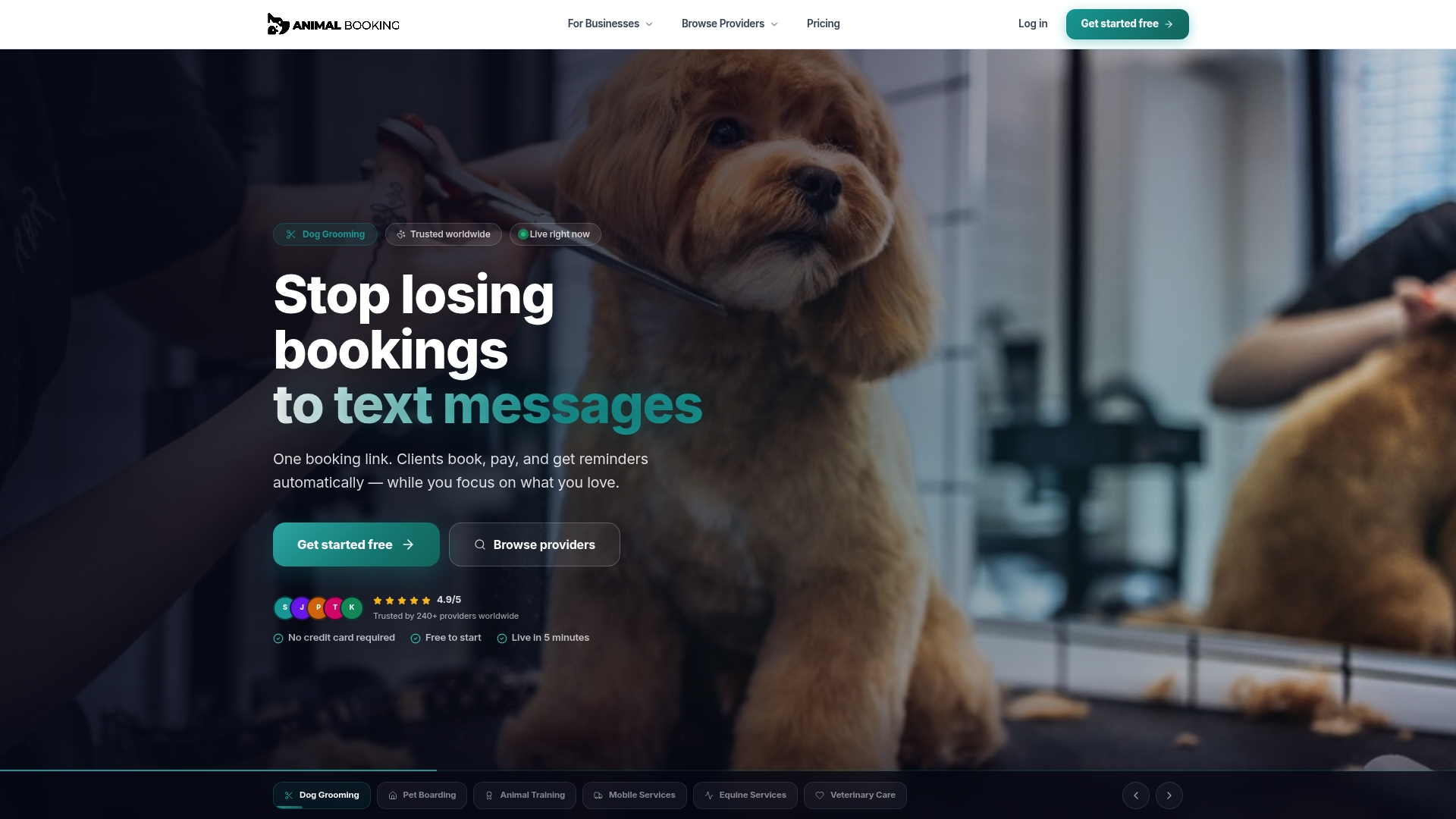
Plans on our pricing page include Starter (no published price), Independent at $49 per month, Teams at $149 per month and Pro at $299 per month. Platform fees on client payments of 3%, 2%, 1.5% and 1% are listed on our provider pricing page. Ready to try it? Get started as a provider.
If you are a groomer setting up for the first time, our guide to going live with ABN and GST details walks through it step by step.
Quick checklist before you publish
- One primary button on the first screen of each service page.
- Button text names the action and the service.
- Wording matches your acceptance process: book, request or quote.
- Price, duration and deposit shown before submission.
- Short first form; the rest after agreement.
- A separate emergency route if you are a vet.
- Testimonial or proof near the button.
- Works on mobile and is accessible.
- Email and SMS include consent and unsubscribe.
- Analytics set up so you can compare changes.
FAQ
What is a booking call to action?
It is a button, link or short line of text that asks a visitor to take a booking step, such as "Book a groom" or "Request a consultation". It should describe exactly what happens when they click. If you need to approve the booking first, the wording should say so.
What is the best wording for a booking button?
Use a verb plus the service, such as "Book a full groom", "Reserve a stay" or "Book a vet appointment". Choose "Request" rather than "Book" if you screen new clients. Clear wording generally works better than clever wording.
How many CTAs should a service page have?
One primary action, repeated at natural decision points: top of the page, after the price, after testimonials and at the end. Secondary options such as click-to-call or a meet and greet can sit nearby, but should not compete with the main button.
How do I write a booking call to action in an email?
Focus on one action and one link, for example "Rebook Bella's groom". Make sure the recipient has agreed to receive marketing and that you include a working unsubscribe option, as the Spam Act 2003 requires in Australia.
How do I know if my CTA is working?
Track visits to your booking page against completed bookings in your website analytics. Change one element at a time, give each version enough time, and also watch no-shows, not just clicks.
Sources
- How to Create Compelling Calls-to-Action (CTAs)
- Online Booking or Quote Request? Choose the Right Website
- Dog Grooming Service Page: A Booking Checklist
- Veterinary Marketing Copywriting That Wins New Clients
- Vet Landing Pages That Drive Bookings
- Set up a business website | business.gov.au
- Service Pages That Book Appointments
- How to Create a Pet Website That Drives Calls and Bookings
- Promoting your business by email or text messages | business.gov.au