

Optimise your Google Business Profile first and add a visible booking link, then build focused service and location pages behind it. GBP changes tend to show movement within 30 to 90 days, while new website pages take longer to earn rankings. A tool like Animal Booking can sit behind that booking link to cut down the friction that turns a Map Pack click into a no-show.
TL;DR:
- Optimizing your Google Business Profile with accurate categories, complete information, and frequent reviews significantly boosts local search visibility within 30 to 90 days.
- Building focused service and location pages with local details, schema markup, and unique content is essential for proper ranking, while duplicate pages can harm your SEO.
- Regularly gathering recent, high-quality reviews and encouraging in-person requests enhances trust and improves your profile’s performance in local searches.
- Linking your GBP and website to a clear booking flow with pricing, deposit info, and automated reminders reduces no-shows and increases booking conversion rates.
- Establishing relationships with local pet businesses and community groups for backlinks and referrals can significantly grow your local client base.
Table of Contents
- Google Business Profile: the checklist every pet sitter must complete
- Website pages that convert: service pages and location pages explained
- Reviews and reputation: build a steady stream of recent, useful reviews
- Local keyword templates and content ideas that attract bookings
- Timeline and metrics: how to measure whether your SEO is working
- Practical workflow: link your GBP and service pages to a booking flow
- Local backlink building strategies specific to pet sitters
- Utilising local citations and directory listings for pet sitting businesses
- Mobile optimisation importance and tips for local SEO
- Leveraging social media platforms for local pet sitter visibility
- Publisher perspective: the highest-leverage changes we've seen work for pet sitters
- Turn your new visibility into confirmed bookings
- Sources
Google Business Profile: the checklist every pet sitter must complete
Your Google Business Profile is the first thing a local search does for you, and it's usually the thing pet sitters half finish and forget. Get the business name right (no keyword stuffing like "Sarah's Pet Sitting Dog Walking Boarding") and pick one primary category, such as "Pet Sitter" or "Dog Walker," then add relevant secondary categories underneath.
If you work from home and visit clients, set your listing to a service area business and hide your address. If clients come to you for boarding or drop off, show the storefront. Getting this wrong is one of the more common reasons listings get flagged or suspended.
From there, fill in every field Google gives you:
- Phone number that actually gets answered, not a spare line nobody checks
- Website and a direct booking URL, not just a homepage link
- Accurate hours, including holiday adjustments
- A full services list with short descriptions
- Attributes (identity, accessibility, service options) where relevant
- At least ten photos to start, covering your face, your work, and client pets
Listings with recent reviews and real photos consistently outperform bare-bones profiles in local search results. Post to GBP weekly with photos or short updates, and set up an automated request that goes out after each completed booking rather than relying on memory.
Pro Tip: Never offer a discount or incentive in exchange for a review. Google's policies treat that as a violation, and it can get your whole profile suspended just as visibility starts building.
Website pages that convert: service pages and location pages explained
A service page and a location page do different jobs, and pet sitters often blur them into one thin "areas we serve" page that ranks for nothing. A proper service page needs a clear description of what's included, a pricing shape (even a range), a short FAQ, one testimonial, and a booking call to action above the fold.
Location pages earn their place when they carry genuine local detail: a mention of the off-leash park you walk clients' dogs through, the suburb's typical yard sizes, or the apartment complexes you already service. Location and service pages are priority page types for local service businesses, but duplicating the same paragraph across five suburb pages with the town name swapped does more harm than good.
A few things worth adding once the basics are in place:
- LocalBusiness schema on your homepage and contact page
- Service schema on each service page, naming the specific offering
- Unique opening paragraphs per location page, even if the closing CTA repeats
Thin, near-identical pages tend to get filtered out of search results entirely, so fewer, better pages beat a suburb-by-suburb template.
Reviews and reputation: build a steady stream of recent, useful reviews
Recency matters as much as total count. A profile with 40 reviews from three years ago reads weaker to Google, and to a nervous pet owner, than one with 12 reviews from the last two months. Check what your closest three competitors show and aim to beat their most recent review date, not just their total.
- Send the review request within 24 hours of drop-off, while the experience is still fresh.
- Use a short SMS or email: "Thanks for trusting us with [pet name] this week! A quick Google review helps other local owners find us." Include the direct link.
- For negative reviews, respond publicly and briefly, then move the resolution to a private message or call.
- Feature your three strongest recent reviews on your homepage and service pages, not buried on a testimonials page nobody visits.
Pro Tip: Ask at the moment of pickup, in person, if you can. A verbal request converts far better than a follow-up text sent the next day when the memory has already faded.
Local keyword templates and content ideas that attract bookings
Most pet sitters either ignore keywords entirely or stuff them everywhere. Neither works. A handful of templates cover almost every high-intent search a pet owner types in:
- "[Service] in [suburb]" — e.g., "dog walking in Northcote"
- "Overnight pet sitting near [landmark or park]"
- "How much is pet sitting in [area]"
- "[Service] vs [app name]" comparison angles
Pricing posts and "what to expect" pages tend to convert well because they answer the exact question stopping someone from booking. A post that clearly states your price range and what a first booking involves removes the biggest hesitation new clients have. Structure each piece with a short direct answer at the top, supporting detail underneath, and a booking link repeated at least once more before the page ends.
Link every service page back to your GBP profile, and link every blog post back to the relevant service page. A pricing post with no path to a booking form is just content sitting idle.
Timeline and metrics: how to measure whether your SEO is working
Expect GBP changes to shift Map Pack position within 30 to 90 days; new website pages usually need 3 to 6 months to rank properly. Track a short list rather than a dashboard full of vanity metrics:
- Map Pack position for your core service terms
- Calls and direction requests from your GBP insights
- Organic clicks to your booking page
- Booking conversion rate on that page
- New reviews added per month
Change one variable at a time (new photos, a fresh category, a rewritten service page) and give it 60 to 90 days before judging it. For a solo sitter, success looks like a steadier trickle of new enquiries each week, not a single viral spike.
Practical workflow: link your GBP and service pages to a booking flow
Visibility without a clean booking path just moves the friction one step downstream. Put a booking link on your GBP profile and on every service page, and make sure that page shows what's included, a price range, and any deposit required before someone commits their time to filling out a form.
- Add a booking link everywhere a client might land, including GBP, service pages, and social bios
- Use automated reminders so clients confirm ahead of time, since Animal Booking's own data shows this can cut no-shows by up to 80% and lift revenue per booking by around 30%
- Place testimonials near the booking button, not just on a separate page
- In the first seven days after publishing: test the booking link end to end, confirm you receive booking notifications, and switch on your review request flow
Local backlink building strategies specific to pet sitters
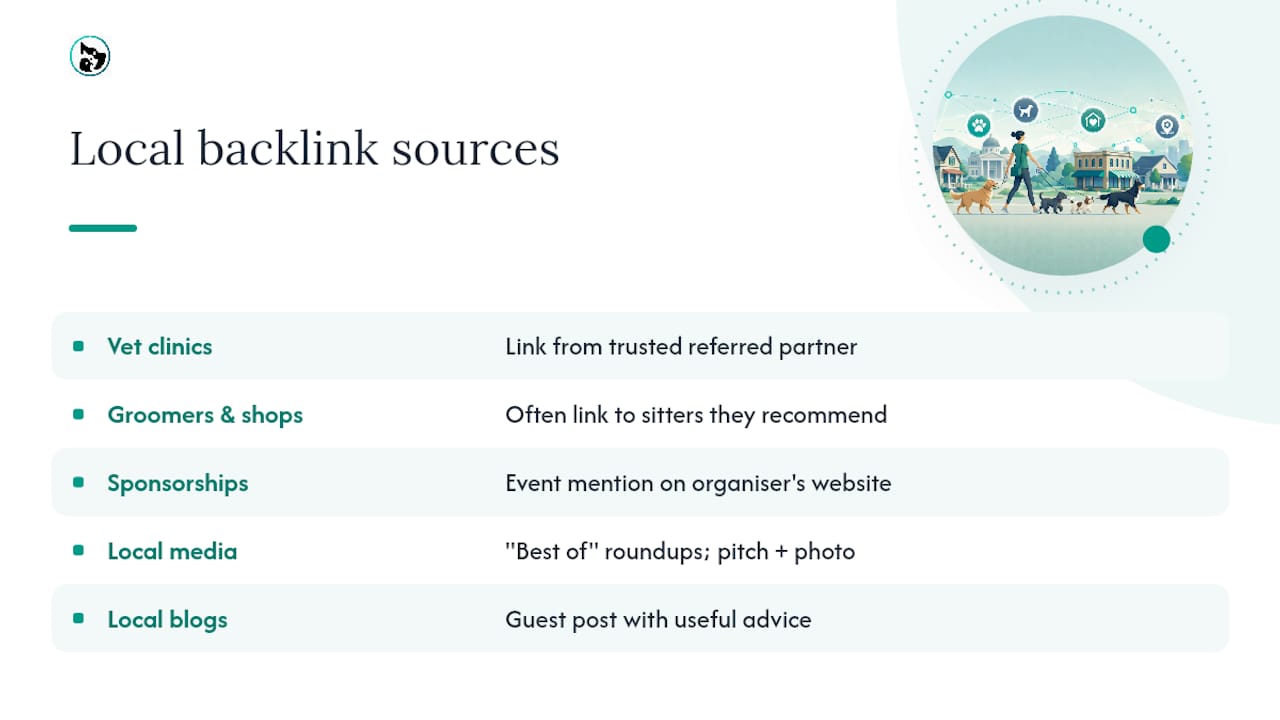
Backlinks for a pet sitter don't come from generic outreach campaigns. They come from the businesses and organisations already sitting inside a pet owner's daily life. Local vet clinics, groomers, and pet supply shops will often link to trusted sitters they refer clients to, especially if you return the favour on your own site.
Sponsoring a local dog park cleanup, a rescue shelter's adoption day, or a school fete pet corner tends to earn a mention on that organisation's website, along with the kind of goodwill that turns into referrals anyway. Local news outlets and community Facebook groups sometimes run "best of" roundups for pet services. A short pitch with your credentials and a photo can land you a spot and a link.
Guest posting on local parenting or lifestyle blogs works too, particularly ones that already cover pet ownership or suburb life. Offer a genuinely useful piece, like "what to check before hiring a pet sitter," rather than a thinly veiled advertisement.
Pet Sitters International frames partnerships and referrals as core client-acquisition channels alongside your website and GBP, and that framing holds for backlinks too. A link from a vet you already have a working relationship with matters more than ten links from directories nobody in your suburb has heard of. Build the relationship first; the link tends to follow.
Utilising local citations and directory listings for pet sitting businesses
A citation is any place your business name, address, and phone number appear online, even without a link. Consistency across every one of these matters more than volume. If your GBP lists "Sarah's Pet Care" and a directory lists "Sarah Pet Sitting Services," that mismatch quietly undermines the trust signals Google uses to confirm your business is real.
Start with the general directories most local businesses claim: Yellow Pages, True Local, and Google's own linked profiles across Maps and Search. Then move to pet-specific directories and marketplaces, where your existing clients are more likely to already be searching. Local chamber-of-commerce listings and council small-business directories carry weight too, since councils are seen as authoritative local sources.
Check your listings every few months for outdated hours, an old phone number, or a defunct website link. An abandoned citation with wrong details does more damage than no citation at all, because it actively confuses anyone trying to reach you. Keep a simple spreadsheet of every directory you've claimed, along with login details, so updates take minutes instead of a rebuilt search each time.
Mobile optimisation importance and tips for local SEO
Most pet owners search for a sitter on their phone, usually while standing in their kitchen deciding whether to book someone before they leave for work. If your site loads slowly or your booking button sits below three scrolls of text, that visitor is gone before they've read a word.
Google's local search results, particularly the Map Pack, draw heavily on mobile behaviour: click-through rate, time on page, and whether someone calls or requests directions straight from their phone. A clunky mobile site depresses every one of those signals.
Practical fixes matter more than a full redesign. Make your phone number and booking link tap-to-call and tap-to-book, sitting near the top of every page rather than buried in a footer. Keep paragraphs short, since mobile readers scan rather than read line by line. Compress your photos so pages load in a couple of seconds, not ten. Test your own site on a phone with average reception, not just office wifi, because that's the actual condition most enquiries happen under.
Leveraging social media platforms for local pet sitter visibility
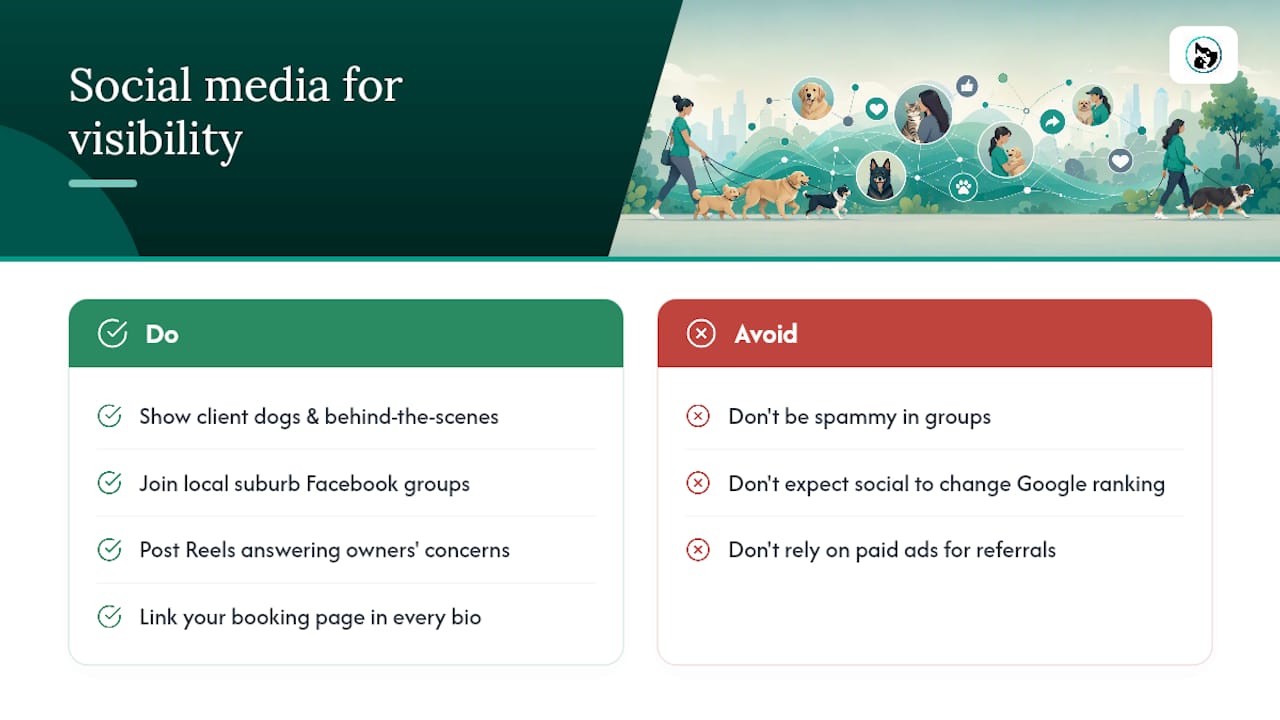
Social media won't directly move your Google ranking, but it does the job local SEO can't: putting a face and a personality in front of people before they ever search. A Facebook or Instagram feed full of client dogs on walks, quick boarding updates, and the odd behind-the-scenes moment builds the kind of familiarity that turns a stranger's search into a booking with someone they already feel they know.
Local Facebook groups, particularly suburb-specific "buy nothing" or community groups, are often where pet owners ask for sitter recommendations directly. Being an active, helpful, non-spammy member of those groups tends to generate more referrals than any paid ad. Instagram Reels showing a typical day, a nervous rescue dog settling in, or a quick tip on separation anxiety perform well because they answer real concerns pet owners have before they book anyone.
Link your booking page in every bio, not just your website. Cross-post your best GBP reviews as social content occasionally, since a five-star review with a client's dog photo works as well on Instagram as it does on your profile. Treat social media as the warm-up act, and your GBP and service pages as the close.
Publisher perspective: the highest-leverage changes we've seen work for pet sitters
Most pet sitters chase every channel at once and measure nothing. Fix your Google Business Profile, build two or three genuinely good service pages, and put a simple booking link in front of both. That combination outperforms scattered effort every time. Pick one experiment, run it for 60 to 90 days, and resist the urge to change five things simultaneously just because a blog post told you to. Small, measured changes compound; keep your review requests steady in the background the whole time.
— AnimalBooking
Turn your new visibility into confirmed bookings
Getting found on Google solves half the problem. The other half is what happens the moment someone clicks your booking link, and that's where a lot of pet sitters lose the client they just worked hard to attract.
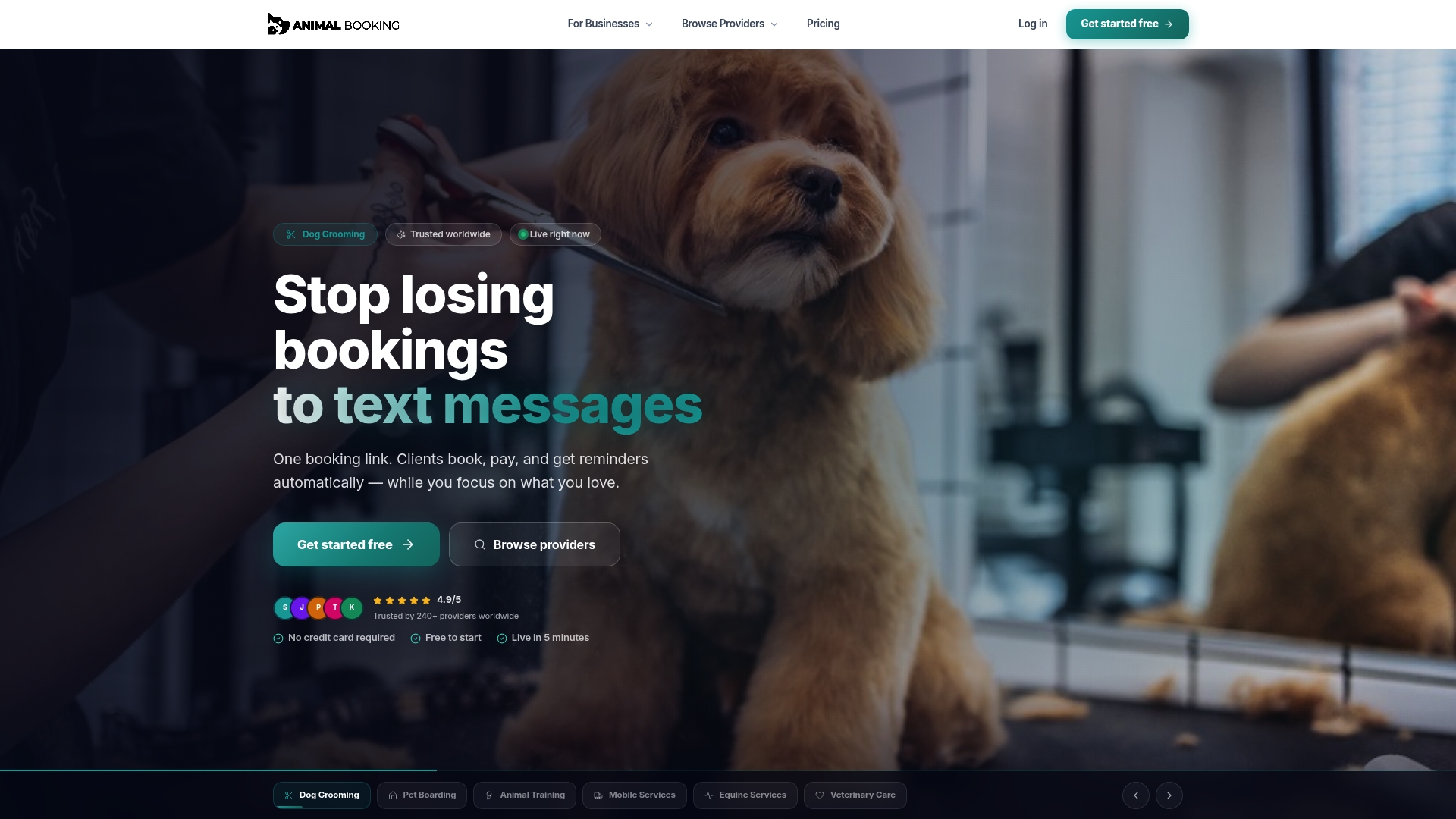
A booking page can show your services, price range, and deposit requirements up front, so there's no back-and-forth over text before someone commits. Automated reminders confirm the booking ahead of time and chase deposits automatically, which is where user feedback points to no-shows dropping by up to 80% and revenue per booking rising around 30%. A customer CRM can keep client and pet notes in one place instead of scattered across text threads.
If you've just tightened up your GBP profile and service pages, the next step is making sure the booking link behind them actually holds. Set up your online booking flow and see how it handles your first week of enquiries.
Sources
Pet Sitters International's client-acquisition guide and the pet care SEO guide cover implementation detail beyond this checklist.
- How to get pet-sitting clients | Pet Sitters International
- Pet Sitter & Dog Walker SEO: Get Found on Google Fast