
The fastest reliable way to take bookings is a purpose-built booking page that enforces realistic service durations, requires a deposit or card authorisation, and sends automated reminders. Set it up right and you'll cut no-shows, take bookings while you sleep, and stop losing twenty minutes a day to phone tag. Add correct ABN and GST invoicing from day one, and the whole system runs itself while you focus on the dog in front of you.
TL;DR:
- Using a purpose-built booking page with realistic service durations, deposits, and automated reminders significantly reduces no-shows and streamlines appointment management.
- Proper setup requires gathering key business details such as ABN, GST registration, service list, staff profiles, and payment gateway integration before configuration.
- Adjust service durations based on the slowest expected job and include buffers for unexpected delays to prevent schedule overlaps and delays.
- Pairing deposits or card authorizations with automated reminders creates a strong incentive for clients to show up and minimizes last-minute cancellations.
- Testing the full booking process beforehand ensures calendar accuracy, proper invoicing, and smooth operation once live.
Table of Contents
- What you need before you set up online booking for groomers
- Step-by-step configuration: services, staff, availability and payments
- How do I reduce no-shows with online booking?
- What should a groomer's booking page include?
- How do you test a booking system before going live?
- A groomer's perspective: what actually changed after going online
- Training staff to manage and optimise the booking platform
- Connecting your booking system to marketing and CRM tools
- Our take: the compliance step is where most guides fall short
- Go live faster with AnimalBooking
- Sources
- FAQ
What you need before you set up online booking for groomers
Before you touch any settings screen, gather the details that turn a generic calendar into a system that actually fits a grooming business. Skip this step and you'll be rebuilding your service list three weeks in, after your first oversized Bernese Mountain Dog blows a two-hour gap in your day.
Start with the paperwork. If you're registered for GST, you need an Australian Business Number and correctly worded tax invoices that show your ABN and the GST component on every transaction. Get this wrong and your BAS reporting becomes a headache every quarter.
Here's what to have ready before you start configuring anything:
- Your ABN, GST registration status, and preferred invoice wording (business name, ABN, GST breakdown).
- A payment gateway that settles in AUD, such as Stripe, with card-on-file and deposit capability enabled.
- A full service list with durations, tiered pricing by pet size or coat condition, and built-in cleaning or travel buffers.
- Staff profiles, station or bay capacity, and the contact channels you'll use for confirmations (SMS, email, or both).
Grooming-specific booking tools consistently show these same four elements in customer reviews on Capterra: pet profiles, size-based pricing, deposit support, and automated reminders. If your setup skips any of them, you're building on a weaker foundation than the market expects.
Step-by-step configuration: services, staff, availability and payments
This is where the actual build happens. Work through it in order. Skipping ahead to "just get it live" is how groomers end up with 30 minute slots booked for double coat de-shedding jobs that take 90.
1. Choose instant booking or request/approval. Instant booking confirms the moment a client pays or submits the form. It's the better default for established clients booking standard services. Request/approval holds the slot until you confirm, which suits new clients, reactive or anxious pets, or any service where you want eyes on the pet's history first.
2. Build your services with honest durations. List every service separately (bath and brush, full groom, de-shed, nail trim) and set the duration for the actual time it takes for a difficult client, not your fastest one. Add a size or breed multiplier so a Chihuahua and a Newfoundland aren't booked into the same 45 minute block. Then add buffers: 15 minutes for cleanup between matted or shedding-heavy jobs, and travel time built into every slot if you run a mobile van.
3. Set staff schedules and capacity limits. Each groomer or bather gets their own working hours, break times, and a cap on how many bookings can run in parallel per station. If you've got two tables and one bath, your system needs to know that, or it'll happily double-book a wash slot that physically doesn't exist. Round robin scheduling distributes new bookings evenly across available staff rather than piling everything onto your most popular groomer.
4. Assign services to staff by skill. Not everyone on your team should be bookable for hand-stripping or show trims. Restrict advanced services to the staff qualified to do them, and open general services (baths, nail trims) to the full roster.
5. Configure payments and confirmation rules. Decide whether you require a flat deposit, a percentage of the service cost, or full card authorisation with no charge unless the client no-shows. Tie your confirmation logic to payment status: no card, no confirmed slot. This single setting does more to protect your calendar than any other.
6. Set your reminder cadence. A 48 hour reminder catches people who forgot to write it down. A 24 hour reminder catches people who need to rearrange their day. A 2 hour reminder catches the honest for getters who'd otherwise just not show up. SMS tends to get read faster than email, but email is cheaper to send at volume and works well for the 48 hour touch. Running both across the three checkpoints covers the most ground.

7. Sync your calendar and configure the widget. Connect the booking system to your working calendar so double-bookings from a manual entry are impossible, then decide whether you're using a hosted booking page or an embedded widget on your existing website. A smart calendar that reflects real-time staff availability is what stops a client booking a 4pm slot that a phone call already filled at 2pm.
Pro Tip: Build your service durations around your slowest realistic job, not your average one. A 10-minute buffer on paper disappears fast when a matted double coat takes an extra 20 minutes, and that gap cascades through every appointment behind it.
How do I reduce no-shows with online booking?
No-shows drop hardest when you run three things together, not one in isolation. Reminders alone tend to underdeliver because there's no financial consequence attached to skipping the appointment. Add a deposit or card authorisation and the equation changes: the client has skin in the game, and the reminder becomes a nudge rather than the only line of defence.
The three pillars work like this:
- Deposit or card-on-file. A flat deposit of $20 to $30, or a percentage of the service price for higher-ticket grooms, gives clients a reason to show up or cancel with notice instead of just ghosting.
- Automated reminders on a fixed cadence. The 48 hour, 24 hour, and 2 hour sequence covers forgetfulness at every stage of the booking lifecycle.
- A visible, enforced cancellation policy. State it plainly at the point of booking: "Cancellations inside 24 hours or no-shows forfeit the deposit." Don't bury it in fine print.
For first-time clients or pets with a bite history, reactivity flags, or medical needs, switch that booking to request/approval so you can make a quick assessment call before the slot locks in.
Groomers who pair a deposit with automated reminders typically see meaningfully fewer no-shows than those relying on reminders alone, because the reminder catches forgetfulness while the deposit removes the incentive to skip without warning.
If you're deciding between a flat deposit and full prepayment, the trade-offs are worth reading through in detail, including example policy wording you can adapt directly.
What should a groomer's booking page include?
Your booking page is doing the job a receptionist used to do, so it needs to answer the same questions a first-time caller would ask. Show a size guide (small, medium, large, giant) so pricing makes sense before checkout, a plain-English description of what's included in each service, and a short note on what to bring (current vaccination info, a photo of the coat if it's badly matted).
Keep the actual booking flow tight:
- Mobile-first layout, since most pet owners book from their phone in a spare five minutes between meetings.
- One clear call-to-action button, not three competing options.
- The cancellation policy visible before payment, not after.
- A hosted page if you want something live in minutes, or an embedded widget if you'd rather keep clients on your existing website.
Publishing the link matters as much as building the page. Add it to your Google Business Profile booking button, your Instagram bio, a Facebook page call-to-action, a QR code on the reception counter, and the confirmation SMS you send after every call-in booking. A partner service like SEO support for pet and veterinary businesses can help more local searches actually find that Google listing in the first place.
How do you test a booking system before going live?
Run the full flow yourself before a single client sees it. Building this in isolation and hoping it works is how groomers discover a broken confirmation email three days after launch, usually from an annoyed client standing in the car park.
- Book a test appointment as if you were a client: pick a service, choose a time, pay the deposit, and confirm the booking email or SMS arrives correctly.
- Check the invoice format shows your ABN and GST line item properly, matching ATO tax invoice requirements.
- Confirm the calendar blocks correctly, staff capacity limits hold, and a reschedule or cancellation flows through without leaving a phantom slot.
A full booking flow with staff allocation, buffers, and deposit capture can realistically go live within a few hours, based on how Australian booking system builds typically run. Once you're live, watch the first two weeks closely. Track which appointments still no-show despite the deposit, and adjust buffer times or deposit amounts based on what actually happens, not what you assumed would happen.
A groomer's perspective: what actually changed after going online
The first mistake almost every new user makes is setting durations too tight and forgetting buffers entirely. A 30 minute slot for "small dog groom" sounds fine until a nervous rescue takes 50 minutes and the next three appointments run late all afternoon. Add 10 to 15 minutes of buffer per booking and the whole day stops bleeding time.
Once the durations and buffers are right, the operational shift is real. Phone interruptions drop because clients book and pay without calling. The daily run sheet becomes something you can actually predict instead of guess. Rebook rates climb too, mostly because automated reminders prompt clients to lock in their next groom before they forget. If you're setting this up for the first time, AnimalBooking's onboarding resources walk through the exact settings that catch most people out early.
Training staff to manage and optimise the booking platform
A booking system is only as good as the person adjusting it day to day. Give at least one staff member (ideally whoever's on reception or answering calls) full access to move appointments, apply manual bookings for walk-ins, and issue refunds when a genuine cancellation warrants it.
Run a short internal session covering three things: how to read the daily schedule at a glance, how to manually override a slot when a regular client calls instead of booking online, and how to check whether a deposit has actually been paid before starting a service. That last point matters more than it sounds. Staff sometimes assume a booking equals a paid booking, and it isn't always true if you allow request/approval bookings without upfront payment.
Set a recurring fortnightly check where someone reviews upcoming bookings for obvious errors, like a service assigned to a groomer who doesn't do that type of trim, or a gap that's too short for a known difficult client. This catches problems before they become a bad Saturday.
Give new staff a written reference sheet rather than relying on verbal handover. Booking software has enough small settings (buffers, staff assignment rules, deposit thresholds) that memory alone won't hold it, especially for casual or part-time team members who only touch the system a few shifts a week.
Connecting your booking system to marketing and CRM tools
Every booking carries information worth using again: the client's contact details, their pet's grooming history, and how often they rebook. A booking platform that feeds this straight into a customer CRM means you're not manually copying names into a spreadsheet or a separate marketing tool after every appointment.
That connection matters more than it looks on paper. Running a separate scheduler, a separate invoicing app, and a separate customer list creates double-entry work and the kind of sync errors that show a client as "new" when they've been coming for two years. An integrated platform where bookings, payments, and client records live in one place avoids that entirely.
Use the CRM data practically. Flag clients who haven't rebooked in longer than their usual cycle and send a targeted reminder. Track which services get added on most often (nail trims, teeth cleaning) and offer them as a prompt during checkout. If you run seasonal promotions, booking promo codes tied to your CRM data let you target lapsed clients specifically instead of blasting a discount to everyone.
Our take: the compliance step is where most guides fall short
Most booking advice treats setup as purely a scheduling problem: pick software, add services, done. That's incomplete. A grooming business charging GST needs invoices with ABN and GST clearly displayed from the first transaction, not retrofitted once an accountant flags it at tax time.

The conventional wisdom also overrates reminders and underrates deposits. A reminder without a financial stake attached is a polite nudge a busy client can ignore. Pair it with even a modest deposit and the entire no-show equation shifts, because the client now has something to lose.
If you're prioritising one thing first, make it accurate service durations with real buffers. Everything else, deposits, reminders, staff rostering, only works well once your calendar reflects how long a groom actually takes. Get that wrong and no amount of automated messaging will fix a schedule that was broken from the start.
— AnimalBooking
Go live faster with AnimalBooking
Every setup step above maps directly onto a feature you can switch on in minutes rather than build from scratch. Pet profiles handle size-based pricing and history. Deposit and card-on-file settings enforce the three-pillar no-show strategy. Automated reminders run on the 48/24/2 hour cadence without you touching a phone, and invoicing supports correct ABN and GST formatting for Australian tax compliance.
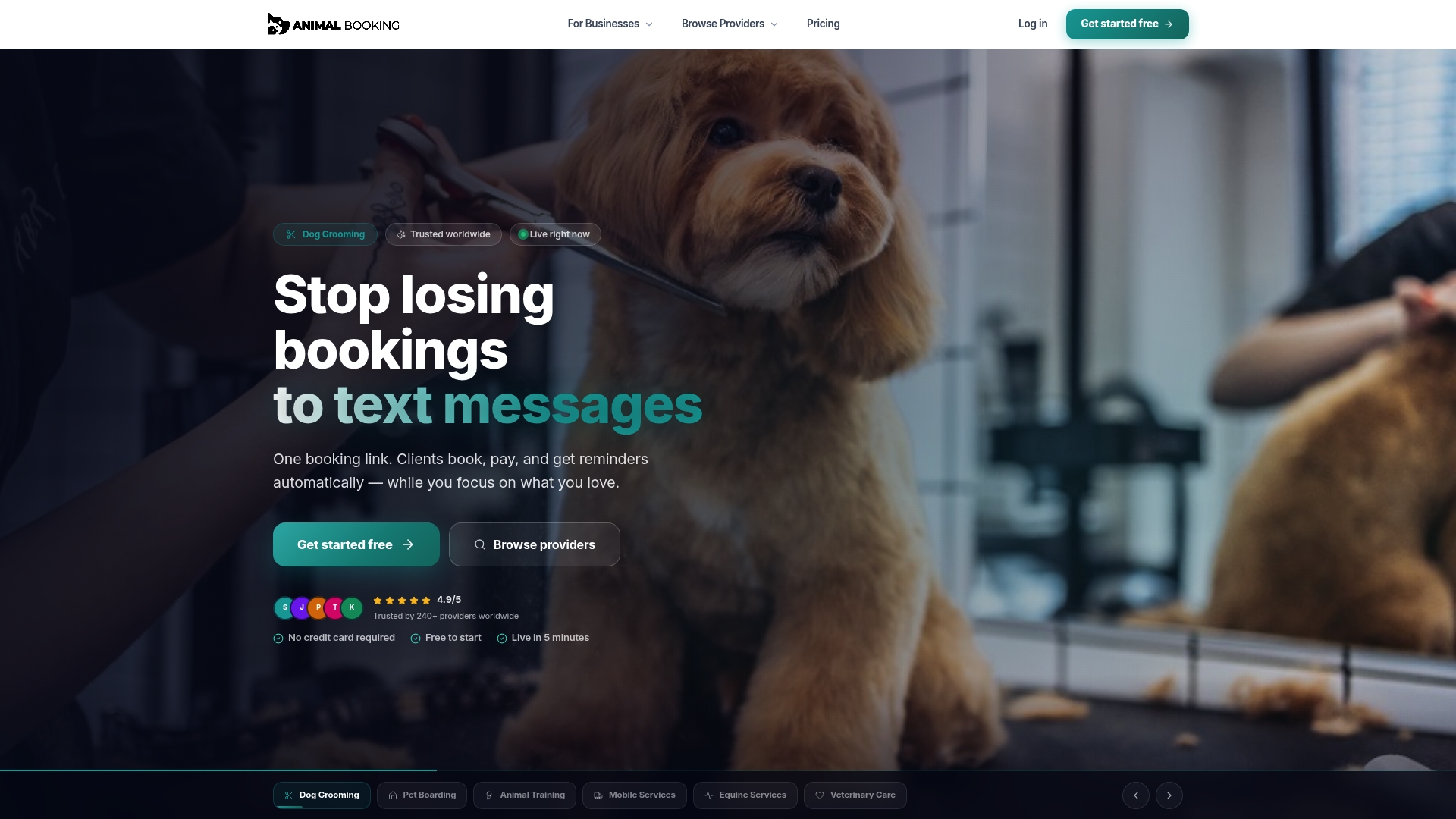
AnimalBooking is built specifically for pet service providers, and it's designed to go live in around 10 to 15 minutes rather than days of configuration. If you're starting from scratch, sign up, add your ABN and GST preferences, connect your payment gateway, and publish your booking link across your Google Business Profile and socials. Plans run from Independent at $49 per month up to Pro at $299, with platform fees scaling down as you move up tiers. Check the online booking feature page to see exactly how pet profiles, deposits, and reminders work together before you commit.
Sources
For the compliance side of setup, go straight to the source rather than relying on secondhand summaries:
- Australian Taxation Office — How GST works
- How to Build a Booking System in Australia — RationalGo
- Bella Booking on Capterra (Australia)
FAQ
What is the best online booking system for dog grooming?
The best system is one built specifically for pet services rather than a generic scheduler, since grooming needs pet profiles, size-based pricing, and buffer time between jobs. AnimalBooking is purpose-built for this, with pricing starting at $49 per month on the Independent plan.
What is the best app for booking pet grooming services?
Look for an app that combines deposits, automated reminders, and pet profiles in one place rather than juggling separate tools for scheduling and payments. Grooming-specific platforms consistently outperform generic calendar apps on these features, based on user feedback on Capterra.
What does FFF mean in dog grooming?
FFF isn't a standard, universally recognised grooming term, and its meaning varies depending on where and how it's used within different salons or courses. If you've seen it used in a specific context, it's worth checking directly with that source rather than assuming a fixed definition.
Can I run my dog grooming business from home?
Yes, running a grooming business from home is common in Australia, though it depends on your local council's zoning rules, any required permits, and noise or water runoff regulations. Online booking still works the same way for a home-based salon. You just need to set your service area and availability to reflect your actual working space and hours.