
The fix for peak season bookings is simple to state and hard to skip: enforce deposits, set disciplined capacity rules, and automate reminders and waitlists. Together, these three actions stop revenue leakage and protect animal welfare when demand spikes. In the next 24 to 72 hours, set a deposit policy, block out risky or unsafe slots, and turn on automated booking reminders.
TL;DR:
- Requiring deposits or prepayments for peak bookings significantly reduces no-shows and ensures clients commit to appointments.
- Automating reminders, confirmations, and waitlists helps fill cancellations quickly and minimizes calendar gaps during busy periods.
- Staffing and rostering should prioritize workforce capacity, as labor shortages are typically the main bottleneck, not physical space.
- Enforcing strict intake proof requirements, such as vaccination certificates, prevents legal and welfare issues.
- Using booking platforms with automation features supports efficient capacity management, reducing errors and administrative workload.
Table of Contents
- Quick checklist: 6 high-impact actions to tame peak demand
- Capacity management and rostering during peak windows
- Pricing, deposits and no-show policies that work in busy periods
- Customer communications: reminders, confirmations and waitlists
- Regulatory and boarding compliance to include in intake and peak-season workflows
- Technology and automation: how to use booking tools to survive peak season
- 30-day implementation plan: step-by-step to get ready for the next peak window
- Why automated booking systems are the pragmatic default
- How Animal Booking helps with peak season bookings
- FAQ
- Sources
Quick checklist: 6 high-impact actions to tame peak demand
When bookings surge, a handful of changes make the biggest difference before you touch anything else. These are the actions we see working across grooming, boarding, training and veterinary calendars.
- Require a deposit or prepayment for peak-date bookings so clients have a reason to show up.
- Set booking blackout windows and reserve priority slots for existing clients first.
- Run a waitlist with instant notifications so cancellations refill within minutes, not days.
- Lock in forward bookings for recurring services like grooming cycles and training packages.
- Automate reminders and confirmations so staff aren't chasing clients by phone.
- Confirm admission requirements, including vaccination proof and medical notes, before the appointment day arrives.
None of these require new staff or new premises. They require policy and a system that enforces the policy consistently, which is where most peak-season failures actually happen.
Capacity management and rostering during peak windows
Start by calculating how many slots you can genuinely run per day without compromising care, then set a fill-rate target against that number rather than against an idealised maximum. Industry benchmarking suggests capacity constraints are often caused by workforce shortages rather than a lack of physical space, which means the rostering decision matters more than squeezing in extra bookings. Tracking fill rates and staffing key performance indicators monthly helps you decide whether to add shifts or simply hold the line on bookings.
- Pre-block slots around known busy periods so staff aren't double-booked on arrival and departure times.
- Stagger pick-up and drop-off windows to avoid a single chaotic rush at the counter.
- Add extra check-in staff during known peak hours rather than across the whole day.
- Keep isolation space and protocols ready before, not during, a busy intake period.
Mandatory boarding codes in some jurisdictions already require appropriate staffing and rostering, with extra staff recommended during heavy check-in and check-out periods and defined staff-to-animal ratios for supervision, under the ACT boarding establishments code. For veterinary clinics, reserve a portion of same-day slots strictly for sick or urgent patients so routine peak-season demand doesn't crowd out the cases that actually need same-day care.
Pro Tip: Review fill-rate data weekly during peak season, not monthly, so you can adjust rosters before a bottleneck becomes a welfare issue.
Pricing, deposits and no-show policies that work in busy periods
Deposits and prepayments solve different problems, so the right choice depends on the service. A small deposit works well for grooming and single boarding stays, while full prepayment suits multi-day boarding or holiday blocks where a no-show costs you the most.
- Charge a deposit for single appointments and full prepayment for stays longer than a few days.
- Set a stepwise cancellation window, for example full refund beyond seven days, partial refund inside seven days, no refund inside 48 hours.
- Apply the same rule to every client so disputes are rare and easy to resolve.
- State the deposit and cancellation policy at the point of booking and again on your website, not buried in fine print.
A clear, consistently applied policy reduces no-shows because clients have financial skin in the game, and it gives you a documented answer when someone disputes a charge. Our pricing and cancellation policy guide walks through workable fee structures for boarding operators, and a side-by-side look at deposits versus prepayments helps you match the policy to the service.
Customer communications: reminders, confirmations and waitlists
A predictable reminder cadence does more to protect a busy calendar than almost any other single change. Send a booking confirmation immediately, a reminder the week of the appointment, and a final nudge 48 to 24 hours out.
- Use SMS for urgent, time-sensitive confirmations clients are likely to see quickly.
- Use email for receipts, deposit confirmations and detailed policy information.
- Turn on a waitlist with instant notification so a cancelled slot is offered out within minutes.
- Prepare a short, polite script for when a client arrives without vaccination proof or with changed care needs, so staff aren't improvising at the counter.
Online scheduling and forward booking are proven ways to lift appointment fill rates and bring in new clients, and the practices that track fill rate alongside their reminder cadence tend to catch problems early, according to Veterinary Practice News. Forward booking for preventive care is widely underused, and a short reminder sequence paired with staff training measurably improves uptake, per ASPCA Pet Insurance.
Regulatory and boarding compliance to include in intake and peak-season workflows
Peak-season pressure is exactly when compliance gaps show up, usually at the counter with a client already waiting. Every boarding admission should require a current vaccination certificate, and if proof isn't available, staff need a clear process: call the owner's veterinarian to confirm status, or refuse admission.
- Confirm identification, current vaccination certificates, and emergency contact details before intake, not during it.
- Record medical needs, special care instructions and collection time at the point of booking.
- Keep a written arrangement with a veterinarian for treatment and priority call-outs if an animal becomes unwell in your care.
- Train staff on isolation and quarantine procedures so a sick animal doesn't share space with the rest of the intake.
These requirements aren't optional extras. Under the Agriculture Victoria code of practice, facilities must identify every animal, sight vaccination certificates and confirm status with the owner's vet when proof is missing. The NSW code of practice sets similar expectations around detailed records and written veterinary arrangements. Our own vaccination records process walks through templates for capturing this at intake so you're not refusing an animal at the door.
Technology and automation: how to use booking tools to survive peak season
Manual booking through texts and spreadsheets breaks down exactly when you need it most, because peak volume multiplies the chance of a double-booking or a missed reminder. A booking platform that handles deposits, automated reminders, waitlists, blackout dates and multi-staff calendars removes most of that manual error.
- Enable deposits on every peak-period booking type, not just the ones you expect to be risky.
- Turn on automated reminder sequences so no confirmation depends on someone remembering to send a text.
- Configure blackout dates in advance so the calendar enforces your capacity rules automatically.
- Use a multi-staff calendar so rostering and bookings stay in sync in one place.
Before enabling deposits anywhere, confirm how refunds are processed and how payment disputes are handled, so your policy and your software agree.
Pro Tip: Turn on blackout dates before you turn on marketing for peak periods, otherwise you'll be advertising slots you can't actually staff.
30-day implementation plan: step-by-step to get ready for the next peak window
A month is enough time to go from reactive to prepared if you work through it in order.
- Week 1: Set your deposit and cancellation policy, update intake forms to capture vaccination and medical details, and enable blackout dates.
- Week 2: Turn on automated reminders, configure the waitlist and instant-notify flow, and brief staff on the new scripts and procedures.
- Week 3: Run a dry-run check-in day, adjust staffing against the results, and confirm isolation space is ready.
- Week 4: Review fill rates against your target, fine-tune reminder timing, and promote forward bookings for the next peak cycle.
By the end of the month you should have a documented policy, a system enforcing it, and staff who've actually practised the busy-day workflow once before it's real. Our blackout dates setup guide and staff scheduling playbook cover the configuration steps in more depth.
Why automated booking systems are the pragmatic default

Most pet businesses resist new booking software until a bad peak season forces the decision, and that's the wrong order to do it in.
I'd rather see an owner run grooming bookings through automation for one season and measure the fill-rate change than overhaul every service line at once, especially by following hundesalon hygiejne tips to keep grooming areas ready during peak demand. Automation doesn't replace good policy, it enforces it consistently, which is the part most businesses struggle with under pressure.
— AnimalBooking
How Animal Booking helps with peak season bookings
We designed our platform around common problems peak season creates: missed deposits, forgotten reminders and calendars that can't enforce blackout dates automatically. Our software handles online booking, deposits, automated reminders, waitlists, blackout dates and multi-staff calendars in one place, and supports launching a branded booking website on your own domain.
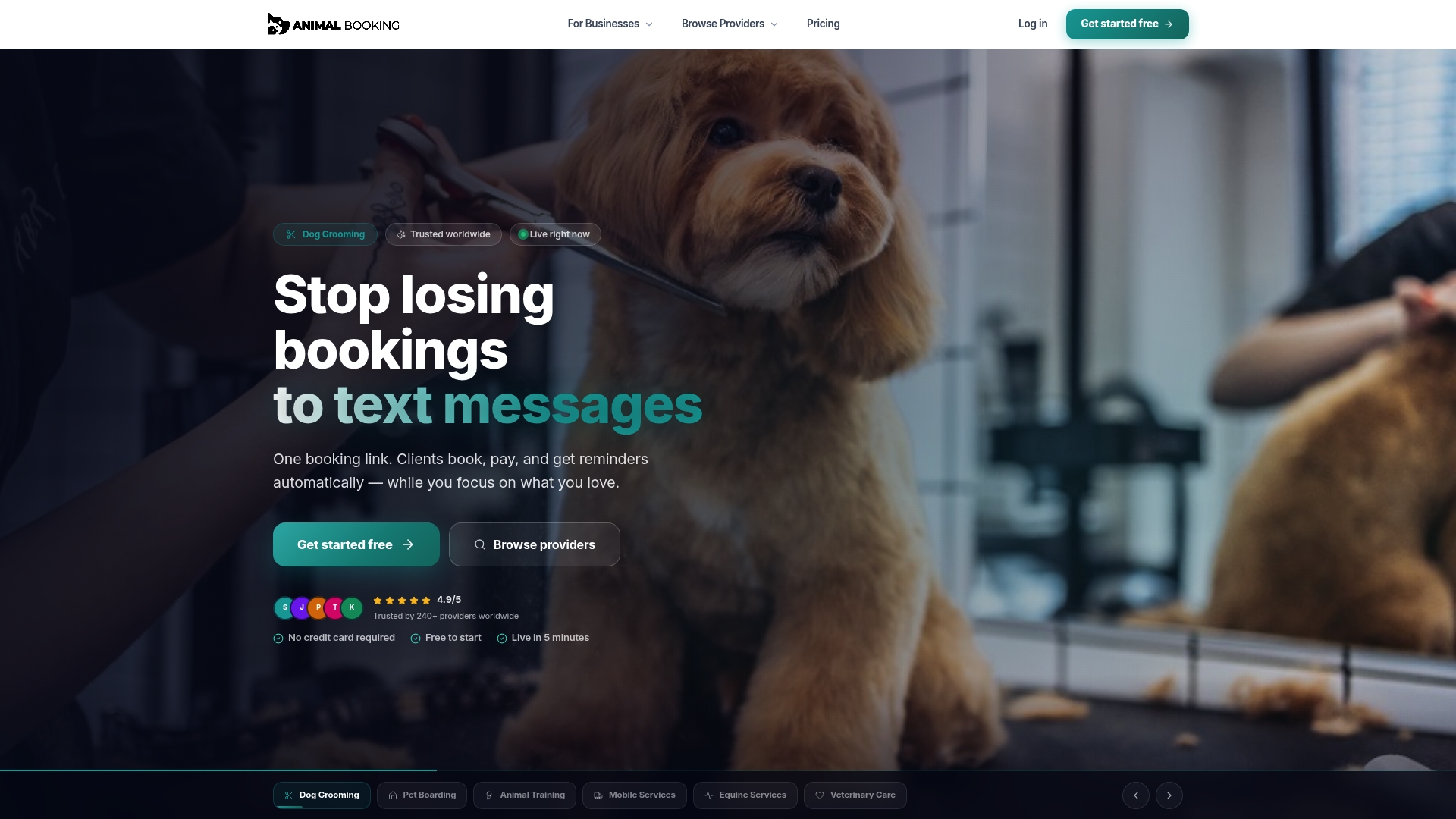
Providers can go live quickly, with no spreadsheets or manual text chains to maintain. Pricing runs from our Starter plan through to Independent, Teams and Pro, with platform fees from 1% to 3% depending on your plan. If you run a boarding business specifically, our pet boarding page shows how the setup maps to your intake and peak-season workflow.
FAQ
How far in advance should pet businesses open peak season bookings?
Open forward bookings as early as your service allows, since forward booking and online scheduling are proven ways to lift fill rates and attract new clients, according to Veterinary Practice News. For recurring services like grooming, booking the next appointment at checkout keeps your calendar full without extra marketing effort.
What's the best way to reduce no-shows during busy periods?
A consistently enforced deposit policy, paired with a reminder sequence sent at booking, the week of, and 48 to 24 hours before, is the most reliable combination. Deposits give clients a financial reason to show up, while reminders catch the ones who simply forgot.
Can we refuse a boarding admission without vaccination proof?
Yes. Boarding codes require current vaccination certificates at intake, and if proof isn't available, the facility should confirm status directly with the owner's veterinarian or decline the booking, under both the Agriculture Victoria and NSW codes of practice.
How much does Animal Booking cost for a small pet service business?
Plans run from Starter through to Independent at $49 per month, Teams at $149 per month and Pro at $299 per month, with platform fees ranging from 1% to 3% depending on the plan. The right tier depends on how many staff calendars and features you need during peak periods.
Should staffing or capacity change first during peak season?
Check staffing before assuming you need more physical capacity, since industry benchmarking shows capacity constraints are often driven by workforce shortages rather than a lack of space, per the VMG economic survey. Track fill rates and rostering together so you adjust the right lever.
Sources
- Code of practice for the operation of boarding establishments — Agriculture Victoria
- NSW animal welfare code of practice no.5 — NSW DPI
- Boarding establishments mandatory code — ACT legislation
- 4 ways to fill your schedule — Veterinary Practice News
- The VMG 2025 economic survey: peer benchmarking — VMG