

Set your base nightly rate to cover fixed and variable costs plus a target margin, then layer on clear, line-itemed fees for extras. Require a flat deposit with explicit cancellation terms, and automate the reminders and charges so you're not chasing balances by text. Get those four pieces right and your pricing stops being a guess and starts being a system.
TL;DR:
- Setting a flat deposit amount, with clear cancellation deadlines and refund policies, significantly reduces cancellations and dispute risks.
- Online booking platforms that automate deposit collection, reminders, and payment reconciliation increase revenue and decrease no-shows by up to 80%.
- Pricing should be based on full fixed and variable costs, divided by bed nights, with added target margins to determine the base rate.
- Cost models like tiered packages and add-on charges allow flexible pricing that captures additional revenue from extra services or higher-value clients.
- Automated workflows for booking and payments help maintain predictable cash flow and improve administrative efficiency.
Table of Contents
- How do you calculate a pet boarding pricing guide from your actual costs?
- Which pricing model suits your boarding business?
- What add-ons should you charge for, and how should they read on the invoice?
- What deposit and cancellation policy protects your revenue?
- What payment workflow keeps cashflow predictable?
- What do worked pricing examples look like in practice?
- How does automation change the numbers behind your pricing?
- What one price change taught us about testing
- How Animal Booking handles deposits, reminders and payments
- Sources
- FAQ
How do you calculate a pet boarding pricing guide from your actual costs?
Every defensible nightly rate starts with a full cost inventory, not a glance at what the kennel down the road charges. Wexford Insurance's pricing guidance puts it plainly: operators need to total fixed and variable costs before setting a single price.
Fixed costs don't move with occupancy. List them monthly:
- Rent or mortgage on the facility
- Insurance premiums
- Salaried staff wages
- Software subscriptions and utilities
Variable costs scale with each animal you board:
- Food and treats
- Bedding, laundry and cleaning supplies
- Per-visit or casual staff labour
- Waste disposal and consumables
Add both totals for a month, divide by your available bed nights (kennels x days x realistic occupancy, not full capacity), and you get a break-even figure per night. A 20-kennel facility running at typical occupancy with certain fixed and variable costs is looking at a break-even cost per booked night in the low tens of dollars range. Add your target margin, which varies depending on local competition, and that becomes your base rate. Shared costs like a receptionist who also handles daycare bookings should be allocated by the proportion of their time spent on boarding, not dumped entirely into one service line.
Which pricing model suits your boarding business?
Once you know your break-even number, the model you wrap around it matters almost as much as the number itself.
- Flat per-night pricing. Simple to quote and easy for clients to compare, but it can undercharge for large dogs or overcharge for a cat that needs almost no attention. Works best for small operations with a narrow range of animal sizes.
- Tiered packages. Basic, standard and premium tiers (different run sizes, extra playtime, webcam access) let you capture more from clients who want more, without raising your entry price. This is where most mid-sized catteries and kennels land.
- Add-on pricing. Keep the base rate lean and charge separately for medication, grooming or extra walks. Clients tend to see this as fairer than a blanket high rate, because they only pay for what their pet actually needs.
- Membership or subscription pricing. A monthly fee for frequent boarders (weekend warriors, FIFO workers) locks in recurring revenue and increases lifetime value, though it requires forecasting capacity carefully.
- Seasonal and demand-based pricing. Holiday surcharges during school breaks and long weekends are common practice and rarely draw complaints if flagged well in advance.
What add-ons should you charge for, and how should they read on the invoice?
Add-ons are where boarding businesses either build trust or generate refund disputes, depending entirely on how the charge is worded. LegalClarity's invoice guidance recommends a description, quantity and unit price on every add-on line, and that discipline pays off the first time a client questions a charge.
Common add-ons and sensible units:
- Medication administration: charged per dose or per day
- Grooming (bath, nail trim, brush-out): flat fee per service
- Extra walks or one-on-one playtime: charged per session
- Holiday or peak-period surcharge: a flat dollar amount or percentage added to the nightly rate
Pro Tip: Write invoice descriptions the way you'd explain them out loud. "Medication administration, twice daily x 3 days, $5/dose = $30" resolves a dispute before it starts.
Bundle only when the combination is genuinely common (a "spa package" including bath and nail trim). Keep everything else itemised. It reduces the time you spend on refund enquiries and chargebacks, according to LegalClarity's analysis of invoice disputes.
What deposit and cancellation policy protects your revenue?
A deposit changes client behaviour before it changes your bank balance. Once money is on the table, cancellations and no-shows drop, and LegalClarity notes that flat-fee deposits are the simplest to defend if a client disputes a charge, because there's no percentage calculation to argue over.
A workable deposit policy needs:
- A flat deposit amount (commonly $25 to $75, or a full night's rate for peak periods)
- A clear statement of whether it's refundable, partially refundable, or credited to a future booking
- A cancellation deadline (48 to 72 hours before check-in is standard) after which the deposit is forfeited
- Written confirmation of the policy on both the booking confirmation and the final invoice
Flat deposits also simplify bookkeeping compared with percentage-based ones, since the amount doesn't shift with every add-on you tack on later. A guide on deposit refund rules by sector walks through how to phrase refundability so it holds up if a client pushes back.
What payment workflow keeps cashflow predictable?
The sequence matters more than the tools. Here's a workflow that keeps balances collectable and disputes rare:
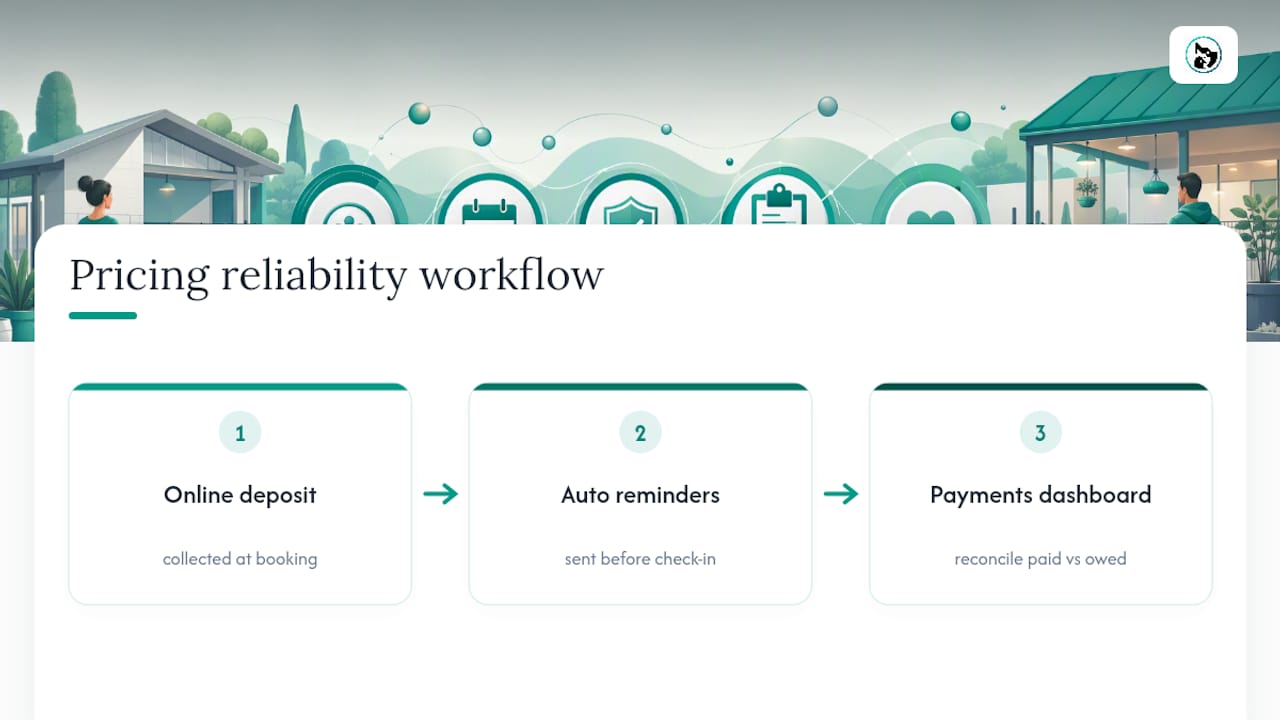
- Charge the deposit at the time of booking, not at drop-off.
- Send an automatic reminder 48 to 72 hours before check-in confirming dates and the remaining balance.
- Collect the balance at pickup, or offer prepayment with a small discount to smooth cashflow further.
- Issue a receipt immediately, itemised by base rate, add-ons, tax and deposit already applied.
On payment methods, accepting card payments online removes the awkward cash handover at pickup, but card processing fees need to be either absorbed into your rate or disclosed as a separate line, never buried. LegalClarity's invoice checklist is explicit on this: state the payment method and any fee amount clearly on the invoice.
Automation is what turns this from theory into something you'll actually run every week. Automated reminders and online deposit collection are the two features that do the heaviest lifting, according to Animalbooking's platform data, which points to no-show reduction and faster payment collection when booking and payment steps are automated rather than manual.
What do worked pricing examples look like in practice?
A flat deposit, non-refundable inside a cancellation deadline, covers the cost of a last-minute cancellation.
Launch checklist:
- Cost calculation done and break-even confirmed
- Pricing model chosen to match your client base
- Deposit amount, refundability and deadline written down
- Payment workflow mapped from booking to receipt
- Sample invoice tested against a real booking to check every line item is clear
How does automation change the numbers behind your pricing?
Pricing only works if you actually collect what you've charged. Automated booking and payment systems cut down the admin that eats into margin, and Animalbooking's platform benefits point to no-show reductions of up to 80% and revenue increases of around 30% per booking when deposits and reminders run automatically instead of manually.
The features that matter most for pricing reliability are online deposit collection at the point of booking, automatic reminders ahead of check-in, and a payments dashboard that reconciles what's paid against what's owed. If you're evaluating tools, check how they handle online booking and deposits and whether the dashboard supports your invoice layout without extra manual work.
What one price change taught us about testing
Roll out a new rate on a small booking cohort first, not your whole calendar overnight. Watch cancellation rates and deposit uptake for two to three weeks before committing further. Clear invoices and automated reminders make the effect on no-shows and cashflow visible fast, instead of buried in a spreadsheet you check once a month.
— AnimalBooking
How Animal Booking handles deposits, reminders and payments
If you're ready to put this pricing structure into practice, the workflow matters as much as the numbers. Animalbooking gives boarding operators a way to collect deposits at the moment of booking, send automatic reminders before check-in, and reconcile payments through one dashboard instead of juggling texts, cash and spreadsheets.
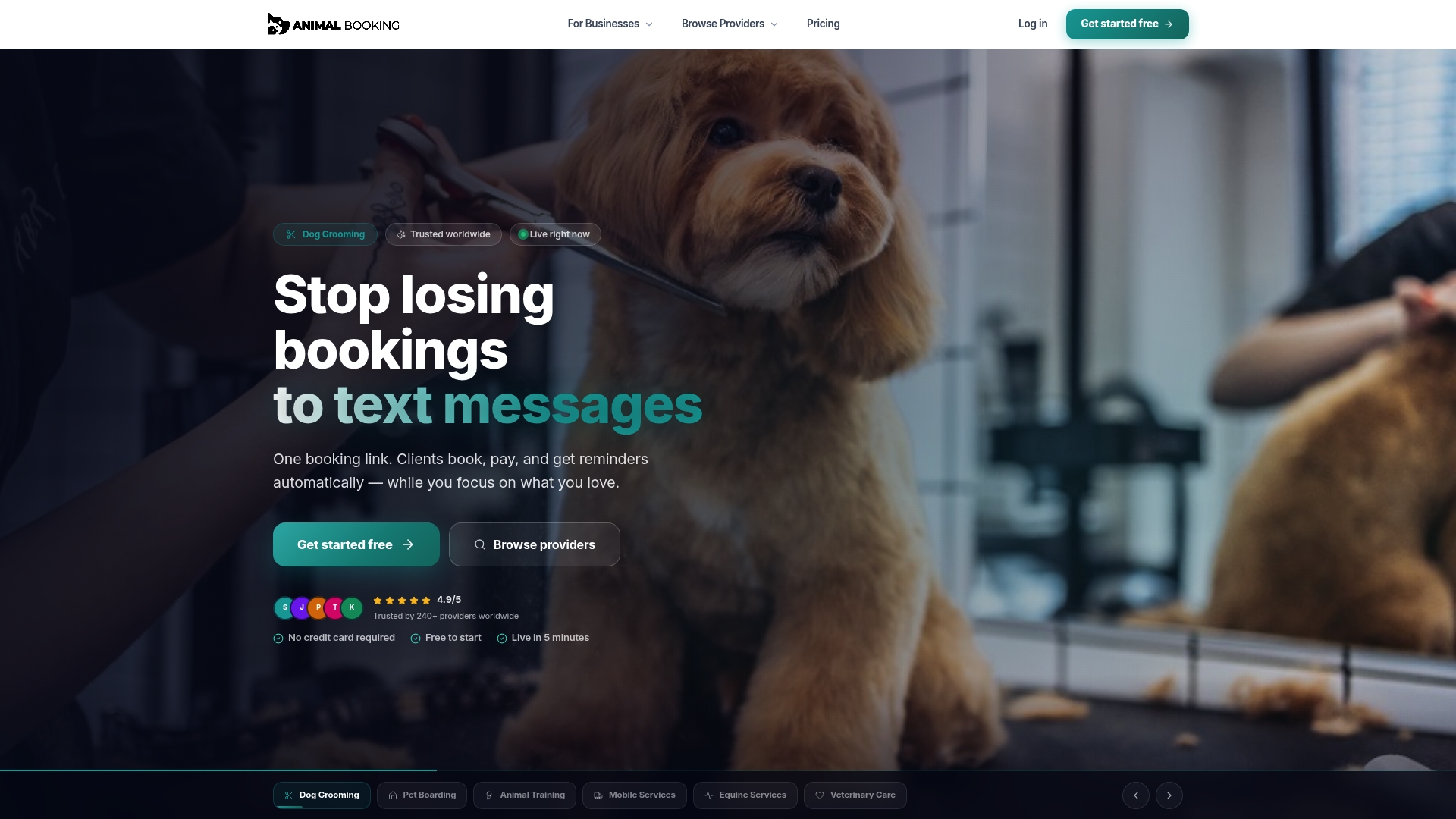
When you trial a platform, check three things specifically: does it support your exact invoice layout (base rate, add-ons, tax, deposit applied), does it let you set your own cancellation deadline and refund rule, and does it show you a clear payments dashboard rather than a list of unread notifications. Animalbooking's online booking and deposit features and payments tools are built around exactly those questions. Set up a booking website with your pricing on display, and you can start collecting deposits on the next booking that comes in.
Sources
- Dog Boarding Invoice Template: What to Include - LegalClarity
- How Do I Price My Pet Boarding Services? - Wexford Insurance (blog)
FAQ
Should pet boarding deposits be a flat fee or a percentage?
A flat fee is usually simpler to manage and easier to defend in a dispute than a percentage-based deposit, since the amount stays fixed regardless of add-ons.
What should a pet boarding invoice include?
A clear invoice separates the base nightly charge from add-ons, lists check-in and check-out dates, shows quantity and unit price for each line, and displays the subtotal, tax and any deposit already applied.
How can automation reduce no-shows in pet boarding?
Automated deposit collection and pre-arrival reminders address the two main causes of no-shows, and platforms like Animalbooking report no-show reductions of up to 80% when these steps run automatically.