
Price grooming services by starting with your fully loaded hourly cost, not the salon down the road. Multiply that cost by a factor of roughly three to set your pricing hourly rate, then convert it into breed and time bands with clear add-ons for difficult dogs, matting and rush jobs. Use fixed prices where the job is predictable and ranges where coat condition varies, and never raise prices without at least four weeks' notice.
TL;DR:
- Setting prices based on your fully loaded hourly cost and applying a multiplier of around three ensures profitability and accounts for unpredictable expenses and no-shows.
- Using fixed prices for predictable services and ranges for variable coat conditions helps manage client expectations and maintain consistent revenue.
- Implementing add-ons as separate, clearly listed charges prevents margin erosion and streamlines the billing process.
- Raising prices gradually with adequate notice and transparent communication preserves client trust and reduces the risk of losing loyal customers.
- Enforcing prices and deposits through automated booking systems minimizes discrepancies, prevents cancellations, and ensures your pricing strategy is consistently implemented.
Table of Contents
- Why cost-based grooming pricing strategy beats copying competitors
- Calculate your true costs and derive a pricing hourly rate
- Choose the right pricing model: fixed prices, ranges, packages and memberships
- Set time standards, breed and size bands, and price bands
- Define add-ons, surcharges and minimums
- How to raise prices without losing your best clients
- Use bookings, payments and deposits to enforce your prices
- Monitor profitability and pricing KPIs
- Practical tools: a pricing checklist and starter worksheet
- Legal considerations in pricing for grooming services
- Psychological pricing tactics that work in a grooming salon
- Seasonal and promotional pricing tactics
- How pricing shapes client retention and new client acquisition
- Author perspective: the pricing mistakes I see most often
- Put your pricing strategy into practice with AnimalBooking
- Sources
- FAQ
Why cost-based grooming pricing strategy beats copying competitors
Most grooming pricing strategy advice tells you to check three local competitors and land somewhere in the middle. That's backwards. Industry analysis has found many grooming salons underprice services by 20 to 40 percent once every real cost is counted, because they copied a rival's board price without knowing whether that rival is even profitable.
Competitor research still matters, just not as your starting point. Once you know your own fully loaded hourly cost, drive past two or three local salons and mobile groomers, note their board prices for a standard breed and size, and compare against your calculated number. If you're 20% below them and busy every day, you're leaving money on the table. If you're above them and quiet, either your marketing or your value story needs work, not necessarily your price.
The standard industry term for what you're building is a cost-plus pricing model, sometimes called cost-based pricing. It starts with your actual operating cost per billable hour and adds a margin on top, rather than guessing at what "sounds fair." Everything in this playbook builds from that single number.
Calculate your true costs and derive a pricing hourly rate
Your pricing hourly rate has to cover every dollar leaving the business, not just the wage you pay the groomer standing at the table. Miss a category and you're subsidising clients out of your own pocket.
Build your annual cost base from:
- Rent or van lease and utilities
- Grooming supplies, shampoo, blades and equipment depreciation
- Booking and payment software subscriptions
- Business insurance and public liability cover
- Payroll tax, superannuation contributions and workers' compensation
- Owner's target wage or drawing, treated as a real cost, not leftover profit
Add those up for the year, then divide by your realistic annual billable hours, which is grooming time only, not the hours spent on admin, cleaning or driving between mobile appointments. That gives you your hourly operating cost.
| Step | Example figure |
|---|---|
| Annual fixed and variable costs | a substantial amount |
| Realistic annual billable hours | a typical workload |
| Hourly operating cost | a sizable hourly cost |
| Pricing factor applied | typically around ×3 multiplier |
| Pricing hourly rate | accordingly set rate |
That multiplier of three isn't arbitrary. It typically needs to cover cost recovery, profit margin, and a buffer for no-shows, slow weeks and the award and superannuation increases that land every financial year. For a quick service like a nail trim, set a flat minimum, usually 15 to 20 minutes of your pricing hourly rate, so a five-minute job never runs at a loss once you count the client's arrival, handling and cleanup.
Pro Tip: Treat your own wage as a fixed cost before you calculate profit, not after. Groomers who pay themselves "whatever's left" are usually the ones working the longest hours for the least money.
Choose the right pricing model: fixed prices, ranges, packages and memberships
Once you have a pricing hourly rate, the next decision is how to present it. Each model solves a different problem.
Fixed prices work when a service is predictable: a bath and tidy on a short-coated breed rarely varies by more than a few minutes. Fixed pricing builds trust because clients know the number before they book, and it removes the awkward "it depends" conversation at drop-off.
Price ranges suit anything affected by coat condition, temperament or size variation within a breed, like a full groom on a double-coated dog that might be pristine or badly matted. Quote the range up front, then confirm the final figure at check-in once you've assessed the coat.
To convert your pricing hourly rate into menu lines, divide it by 60 to get a per-minute rate, then multiply by your average service time. A 90-minute full groom at your pricing hourly rate works out to a proportionate amount, which you can round to a clean price range.
Beyond single visits, three structures stabilise revenue:
- Frequency packages — a discount for booking every four or six weeks, which locks in repeat business and smooths your calendar.
- Memberships — a flat monthly fee covering one groom plus nail trims, which turns irregular income into predictable recurring revenue.
- Demand-based premiums — a surcharge of 10 to 20% for weekend slots, public holidays or same-day bookings, reflecting genuine capacity pressure rather than punishing the client.
Set time standards, breed and size bands, and price bands
Price bands only work if the time estimates behind them are honest. Track actual grooming minutes for a month, by breed and coat condition, using whatever notes your booking system already captures.
Once you have real time ranges, convert them to price bands using your per-minute rate. For example, a groomer charging an hourly rate translates minutes worked into an appropriate price band for breeds and service times.
Standard buckets that work for most salons:
- Small, short coat (e.g. Chihuahua, Beagle)
- Small, long or curly coat (e.g. Cavalier, Bichon)
- Medium, double coat (e.g. Border Collie, Corgi)
- Large or giant breed (e.g. Labrador, Standard Poodle)
- Heavily matted or neglected coat, priced as its own tier regardless of breed
| Time range | Price band |
|---|---|
| 30 to 45 minutes | Entry band |
| 60 minutes | Standard band |
| 90 minutes | Extended band |
| Matted or over 90 minutes | Premium/dematting band |
Reference points like Groom Dog City's published breed table are useful for sanity-checking your bands against what clients already expect to see, though your own time data should always override a generic list.
Define add-ons, surcharges and minimums
Add-ons protect your margin from the jobs that quietly cost more than the base price covers. List them separately on your menu rather than folding them into the base price, so clients see exactly what they're paying for.
Common add-ons and how to price them:
- Dematting — charge per 15-minute increment rather than a flat fee, since severity varies enormously.
- De-shedding treatments — a flat add-on, typically $15 to $40 depending on coat size.
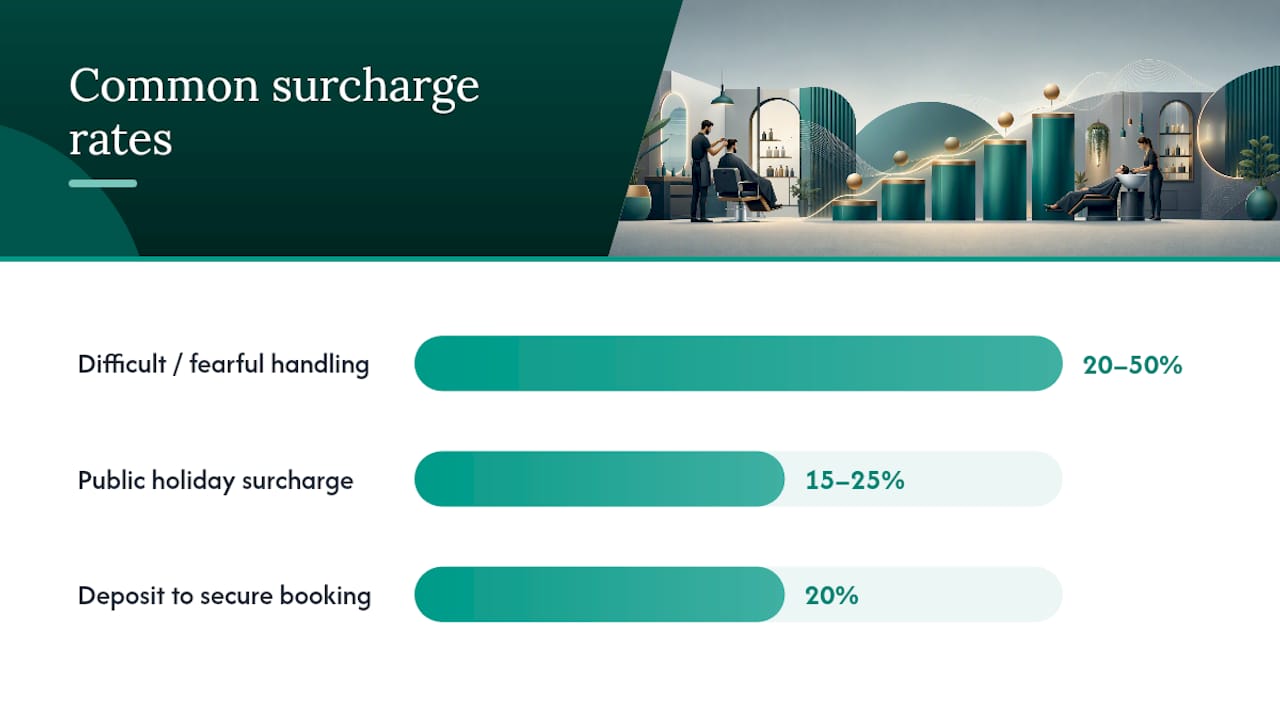
- Difficult or fearful dog handling — a flat surcharge of 20 to 50% on the base price, applied consistently, not negotiated case by case.
- Express or same-day slots — a flat premium of $10 to $30 for jumping the queue.
- Public holiday appointments — a flat surcharge, commonly 15 to 25%.
A behaviour or difficult-dog fee only holds up if you apply it every time the trigger occurs, whether that's biting risk, sedation needs or excessive handling time. Note it on the booking record so the next groomer isn't caught off guard, and consider a signed grooming release form for dogs with a known history.
Deposits deserve the same consistency. A policy along the lines of "A 20% deposit secures your booking and is non-refundable within 24 hours of your appointment" removes ambiguity and cuts down the no-show conversations that eat into a groomer's paid hours.
Pro Tip: Publish your add-on prices, don't just mention them verbally. Clients who see "Dematting: $15 per 15 minutes" on the menu rarely argue at pickup, because they agreed to it in writing.
How to raise prices without losing your best clients
Price increases fail when they're sudden, unexplained or applied unevenly across your client list. A staged system fixes all three problems at once.
- Set the size and notice period. A 10 to 15% increase with four to six weeks' notice typically keeps churn low, because it gives regulars time to budget rather than feeling ambushed at checkout.
- Write the message once, use it everywhere. A short email or SMS explaining the increase covers wages, rising input costs and quality investment. Keep it under 100 words: state the new price, the effective date, and one line of reasoning. No apology needed, this is a business update, not a confession.
- Pilot before you roll out. Test the new price on new bookings for two to three weeks before applying it to existing clients, and watch your rebooking rate closely during that window.
- Consider grandfathering your longest-standing clients for one extra cycle, or offer a loyalty add-on like a free nail trim, to soften the transition for the people who've been paying you for years.
Pro Tip: *Track rebooking rate for the eight weeks after any increase.
Use bookings, payments and deposits to enforce your prices
A price list only works if your booking system actually enforces it. Board prices that live only in someone's head get discounted on the spot, under pressure, at the counter.
Set up your booking platform to:
- Publish breed and size menus so clients see the price band before they book, not after.
- Require a deposit or full prepayment on new clients and known difficult dogs, reducing the no-show risk that eats into paid hours.
- Auto-apply surcharges for holiday slots or express bookings, so no groomer has to remember to add them manually.
- Set membership pricing as a recurring plan rather than a manual discount applied at checkout.
- Send automated reminders ahead of appointments to cut last-minute cancellations.
Platforms like Animalbooking are built around exactly this workflow, and providers using automated deposits and reminders through the platform report no-shows cut by up to 80% and revenue per booking up roughly 30%, largely because prices and deposits are enforced automatically instead of negotiated verbally.
Configuring this takes an afternoon: publish your bands, set a deposit percentage, turn on reminders, and link receipts to your reporting so every price change flows straight into your books.
Monitor profitability and pricing KPIs
Set a pricing strategy once, then check it against real numbers every month. The metrics that matter are revenue per billable hour, average ticket size, staff utilisation rate, and client churn after any price change.
Review monthly:
- Revenue per billable hour against your target pricing hourly rate
- Utilisation rate, aiming to stay above 70% of available grooming hours
- Client churn in the eight weeks following any price adjustment
Review quarterly:
- Cost inflation against your original cost base, especially wages and supplies
- Average ticket trend across your service mix
A useful trigger threshold: if input costs rise 5 to 10% or utilisation drops below 70%, revisit your pricing hourly rate rather than waiting for the next annual review. Keep these fields on a simple dashboard, even a shared spreadsheet, so you're reacting to numbers rather than gut feel.
Practical tools: a pricing checklist and starter worksheet
Before publishing any new menu, run through this sequence:
- Recalculate your fully loaded hourly cost using current wages and supply prices.
- Audit real service times over at least two weeks of bookings.
- Check your rate against local award minimums and staff pay.
- Confirm your deposit and cancellation wording is current.
- Publish the menu with add-ons listed separately, not bundled.
Set up a worksheet with these fields: annual costs, annual billable hours, hourly operating cost, pricing hourly rate, per-minute rate, and one row per breed/size band. Paste real numbers in, not estimates, and revisit it every quarter.
Legal considerations in pricing for grooming services
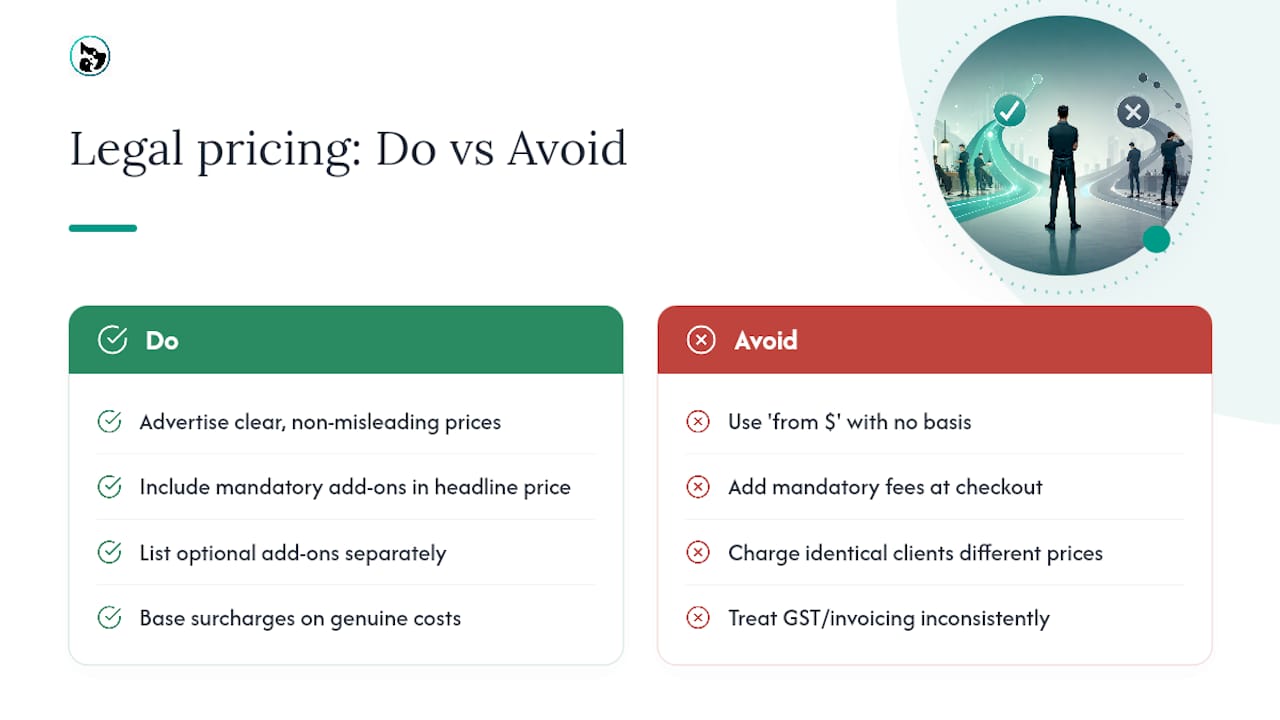
Pricing freedom in Australia isn't unlimited, and a few rules matter directly to grooming salons. The ACCC's guidance on business pricing requires that advertised prices be clear and not misleading, meaning a "from $45" board price needs a genuine basis, not a bait figure that never applies in practice.
Component pricing rules mean that if a service has a mandatory add-on, such as a flea treatment fee that applies to every dog regardless of condition, it generally needs to be included in the headline price rather than added as a surprise at checkout. Optional add-ons like dematting can be listed separately, since the client chooses whether to incur them.
Price discrimination, charging different clients different prices for identical services based on personal characteristics rather than genuine cost differences, sits in a different category to legitimate variable pricing. Charging more for a matted coat or a difficult temperament is a defensible cost-based decision. Charging a regular more than a new client for the identical service, with no service difference, is harder to justify and can damage trust even where it isn't strictly unlawful.
Keep your GST treatment and invoicing consistent with ATO requirements/) for registered businesses, since your published prices need to reflect whether GST is included, and your Business Activity Statement obligations flow directly from how you price and invoice each job.
Psychological pricing tactics that work in a grooming salon
Charm pricing, ending a price in $9 rather than a round number, works less well in grooming than in retail, because clients are booking a recurring service rather than making an impulse purchase. A $67 groom doesn't feel meaningfully cheaper than $70, and the odd number can read as unpolished on a professional menu.
Anchoring works better here. Listing your premium package (full groom with de-shedding treatment and teeth cleaning) above your standard groom on the menu makes the standard option look like the sensible middle choice, even if most clients were always going to pick it.
Bundling changes how clients perceive value without changing your margin. A "spa package" that combines a bath, nail trim and ear cleaning for a set price feels more generous than the same three services listed separately, even at an identical total cost, because the client isn't doing the mental addition themselves.
Decoy pricing works well for size tiers. Placing a mid-size band between a cheap small-dog price and an expensive large-dog price makes the middle option feel like reasonable value, which is exactly why breed and size bands should sit next to each other on a printed or digital menu rather than scattered across separate pages.
Round numbers still earn their place at the premium end. A $500 full-day spa package reads as considered and confident, where $497 reads like it was calculated to squeeze past a threshold.
Seasonal and promotional pricing tactics
Grooming demand isn't flat across the year, and pricing that ignores the seasonal curve leaves money on the table during peak weeks and empty chairs during the quiet ones.
The same logic applies to the fortnight before major holidays, when clients want their dogs groomed for family visits and will pay a premium to get a slot.
Quiet periods deserve the opposite treatment.
Promo codes work best when they're tied to a specific behaviour you want to encourage, like booking their next appointment before leaving, rather than a blanket discount open to anyone. Setting these up through a booking system with built in promo code support means you can track exactly which offers actually drove bookings, instead of guessing at the end of the month.
Avoid discounting your premium or difficult-dog surcharges seasonally. Those exist to cover genuine extra cost and time, and a seasonal promo undermines the logic behind them the moment a client remembers the discounted rate.
How pricing shapes client retention and new client acquisition
Higher prices don't automatically drive clients away, and lower prices don't automatically win them. What actually moves both retention and acquisition is whether the price matches what the client believes they're getting.
Clients who value convenience, low stress for their dog, or genuine grooming expertise will often pay above the local average and stay loyal for years, provided the experience backs up the price. Experts commonly recommend surveying your own client base directly to find out which of those factors matters most to them, rather than assuming everyone is price-sensitive by default.
Acquisition works differently to retention. New clients are comparing your board price against two or three others before they've experienced your work, so your entry-level service needs to be priced competitively enough to get them through the door once. Retention then depends on everything that happens after that first visit: consistency, communication, and whether the price they were quoted matches the price they paid.
Inconsistent pricing, where two similar dogs get different quotes depending on who answered the phone, damages retention faster than a straightforward price increase ever will. Clients tolerate a fair price rise. They don't tolerate feeling like they were charged more than the person before them for no clear reason.
Author perspective: the pricing mistakes I see most often
Undercutting is the most common mistake, closely followed by hidden fees that surface at pickup rather than at booking, and quotes that shift depending on who's answering the phone that day. Each one erodes trust faster than a straightforward price increase ever does.
The fix isn't a perfect pricing model on day one. It's treating your prices as a living system: recalculate costs annually, test increases on a small group first, and watch your utilisation and churn numbers instead of guessing. Groomers who review the data quarterly tend to run calmer, more profitable salons than those who set a price once and hope.
— AnimalBooking
Put your pricing strategy into practice with AnimalBooking
Working out breed bands and add-on fees on paper is one thing. Getting clients to actually pay them, on time and without a negotiation at the counter, is the harder part, and it's where a booking system earns its keep.
Animalbooking is built for exactly the workflow this playbook describes: publish breed and size menus so every client sees the price before they book, require a deposit on new or high-risk bookings, and let automated reminders chase confirmations instead of you chasing clients by text. Membership pricing runs on autopilot rather than manual discounts at checkout, and every payment flows straight into your reporting so you can see revenue per booking without pulling numbers from three different spreadsheets.
Plans start with a Starter tier and scale up through Independent at $49 per month, Teams at $149 per month, and Pro at $299 per month, with platform fees on processed payments ranging from 1% to 3% depending on your plan, detailed on the provider pricing page. Check the full plan breakdown, and if you're comparing marketing support to promote your new price list, HarbourSide Digital's pricing page is worth a look too. Start by auditing your current prices against the calculations in this guide, then test a deposit-only booking flow with one client type before rolling it out salon-wide.
Sources
- Fair Work — annual wage review 2023–24
- ABS — consumer price index Australia
- ACCC — business pricing guidance
- PawPortal — pricing strategy for grooming salons
FAQ
What are the 10 pricing strategies for a grooming business?
There's no single official list of ten, but the models that actually matter for groomers are cost-plus pricing, fixed pricing, price ranges, packages, memberships, demand-based premiums, add-on and surcharge pricing, penetration pricing for new locations, anchoring on a menu, and bundling. Most salons use a mix of four or five of these rather than picking just one.
Why is dog grooming so expensive?
Grooming prices reflect skilled labour time, specialised equipment, insurance, and handling risk with animals that can bite, panic or resist restraint. When you calculate a fully loaded hourly operating cost including wages, superannuation and overheads, the true cost per dog is usually far higher than clients assume from watching a 90-minute appointment.
How profitable is a pet grooming business?
Profitability depends heavily on whether pricing covers the fully loaded hourly cost, including owner wages, rather than just materials and time at the table. Salons using cost-plus pricing with a factor around three times their hourly operating cost, tracked through a system like Animalbooking to enforce deposits and cut no-shows, typically run healthier margins than those pricing off competitor guesswork.
How much should a groomer be tipped?
Tipping isn't standardised in the grooming industry, and it's the client's discretion rather than a set business policy.