
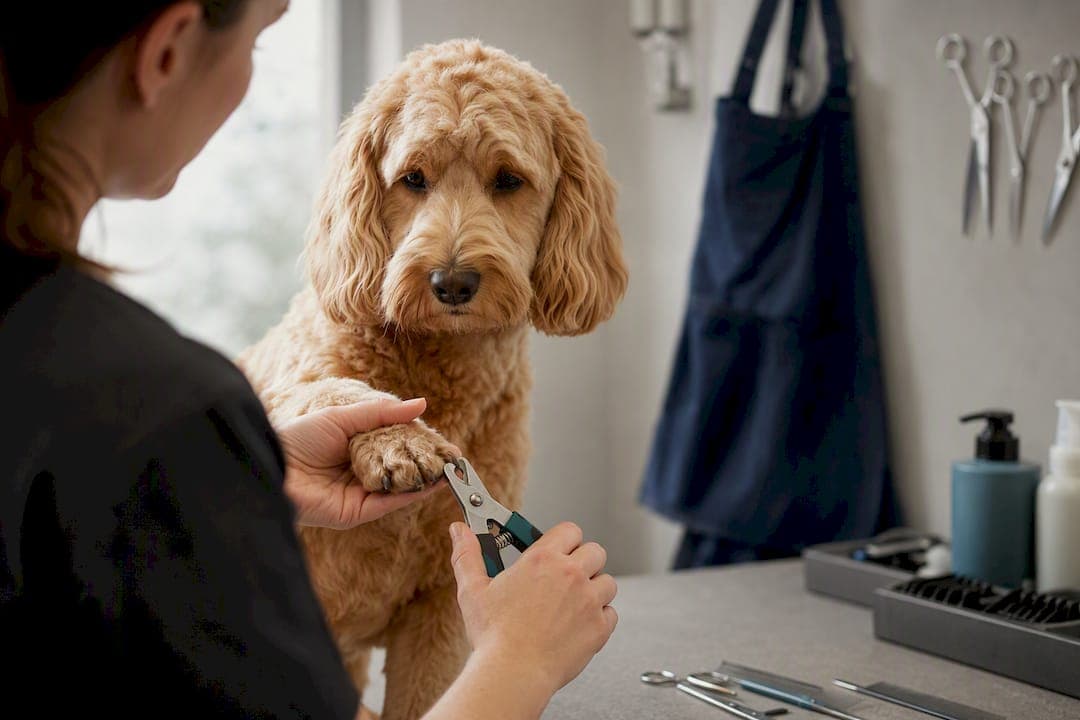
A grooming release form protects you and the pet in your care by documenting what the owner has disclosed and what they've agreed to before clippers touch fur. The single best move right now: grab an editable template, fill in your business details, and start using it at your next appointment. It matters because groomers face real risk from matted coats, health surprises, and aggressive animals, and an unsigned or vague form leaves you exposed if something goes wrong.
Your fastest options for getting one in hand today:
- A free editable template from a form builder like Jotform, covering vaccination proof, matting consent, and a liability release, with acknowledgement of typical grooming risks.
- A paid, professionally reviewed template pack, often with e-signature support and periodic updates.
- A veterinary informed-consent example adapted for grooming, useful if you handle senior or medicated pets regularly.
Whichever you choose, the form should capture owner and pet details, health disclosures, matting consent, emergency vet authorisation, and a plain-language liability acknowledgement.
Key Takeaways
A grooming release form works because it turns vague verbal warnings into documented, initialled consent that protects both the pet's welfare and the groomer's business.
| Point | Details |
|---|---|
| Start with a template | Download an editable grooming release template and customise it with your business details before your next appointment. |
| Separate high-risk clauses | Use individual initial boxes for matting, aggression, and emergency authorisation instead of one blanket signature. |
| Consent isn't permanent | Update disclosures for repeat clients, especially senior or medicated pets, rather than reusing an old signature. |
| Match the format to your business | Solo mobile groomers suit simple e-signature forms; busy salons benefit from conditional logic for matted or aggressive pets. |
| Automate collection where possible | Animalbooking lets providers send consent forms ahead of appointments and store them against the booking record. |
Table of Contents
- What is a grooming release form and when do you need one?
- What clauses does a grooming release form need?
- A copy-ready grooming consent template you can adapt
- How should you collect signatures and store the records?
- Where can you get a grooming release template?
- What are the legal limits of a grooming release form?
- Why detailed consent protects pets and groomers alike
- Collect consent before the pet walks through the door
- Sources
What is a grooming release form and when do you need one?
A grooming release form is a consent and liability document. It records what the owner has told you about their pet's health and temperament, and what they're agreeing to let you do, including handling mats, treating parasites, or authorising emergency vet care if something happens mid-groom.
You should ask for a signed form:
- At the first appointment with any new client.
- Whenever a coat is visibly matted or the pet hasn't been groomed in months.
- For senior pets (roughly seven years and up) or animals with known health conditions.
- For anxious or aggressive animals that may need extra restraint.
- Before any mobile or off-site grooming visit, where you're working without backup on hand.
It overlaps with veterinary consent in one spot: emergency authorisation. A grooming release grants you permission to seek urgent care; it isn't the same as a vet's own treatment consent, which covers the actual medical procedure once the animal arrives.
What clauses does a grooming release form need?
The strongest forms read like a checklist, not a wall of text. Miss one of these and you're relying on goodwill instead of paperwork.
- Owner and pet details: full name, contact number, pet's name, breed, age, and your vet's contact information.
- Health disclosures: current medications, known conditions, and recent surgeries, confirmed alongside vaccination status.
- Matting consent: explicit acknowledgement that mat removal can require a full shave and carries a small risk of nicks or skin irritation, a point grooming safety guidance flags as standard practice for at-risk pets.
- Behaviour and aggression clause: permission to muzzle or restrain, and your right to refuse or stop a service for safety reasons, with an extra handling fee where relevant.
- Parasite policy: consent for flea or tick treatment and the associated charge if fleas turn up mid-groom.
- Liability acknowledgement: a plain list of reasonable risks, including nicks, clipper irritation, and stress in older or anxious animals.
- Emergency medical authorisation: your authority to seek immediate vet care, and who's responsible for the bill.
- Pickup and late fees: what happens if the owner is late, and how cancellations are handled.
- Photo and marketing consent: optional, and should sit as its own tick box rather than buried in the fine print.
Pro Tip: Don't lump matting, aggression, and emergency authorisation into one signature line. Give owners a separate initial box for each high-risk item. It slows the sign-up by thirty seconds and saves you an argument later.
A copy-ready grooming consent template you can adapt
Here's a compact version you can paste into a document and adjust to your business. Treat it as a starting skeleton, not a finished legal instrument.
Grooming Consent and Release Form Owner name, phone, email. Pet name, breed, age, sex. Emergency contact and veterinary clinic name and number. I confirm my pet's vaccinations are current and disclose the following health conditions or medications: [ ]. I consent to mat removal, including shaving where required, and understand this carries a risk of nicks, clipper irritation, or stress. I authorise flea/tick treatment if parasites are found, at an additional charge of [amount]. I authorise [business name] to seek emergency veterinary care if needed, and accept responsibility for resulting costs. I understand grooming carries reasonable risks and release [business name] from liability for injury not caused by gross negligence. Late pickup after [time] incurs a fee of [amount]. I may / may not have photos used for marketing (circle one). Signature: __________ Date: __________
A few annotations worth keeping in mind. For mobile groomers, add a line specifying the service address and a note that emergency transport may take longer without clinic proximity, something the mobile services side of the business needs spelled out clearly. For senior or medicated pets, expand the health disclosure into its own short section rather than a single line. And always add your business name, a "last updated" date, and, where you can arrange it, a line noting the form has been reviewed by a vet or lawyer.
How should you collect signatures and store the records?
Paper works, but it's slow to retrieve and easy to misplace. A scanned PDF is better for storage but still needs a genuine signature underneath it. E-signatures collected through a form builder tend to hold up best because they timestamp the agreement and tie it to a specific booking, something Paperform's consent templates are built around, with conditional fields that only appear when a pet's coat is flagged as matted or its temperament as reactive.
Practical steps that save time on the day:
- Send the form digitally before the appointment so it's signed before the pet walks in.
- Keep a tablet at intake for walk-ins who haven't completed it beforehand.
- Ask for ID or a booking reference when someone other than the listed owner drops the pet off.
Pro Tip: Name saved files consistently, something like petname_ownersurname_date, and keep signed forms for at least two years. Store them somewhere access-controlled, and check your data handling practices cover how long you retain client medical details.
Where can you get a grooming release template?
Free editable forms get you moving fast, but check they actually cover matting, parasites, and emergency authorisation before you trust one. Many free templates skip the behaviour clause entirely, which is exactly the one that protects you when a dog bites during a nail trim.

Paid template packs, like the ones sold through Jotform's release form template, usually come with periodic updates and sometimes a note on legal review, worth the small cost if you'd rather not draft clauses yourself. Online form builders add another layer: conditional logic that shows extra fields only when a pet is matted or flagged as aggressive, plus built-in e-signature capture.
What to weigh before picking one:
- Cost, and whether "free" actually includes the clauses you need.
- How easily you can rebrand it with your logo and business name.
- Whether it supports e-signatures and conditional fields.
- Download format: PDF, Word, or a live online form.
- Whether it's been reviewed by a vet or lawyer, and how recently.
A solo mobile groomer usually does fine with a simple e-signature form sent ahead of each visit. A busy salon benefits more from conditional logic that adapts to matting or aggression on the spot. A veterinary groomer should lean toward a vet-reviewed template, given the closer overlap with treatment consent.
What are the legal limits of a grooming release form?
A release form can't lawfully wipe out your liability for gross negligence or wilful misconduct, no matter how the clause is worded. Keep the liability language reasonable and specific to ordinary grooming risks, not a blanket "we're never responsible for anything" statement, which courts tend to read as unenforceable overreach.
Consent isn't a one-off signature either. Veterinary regulators frame informed consent as an ongoing process, and the same logic applies to grooming: update disclosures for repeat clients, especially once a pet ages into higher-risk territory or starts a new medication.
Treat every returning senior or medicated pet as a fresh consent conversation, not a rubber stamp on last year's paperwork.
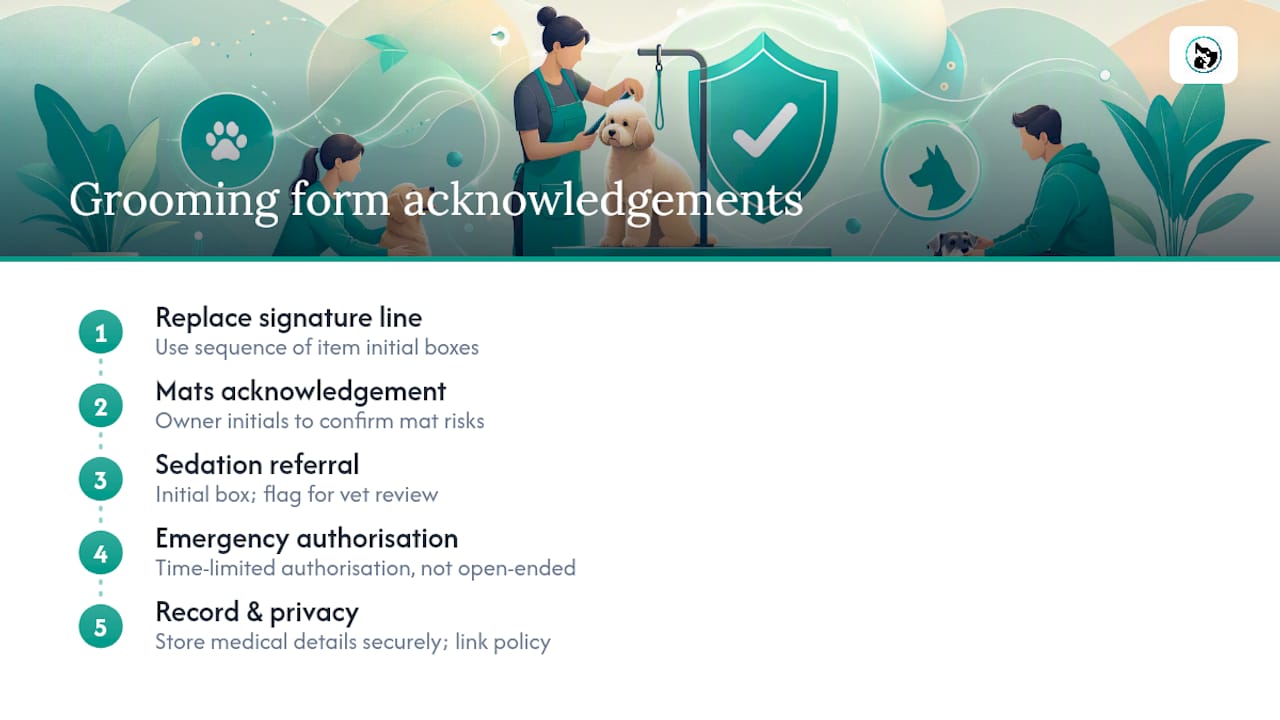
A few safeguards are worth building in from the start: a "last reviewed" date on the form itself, a vet or lawyer's eyes on anything covering higher-risk services, and time-limited emergency authorisation rather than an open-ended blank cheque. Store medical details securely and never publish them, and link clients to your privacy policy rather than explaining data handling in the margins of a consent form.
Pro Tip: Replace the single signature line with a short sequence of initial boxes for the highest-risk items, mats, sedation referral, emergency authorisation, so you can prove the owner actively acknowledged each one, not just the form as a whole.
Why detailed consent protects pets and groomers alike
Clear consent isn't paperwork for its own sake. It forces a real conversation about a pet's health and temperament before anything risky happens, which means fewer disputes afterwards and a stronger position if one arises anyway. Animalbooking works with groomers daily on exactly this kind of intake friction, and the businesses that treat consent as a genuine step, not a formality, consistently run smoother appointments.
Collect consent before the pet walks through the door
Chasing a paper form at intake while a matted, anxious dog waits in reception is the worst possible moment to be reading fine print. Booking software that sends your consent form ahead of the appointment fixes that: owners fill it in from home, you review it before the pet arrives, and you already know whether you're dealing with a shave-down or a straightforward trim.
Look for a system that supports e-signatures, conditional fields that surface extra questions for matted or reactive pets, and automatic reminders so forms don't get forgotten. Animalbooking ties signed consent directly to the booking record, so nothing sits in a separate folder disconnected from the appointment it belongs to. If you're still juggling paper forms and sticky notes, check the provider pricing page and see what an integrated intake workflow would look like for your salon.
Sources
Start with the template sources that already build in the clauses this article covers, then adapt the wording to your own business rather than copying it word for word.
- Grooming safety — policies
- TEMPLATE: informed client consent form (College of Veterinarians of Ontario)
- Pet grooming services consent form template | Paperform
- Grooming release form template | Jotform
The Jotform and Paperform links are ready-to-use templates. The veterinary consent template is practice guidance to borrow principles from, not paste directly into a grooming form. The salon example is a real-world form worth studying for tone and clause phrasing before you write your own.
This article is general information, not a substitute for advice from a qualified lawyer. Consult a qualified legal professional about your own circumstances before acting on anything here.