
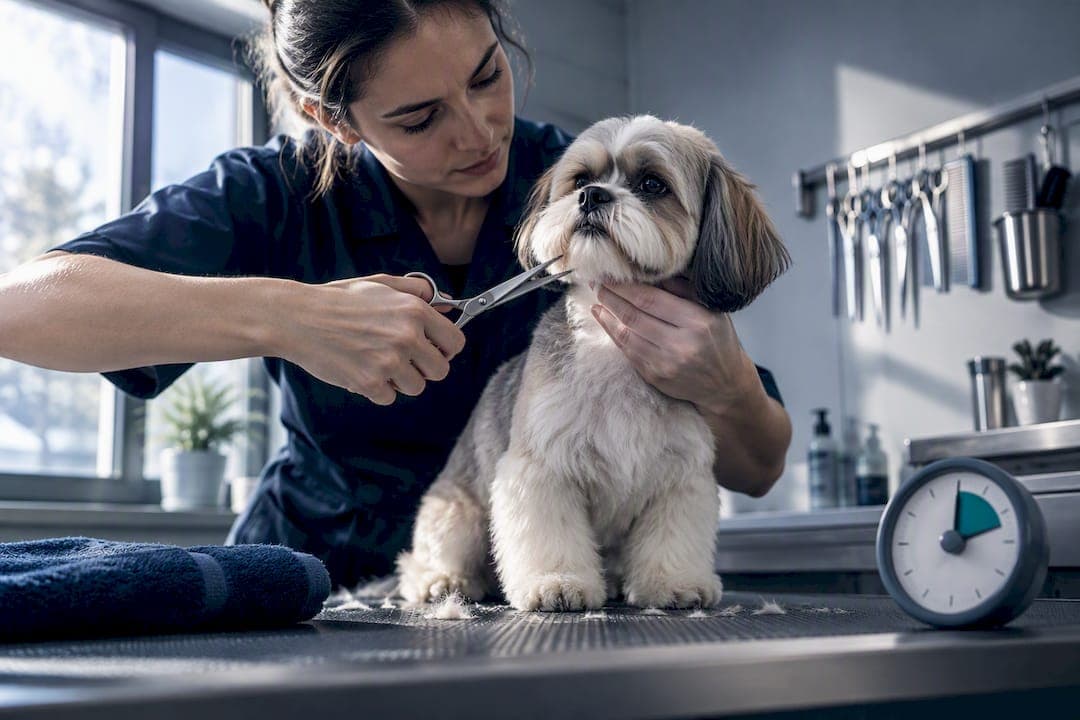
If you haven't reviewed your prices in 12 to 24 months, the answer is yes, raise them, and the first move isn't picking a number, it's running a chair-hour check. A modest increase to your service prices, such as a small flat amount or a percentage, is usually the safest starting strategy until your cost analysis indicates a different need. Once you know your real cost per chair-hour, everything else, sizing, timing, communication, gets easier to decide with confidence instead of guesswork.
TL;DR:
- Knowing your real cost per chair-hour, including wages, on-costs, rent, consumables, fees, and profit margin, is essential before raising prices.
- Adjust prices using flat-dollar, percentage, tiered pricing by size and coat, or add-on fees, with pilot testing on new clients to gauge feedback.
- Give clients at least several weeks' notice, especially for long-term bookings, and communicate increases by explaining the rising costs honestly.
- Use automated booking tools to enforce new prices, collect deposits, and send reminders, easing the rollout and reducing disputes or confusion.
- Review costs regularly with official economic data and conduct annual or more frequent price assessments to avoid underpricing and stay aligned with rising expenses.
Table of Contents
- How to calculate the grooming price increase you actually need
- Common approaches for sizing grooming price increases
- When to raise grooming prices and how much notice to give
- How to tell clients about a grooming price increase
- Handling client pushback when you raise grooming prices
- Rolling out your new grooming prices without disruption
- How booking tools reduce friction when you raise grooming prices
- Why planned pricing protects your grooming business
- Publish your new prices without the admin headache
- Where to check the real numbers before you raise prices
- Sources
- FAQ
How to calculate the grooming price increase you actually need
Most groomers price by gut feel or by copying whatever the salon down the road charges. That's how salons end up underpricing for years, something PawPortal's operator analysis flags as common across the industry. The fix is a "fully loaded" chair-hour figure, meaning every dollar it costs you to run one hour on the table, not just wages.
A fully loaded chair-hour includes:
- Groomer wages for that hour, including any penalty rates or loadings.
- Payroll on-costs — superannuation, workers' compensation, leave accrual.
- Rent and utilities apportioned per working hour (weekly rent ÷ total billable hours available).
- Consumables — shampoo, blades, towels, laundering.
- Card processing and platform fees on the average transaction.
- A genuine profit margin, not whatever's left over.
Add these six line items, divide by your billable hours per week, and you get your break-even chair-hour cost. Add your target margin on top, and that's your real chair-hour rate.
Industry pricing frameworks recommend exactly this build-up approach rather than relying on competitor averages, because your rent and wage structure aren't the same as the groomer's three suburbs over (Franpos's pricing framework). To convert the chair-hour rate into service prices, time 20 to 30 real grooms across your typical mix of sizes and coat types, then multiply average minutes by your chair-hour rate. A 45-minute small-dog wash and tidy priced at the target chair-hour rate would cost roughly in the mid-range of typical starting prices for such services. Round to the nearest $5 and list it as a "starting at" price, since coat condition always adds variance.
Common approaches for sizing grooming price increases
Once you know your target rate, you need a method for closing the gap between what you charge now and what you should charge. Four approaches dominate in practice.
- Flat-dollar increases — adding a fixed amount ($5, $10) to every service. Simple to explain, easy for reception staff to apply consistently, but it can squeeze margins on your longest, most expensive services if the gap is large.
- Percentage increases — lifting every price by the same percentage (say 8%) preserves the relative gap between a small tidy-up and a full groom on a doodle. This suits salons whose pricing tiers already reflect real time differences.
- Tiered pricing by size, coat and handling — mapping measured chair time to size and coat bands (small/smooth, medium/curly, large/double-coat) rather than breed name alone, since MuttMark's cost analysis confirms size and coat, not breed, drive groom time.
- Explicit add-on fees for de-matting, difficult handling, senior/anxious dog care and mobile call-outs. Publishing these separately protects your margin on the hard jobs without penalising every easy client.
Pro Tip: Before rolling out a full increase, pilot the new tiered structure on new client bookings only for two to three weeks. It shows you real-world pushback without touching your existing client base.
When to raise grooming prices and how much notice to give
An annual review is the sensible default, and small, predictable increases land better than rare, painful jumps. Practitioner commentary consistently notes clients absorb a modest yearly lift far more easily than an overdue 20% correction (PawPortal).
Raise earlier than your usual cycle when:
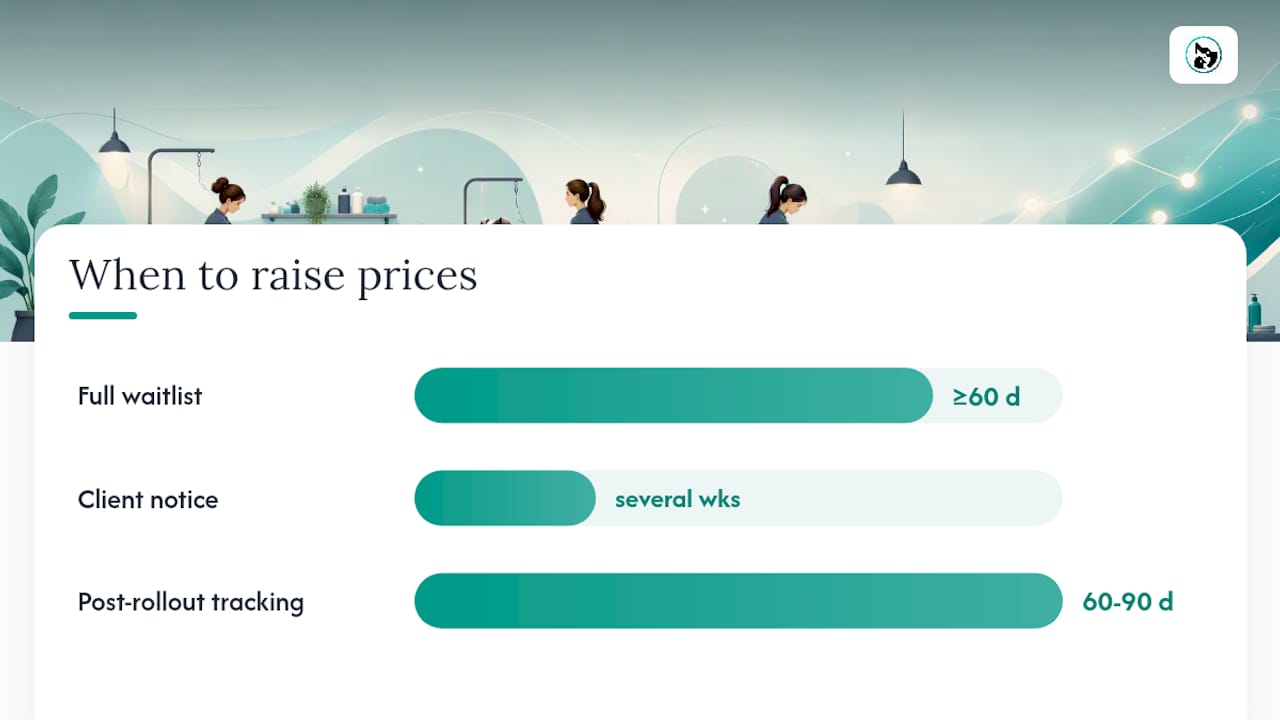
- Your waitlist has been consistently full for two months or more, a clear demand signal.
- The Fair Work annual wage review lifts award rates and your payroll jumps mid-year.
- The ABS consumer price index shows a sustained spike in a cost category you can't absorb, like rent or utilities.
- A single supplier cost (shampoo, blades, insurance) rises sharply and unexpectedly.
It's recommended to give clients at least several weeks' notice before a price increase, with longer notice for clients who book far ahead or have regular monthly appointments. Some salons stagger the rollout, applying new prices to new bookings immediately while grandfathering existing appointments booked before the announcement, especially for your longest-tenured clients. After rollout, track rebooking rate, average revenue per booking, and waitlist length over the following 60 to 90 days to see whether the increase actually improved your position.
How to tell clients about a grooming price increase
The message that works focuses on why, not just what. Clients tolerate an increase far better when they understand it's tied to real costs, not arbitrary greed.
- In person at checkout — reception says something like: "Just a heads up, our prices are adjusting from [date] to reflect rising costs, your next booking will be at the new rate."
- Email or SMS four weeks out — short, warm, specific: "From [date], our grooming prices are increasing to keep up with rising wages and supply costs. Your loyalty means a lot to us, thank you for sticking with [salon name]."
- Posted signage and booking page updates — list new prices as "starting at" figures, with the exact quote confirmed at check-in based on coat condition and behaviour.
- Value add-ons — a free nail trim, a small skin conditioning treatment, or a loyalty stamp card softens the announcement without discounting the core price.
Pro Tip: Never bury the increase in a generic "policy update" email. Clients trust specific reasons, rising wages, insurance, product costs, far more than vague corporate language.
Update your booking platform the same day you send the notice, so there's no gap between what clients read and what they're charged.

Handling client pushback when you raise grooming prices
Front-of-house staff need short, confident scripts, not apologies. A defensive tone invites negotiation; a calm, factual one usually ends the conversation.
- "Why did the price go up?" — "Our costs for wages and supplies have risen, and we've held our prices for over a year."
- "Can I get the old price?" — "We've kept your last booking at the previous rate, but new bookings are at the current price."
- "I'll go elsewhere." — "I understand, we'd love to keep grooming [pet's name], but our new pricing reflects the quality and time we put into every groom."
Offer limited grandfathering only for clients booked before the notice period ended, and only once. A payment plan makes sense for a genuinely large one-off cost (a major dental or de-matting job), not for a routine increase. Any exception beyond your written policy should go to a manager or owner for sign-off, never to whichever staff member is on the desk that day. The moment you start negotiating case by case, you've effectively cancelled the increase for anyone who complains loudly enough.
Rolling out your new grooming prices without disruption
A clean rollout comes down to four operational tasks, done in order.
- Update every price point in your booking system, printed price list and in-salon signage on the same day, so nothing conflicts.
- Document your grandfathering rule in writing (who qualifies, until when) so every staff member gives the same answer.
- Adjust deposit and cancellation terms to match the new rate, particularly for add-on fees like de-matting or difficult handling.
- Track retention, revenue per booking and waitlist length for 30 to 90 days after go-live to confirm the increase is working, not just landing.
How booking tools reduce friction when you raise grooming prices
Automated systems make the new price stick without a single awkward conversation. Published prices, deposits and reminders enforce the change quietly, before the client even reaches the counter.
- Published online prices remove the "what does it cost" ambiguity that leads to disputes at pickup.
- Deposits collected at booking confirm the client has seen and accepted the new rate, a useful safeguard covered in this breakdown of deposits versus prepayments.
- Auto-reminders referencing the booked price reduce no-shows and last-minute renegotiation.
- A documented release form covering scope and add-ons, like this grooming release form template, locks in what's included before the groom starts.
Setup is simple: publish the new prices, set an effective date, switch on deposits, and let reminders do the rest.
Why planned pricing protects your grooming business
Losing a handful of price-sensitive clients after an increase isn't failure, it's often a sign you were undercharging the wrong people for too long. The groomers who handle this well are the ones who ran the numbers first and communicated with confidence, not the ones who guessed. Do the chair-hour calculation, follow the rollout checklist, and use the resources built for exactly this moment.
— AnimalBooking
Publish your new prices without the admin headache
AnimalBooking is the alternative to sticky notes and group texts for rolling out a grooming price increase, you set the new rate once, and the system enforces it on every booking from that point on. Published prices stop the "how much is it again" conversation before it starts, deposits confirm clients have seen the new figure before they book, and auto-reminders keep no-shows down while your new rates settle in.
For groomers juggling grandfathered clients and new pricing tiers at the same time, the platform's smart calendar and online booking tools keep both running without double handling. Plans start with Independent at $49 per month, up to Teams at $149 and Pro at $299, each with a lower platform fee as you move up tiers, full details are on the pricing page. If you're planning a rollout in the next few weeks, set up your account and publish the new price list before your notice period ends.
Where to check the real numbers before you raise prices
For inflation trends, check the ABS consumer price index. For wage movements, see the Fair Work annual wage review. For GST and invoicing, consult ATO guidance on BAS/). For a practical retention angle alongside your new prices, see these customer retention strategies.
Sources
- Australian Bureau of Statistics — Consumer price index, Australia
- Fair Work — Annual wage review 2023–24
- Pricing your grooming services: what the market data shows — PawPortal Blog
FAQ
Why is dog grooming so expensive now?
Grooming costs have risen mainly because wages, rent and consumables have all gone up, and the Fair Work annual wage review directly affects what salons pay staff each year. Many salons were also underpricing to begin with, according to PawPortal's analysis, so recent increases are partly a correction, not just inflation.
How much should dog groomers charge?
Charge based on your fully loaded chair-hour cost, wages, on-costs, rent, consumables and margin, divided across your billable hours, then applied to the measured average time each service takes. This chair-hour method, recommended in Franpos's pricing framework, gives a defensible number rather than a guess based on competitors.
What is a teddy bear cut on dogs?
A teddy bear cut is a rounded, even trim that leaves the coat short but fluffy, most common on breeds like Poodles, Bichons and Shih Tzus. It's a specific style choice, not a service tier, so it should be quoted the same way as any other full groom based on coat condition and handling.
How much does it cost to groom a dog in Australia?
Prices vary by size, coat type and matting, with small, smooth-coated dogs at the lower end and large, double-coated or heavily matted dogs at the higher end. Rather than relying on a single national figure, base your own pricing on your chair-hour calculation and the specific coat and handling needs of each dog.
How often should groomers review their prices?
An annual review is the standard cadence, with small, regular increases proving easier for clients to accept than rare, large jumps. Review earlier than usual if wage decisions, rent, or supply costs shift sharply mid-year.