
The fastest way to schedule dog training classes is to run them through a purpose-built booking platform, paired with clear enrolment, payment and cancellation policies. That combination handles capacity limits, deposits and reminders automatically, while keeping your business aligned with ACCC consumer rules and OAIC privacy guidance. Get those two pieces right and the rest of the schedule runs itself.
TL;DR:
- Using a dedicated booking platform automates capacity management, deposits, and reminders, reducing admin work and preventing overbooking issues.
- Structuring classes as recurring series, block bookings, or drop-in sessions depends on the type of training and owner demand, requiring clear enrolment rules.
- Collecting detailed intake information and providing transparent cancellation, refund, and privacy policies at booking minimizes disputes and builds trust.
- Automated reminders and waitlist features help reduce no-shows and fill canceled spots without manual intervention.
- Animal Booking offers an all-in-one system that streamlines scheduling, intake forms, deposits, and calendar syncing, starting at $49 per month with variable fees.
Table of Contents
- Set up your class structure and timetable
- Publish the schedule: booking pages, embedding and calendar workflows
- Payments, deposits and refund policy for classes
- Manage enrolments, reminders and no-shows
- Legal, privacy and consumer obligations to cover when running classes
- Considerations for selecting class times based on dog and owner availability
- How to accommodate different skill levels within classes
- Staff and trainer scheduling and availability management
- Operational perspective from a platform provider
- How Animal Booking helps schedule and manage dog training classes
- Sources
- FAQ
Set up your class structure and timetable
Before you touch a calendar, decide what you're actually scheduling. Most training businesses run a mix of puppy classes, beginner obedience courses, multi-week intermediate programs and ongoing weekly classes for graduates who want to keep training. Each type needs its own rhythm: puppy classes tend to run as short, fixed-length courses, while obedience and agility groups often work better as an ongoing weekly series with rolling enrolment.
Class length and frequency should match what the dogs and trainers can sustain. Dogs Victoria guidance suggests puppy classes typically run for a few weeks and should stay small, avoiding a large number of puppies per class, with on-lead work and disinfectable indoor spaces to limit disease exposure. That ratio matters just as much for adult obedience classes: too many dogs per trainer and you lose the individual correction that makes a class worth paying for.
Once you know your class types, pick a scheduling model:
- Recurring series: a fixed group meets weekly for a set number of sessions, ideal for puppy preschool and structured courses.
- Block bookings: owners pay upfront for a term of classes, which smooths cashflow but requires firm enrolment cut-offs.
- Drop-in classes: casual weekly sessions with no fixed roster, flexible for owners but harder to plan capacity around.
Set enrolment rules alongside the timetable: a minimum class size before a session runs, an opening and closing window for bookings, and a waitlist policy that automatically offers a spot when someone cancels. Decide too whether graduates roll straight into the next course or need to actively re-enrol.
Pro Tip: Cap each class a few spots below your physical maximum so a late booking or a trial dog doesn't push you over your safe trainer-to-dog ratio.
Publish the schedule: booking pages, embedding and calendar workflows
A class timetable is only useful if people can actually see it and book into it without emailing you back and forth. The simplest setup is an embeddable booking widget on your own website, paired with a hosted booking page you can send directly to referrals from vets or groomers who don't have their own online form.
Behind the scenes, bookings should sync straight to each trainer's calendar so nobody double-books a room or a handler. Where it suits your business, publishing a public schedule feed also lets regular clients subscribe and see upcoming sessions without checking back on your site each week.
Every class listing needs enough detail that a booking arrives with the right context attached:
- Class description: what the session covers and who it suits (age, breed size, temperament).
- Prerequisites: vaccination status, minimum age or completion of a prior course.
- Intake questions: behaviour notes, previous training history and any reactivity flags.
Get this right and you spend less time fielding "is this class right for my dog" messages and more time actually training. Animal Booking's booking tools are built around exactly this kind of embeddable schedule and intake flow for trainers.
Payments, deposits and refund policy for classes
How you take payment shapes your cashflow and your no-show rate just as much as your training methods shape the dogs. Three models cover most trainers:
- Full prepayment: locks in revenue for the whole course upfront but can put off owners unsure whether the class will suit their dog.
- Deposit plus balance: a smaller commitment at booking, balance due before or at the first session, which reduces friction while still discouraging no-shows.
- Pay on arrival: the lowest barrier to booking, but the highest exposure to empty spots and lost revenue on the day.
Whichever model you choose, the ACCC is clear that a business must not accept payment for a service it knows it cannot supply by the promised date, and a consumer is entitled to a refund for the portion of a service not delivered. If a course is likely to be cancelled or delayed, that has to be communicated before you take money, not after.
Even a small deposit can noticeably reduce no-shows because it gives owners a reason to message you if their dog can't make it, rather than simply not turning up.
Automated payment capture and instant receipts remove the manual chasing that eats into a trainer's evening, and they create a clean record if a refund dispute ever comes up.
Manage enrolments, reminders and no-shows
Every booking should start with a short intake form, not a phone call. Capture vaccination status, any behaviour notes a trainer needs to know before the dog walks in, and an emergency contact in case something goes wrong mid-session.
From there, automation does the heavy lifting:
- Reminders: automated email and SMS reminders sent a day or two before class, with a cancellation link built in, cut down on forgotten sessions.
- Waitlists: an auto-managed waitlist fills a cancelled spot and notifies the next person on the list without you lifting a finger.
- Attendance tracking: logging who showed up flags patterns early, whether that's a dog who needs a different class time or an owner who needs a follow-up call.
Pro Tip: Send the cancellation link in the reminder itself, not buried in a separate email. Owners who can cancel in one tap are far more likely to free up the spot instead of just not showing.
Legal, privacy and consumer obligations to cover when running classes
A few rules sit underneath every booking you take, and getting them wrong costs more than the class fee itself.
- Payment timing: under ACCC guidance, don't accept payment if you already know you can't deliver the service, and if a class changes materially after payment, notify the owner and refund those who don't consent to the change.
- Privacy: if you collect sensitive information such as behavioural notes or health details at booking, align your collection and storage with the Australian Privacy Principles and publish a plain-language privacy notice at the point of booking.
- Documented procedures: write down your cancellation, refund and change process once, then train every staff member to apply it the same way every time.
Consistency here builds trust faster than any Veterinary SEO Services marketing does. Owners remember the trainer who handled a cancellation fairly far more than the one who ran a flawless first class.
Considerations for selecting class times based on dog and owner availability
Picking a time slot is a balancing act between when dogs are at their best and when owners can actually get there. Puppies and reactive dogs often do better in quieter, low-arousal windows, such as mid-morning or early afternoon, away from the energy of a Saturday rush. Working owners, on the other hand, mostly need evenings or weekends, which is exactly when demand for a room and a trainer peaks.
Look at your own booking history before assuming what will work. If you're just starting out, offer a small spread of times across a weekday evening and a weekend morning, then adjust once real bookings show you where the demand actually sits.
Consider the dog's energy and the owner's commute together. A high-energy breed class scheduled right after work, when the owner is tired and the dog has been crated all day, tends to produce worse outcomes than the same class run on a Saturday morning. Building in a short buffer between back-to-back classes also matters: it gives a trainer time to reset the space and stops one session's stragglers colliding with the next group's early arrivals.
Recurring weekly slots work best for owners once they've settled into a routine, but keep at least one flexible make-up slot per week for the inevitable missed session. That single slot does more to protect retention than almost any other scheduling decision.
How to accommodate different skill levels within classes
Mixed-ability classes are workable, but only with a plan for the gap between the fastest and slowest dogs in the room. The simplest fix is levelling by intake: use your booking form to ask about prior training, age and known behaviour issues, then place dogs into beginner, intermediate or advanced groups before the first session rather than discovering the mismatch on the day.
Within a single class, small-group work lets a trainer run two or three skill tiers side by side, giving the more advanced dogs a harder variation of the same exercise while beginners work on fundamentals. This keeps a class size workable without needing a second trainer for every session.
For agility or advanced obedience, a light entry assessment before enrolment saves everyone frustration. It also protects the Dogs Victoria recommended class sizes, since a mismatched class often needs more trainer attention per dog than the ratio allows.

Where the spread is too wide to manage safely in one room, the better answer is simply splitting into two scheduled classes rather than stretching one trainer across skill levels that need genuinely different pacing.
Staff and trainer scheduling and availability management
Once you're running more than one class type, trainer availability becomes its own scheduling problem. Each trainer needs a clear view of which classes they're rostered for, when they're free to add a private lesson, and where their availability might clash with another trainer needing the same room.
A shared calendar that every trainer can check and update themselves cuts out most double-booking issues before they happen. It also makes it far easier to cover a trainer's classes at short notice, since anyone else on the roster can see exactly which sessions need a stand-in and what that class was doing that week.

Build in buffer time between a trainer's back-to-back classes, particularly if one group is puppies and the next is a higher-energy adult class. That gap gives the trainer a moment to reset, and it stops one session's overrun from cutting into the next.
If you run private lessons alongside group classes, keep those bookings on the same calendar as the group timetable rather than a separate system. A trainer who's double-booked between a private client and a scheduled class is the fastest way to damage the trust you've built with both.
Operational perspective from a platform provider
The biggest scheduling mistakes we see aren't about timetables at all. They're unclear cancellation policies, waitlists managed by memory instead of software, and intake checks that get skipped when a trainer is busy. Automation doesn't fix bad training, but it does remove the admin errors that quietly cost classes their reputation.
A platform that handles enrolment, deposits and reminders in one place gives a trainer back the hours they'd otherwise spend chasing payments or manually reshuffling a waitlist, time better spent actually working with dogs.
— AnimalBooking
How Animal Booking helps schedule and manage dog training classes
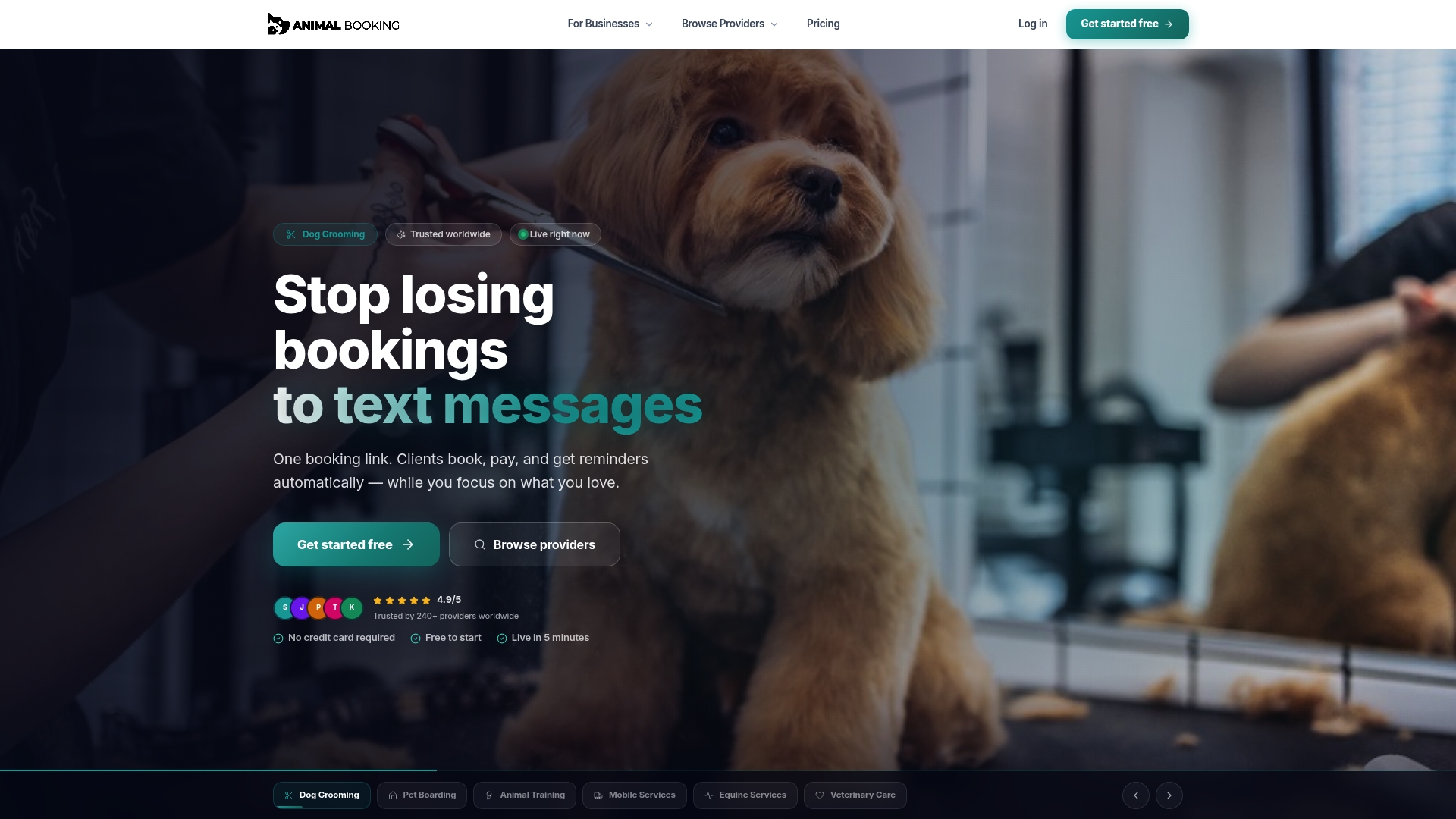
Running classes through Animal Booking means the recurring timetable, intake forms, deposits and reminders live in one system instead of a spreadsheet, a text thread and a payment app. The platform is built for a setup that takes minutes rather than days, so a new course can go live the same afternoon you decide to run it.
For trainers, that means:
- Recurring class setup: build a weekly series or a fixed-length course once and let bookings fill against it automatically.
- Intake forms and waivers: capture vaccination status and behaviour notes at booking, with templates such as this dog training waiver guide covering the consent side.
- Deposits and automated reminders: reduce no-shows without a single manual phone call.
- Embeddable booking page and calendar sync: publish your schedule on your own site and keep every trainer's calendar in sync.
Plans start with the Starter tier with no published price, running up to Independent at $49 per month, Teams at $149 per month and Pro at $299 per month, alongside platform fees from 1% to 3% depending on tier. Check the pricing page to find the plan that matches your class load.
Sources
- Repair, replace, refund, cancel | ACCC
- Read the Australian Privacy Principles | OAIC
- Your new puppy has a lot to learn | Dogs Victoria
FAQ
How far in advance should I open class bookings?
Most recurring classes work well opened two to four weeks before the start date, giving owners time to plan while keeping numbers firm enough to confirm the class will run. Shorter courses, like puppy preschool, often benefit from a slightly longer lead time since owners tend to book around a puppy's vaccination schedule.
What's a reasonable class size for puppy training?
Dogs Victoria guidance suggests keeping puppy classes small, avoiding more than five or six puppies per session, with on-lead work in a disinfectable indoor space. Smaller classes also make it easier to spot early behaviour issues before they become a pattern.
Can I keep a deposit if someone cancels last minute?
Under ACCC guidance, you can only withhold payment for the portion of the service you were genuinely able to supply, so your cancellation policy needs to set out clearly what happens at each notice period. Publishing that policy at the point of booking, rather than explaining it after the fact, avoids most disputes.
Do I need a privacy policy just to run a booking form?
Yes, if your intake form collects sensitive details like behaviour notes or health information, the Australian Privacy Principles expect a clear notice explaining what you collect and why. A short privacy statement linked at booking covers this without needing a lengthy legal document.
How much does Animal Booking cost for a training business?
Animal Booking's plans run from the Starter tier with no published price up to Independent at $49 per month, Teams at $149 per month and Pro at $299 per month, plus platform fees between 1% and 3% depending on tier. Full details are on the pricing page.