
Before your first client walks through the gate, get a signed, tailored dog training waiver in place. That single document acknowledges risk, records consent, and gives you a defensible paper trail if something goes wrong. You can download or copy the editable sample wording in Section 4 of this guide, then adapt it to your business before your next session.
Three things to know upfront:
- A waiver must be read, understood, and signed before participation begins, not handed over on the day and signed in a hurry.
- Australian Consumer Law (ACL) limits what any waiver can exclude. You cannot contract out of statutory consumer guarantees, and a waiver will not protect you from gross negligence.
- For complex cases, multi-site operations, or any situation involving minors, get the document reviewed by an Australian solicitor before you use it.
Key takeaways
A signed, plain-language dog training waiver collected before the first session is the single most effective step an Australian trainer can take to manage consent and reduce liability exposure.
| Point | Details |
|---|---|
| Sign before the session | Waivers must be read, understood, and signed before participation — not on the day. |
| Include the core clauses | Assumption of risk, release, indemnity, fitness declaration, emergency consent, and severability are non-negotiable. |
| Know the ACL limits | Australian Consumer Law consumer guarantees cannot be excluded; waivers do not cover gross negligence. |
| Go digital for storage | Timestamped digital signatures create a cleaner audit trail than paper and are accepted as valid evidence. |
| Animalbooking automates sign-off | Animalbooking integrates waiver collection into the booking confirmation flow, so clients sign before sessions are confirmed. |
Table of Contents
- What does a dog training waiver actually do?
- Core clauses every Australian dog training waiver should include
- What does the sample waiver template look like?
- What registration and intake fields should you capture?
- How enforceable are waivers in Australia?
- How do you collect and store signed waivers properly?
- How do you combine cancellation and refund policies with your waiver?
- What mistakes make a waiver unenforceable?
- Animalbooking's view on waivers and admin
- Animalbooking makes waiver collection part of every booking
- Sources
What does a dog training waiver actually do?
A waiver, sometimes called a release of liability or training consent form, is a written agreement where a client acknowledges the risks involved in an activity and agrees, to the extent the law allows, not to hold the trainer liable for certain losses or injuries. It differs from a booking confirmation (which records the appointment) and from a consent form (which records permission for a specific action). A dog training waiver combines risk acknowledgement, liability release, and consent in one document.
The situations where a signed waiver matters most include group obedience classes, one-on-one behaviour modification sessions, agility workshops, off-site training at parks or third-party venues, and trial sessions with dogs whose history is unknown. The risk profile changes when you move off your own premises, work with reactive dogs, or run high-energy activities like agility or scent work. In those cases, a waiver is not optional paperwork — it is part of your duty of care.
Timing matters too. Present the waiver at sign-up, before the first session, and again whenever the conditions change significantly — a new outdoor venue, a new training method, or a change in the dog's behaviour history.
Core clauses every Australian dog training waiver should include
Standard release forms for training activities typically include assumption of risk, release and waiver, indemnification, and a governing-law clause. For dog training in Australia, the following clauses form the backbone of an enforceable agreement:
- Assumption of risk: "The Owner acknowledges that dog training involves inherent risks, including bites, scratches, falls, and unpredictable animal behaviour, and voluntarily assumes all such risks."
- Release of liability: "To the fullest extent permitted by law, the Owner releases [Trainer Name] from any claim arising from participation in training sessions."
- Indemnity: "The Owner agrees to indemnify and hold harmless [Trainer Name] against any third-party claim arising from the dog's behaviour during or after a session." Dog-training releases commonly include this clause to assign responsibility for the dog's conduct explicitly to the owner.
- Declaration of fitness: "The Owner declares that the dog is in good health, up to date on vaccinations, and has no known history of aggression that has not been disclosed to the trainer."
- Emergency treatment consent: "In the event of injury or illness during a session, the Owner consents to the trainer seeking emergency veterinary or medical treatment at the Owner's expense."
- Duty to follow instructions: "The Owner agrees to follow all trainer instructions during sessions and accepts that failure to do so may result in termination of the session without refund."
- Vaccination and behaviour declaration: Record vaccination status and any known behavioural issues as a separate field, not buried in the waiver text.
- Governing law and severability: "This agreement is governed by the laws of [State/Territory], Australia. If any provision is found unenforceable, the remaining provisions continue in full force." Activity waivers consistently include severability clauses for exactly this reason.
- Guardian signature block: Where the owner is under 18, a parent or legal guardian must sign. Never accept a minor's signature alone.
Pro Tip: Keep the waiver itself short and plain. Pair it with a separate intake health screening for medical and behavioural detail. Stuffing every medical question into the waiver makes it harder to read and harder to enforce.
What does the sample waiver template look like?
The excerpt below shows the top-of-form acknowledgement and signature block you can copy and adapt. This wording draws on informed-consent models that explicitly list possible adverse events and confirm the participant understands and accepts those risks.
DOG TRAINING AGREEMENT AND RELEASE OF LIABILITY
[Trainer/Business Name] | [ABN] | [Address] | [Date]
Acknowledgement of risk: I, the undersigned, acknowledge that dog training activities carry inherent risks including but not limited to bites, scratches, falls, and unpredictable animal behaviour. I have been given the opportunity to ask questions and I voluntarily choose to participate.
Release: To the fullest extent permitted by Australian law, I release [Trainer Name] and their employees from liability for any loss, injury, or damage arising from participation, except where caused by gross negligence or a breach of a non-excludable statutory guarantee.
Owner signature: _______________ Date: _________
Witness signature: _______________ Date: _________
Guardian signature (if owner is under 18): _______________ Date: _________
The template is available in the following formats:
| Format | Best for |
|---|---|
| Word (.docx) | Editing clauses, adding your branding, printing |
| Fillable PDF | Paper signing at the venue, scanning and archiving |
| Google Docs | Shared editing with a co-trainer or solicitor |
| Plain text | Embedding in a CMS, booking platform, or email |
Copy the plain-text version directly into your booking software or website intake page so clients can read and sign online before their first session.
What registration and intake fields should you capture?
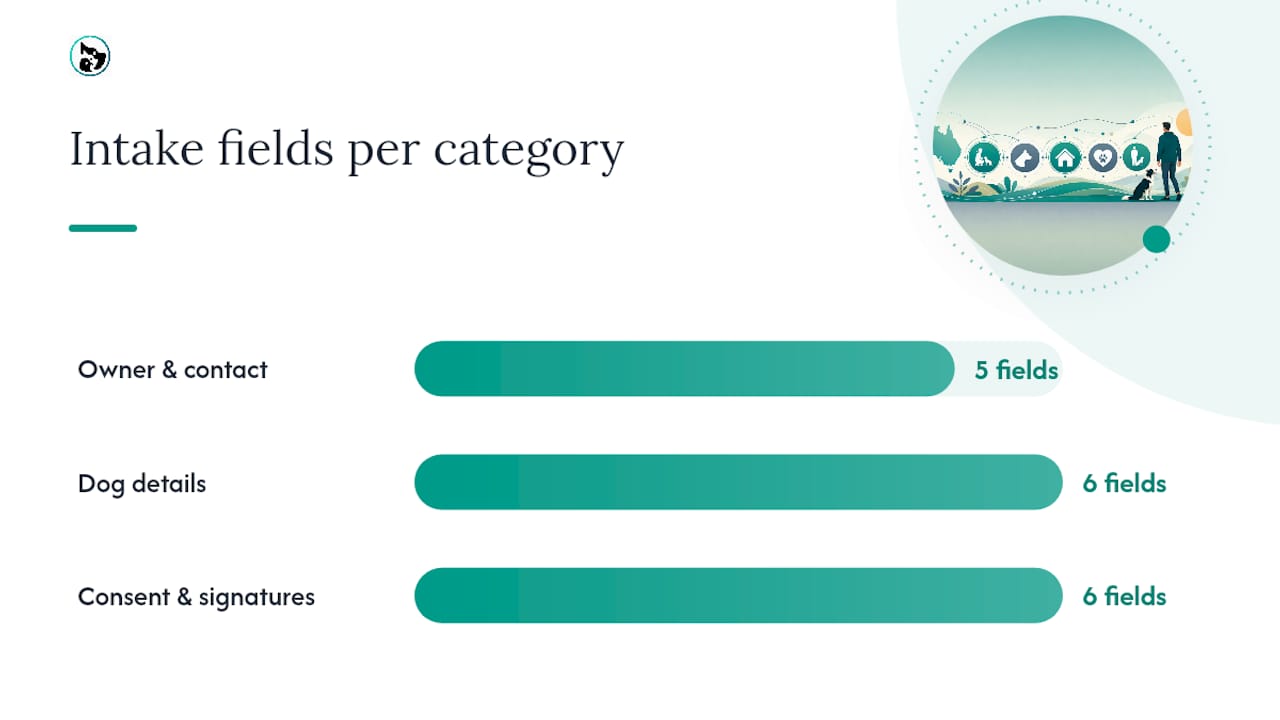
A waiver tied to no identifiable record is almost useless in a dispute. Capture these fields alongside the waiver, either on the same form or in a linked intake document. Practical intake forms for organised classes include explicit fields for emergency treatment consent and venue jurisdiction alongside the standard contact details.
Owner and contact details
| Field | Notes |
|---|---|
| Full legal name | As it appears on ID |
| Phone number | Mobile preferred for reminders |
| Email address | For digital waiver delivery and records |
| Residential address | Required for legal correspondence |
| Emergency contact name and phone | A person other than the owner |
Dog details and declarations
| Field | Notes |
|---|---|
| Dog's name and breed | For session records |
| Age and sex (desexed/entire) | Relevant for behaviour assessment |
| Microchip number | If applicable |
| Vaccination status and date | Request proof; vaccination records matter for group classes |
| Known behavioural issues | Aggression, reactivity, fear responses |
| Medical conditions or medications | Disclose anything affecting training |
Consent and signature fields
| Field | Notes |
|---|---|
| Declaration of fitness | Owner confirms dog is fit to participate |
| Emergency treatment permission | Consent for vet treatment if needed |
| Media consent | Permission to photograph or film sessions |
| Owner signature and date | Mandatory |
| Witness signature and date | Recommended; required for some disputes |
| Document version and date | Track which version was signed |
How enforceable are waivers in Australia?
Waivers are a useful risk-management tool, not a blanket shield. Under the Australian Consumer Law, consumers have statutory guarantees that cannot be excluded, restricted, or modified by contract. A waiver clause that attempts to remove those guarantees is unenforceable to that extent, though a severability clause means the rest of the agreement survives.
Three specific limits apply in Australia:
- Consumer guarantees under the ACL cannot be contracted out of. Services must be provided with due care and skill regardless of what the waiver says.
- Gross negligence and deliberate harm are not protected by any waiver. If a trainer acts recklessly or causes deliberate harm, the release clause will not hold.
- Minors cannot sign on their own behalf. A parent or guardian must sign, and even then, courts may scrutinise whether the guardian had full information.
Practical safeguards that improve enforceability: use plain language, present the waiver before the session (not during), have it witnessed and dated, keep a separate health screening form, and review the document with a solicitor at least once a year as laws evolve.
A well-drafted waiver is not a substitute for insurance. Keep professional liability cover current even when every client has signed. As Pabau's trainer waiver guidance notes, insurance and waivers work together — one does not replace the other.
Pro Tip: Include a severability clause in every version of your waiver. If an ACL challenge strikes down one clause, the rest of the agreement remains intact and still provides meaningful protection.
How do you collect and store signed waivers properly?
A signed waiver you cannot locate is no waiver at all. Here is a practical workflow for small training businesses:
- At booking: Send the waiver and intake form automatically with the booking confirmation. Require completion before the session is confirmed.
- Before the first session: Briefly explain the key clauses in plain language. Clients who understand what they are signing are far more likely to have that consent treated as informed in a dispute.
- Collect the signature: Digital signatures with a timestamp are accepted as valid evidence. Paper signatures should be scanned and stored immediately.
- Save to the client record: Link the signed document to the booking record, not just a general folder. If a dispute arises, you need to show which version the client signed and when.
- Audit annually: Review stored waivers once a year. Confirm the document version matches your current template and that no records are missing.
Paper vs digital: Paper works for walk-in clients and venues without reliable internet, but it creates storage and retrieval problems. Digital collection timestamps the signature, makes retrieval instant, and removes the risk of a form going missing in a filing cabinet. For most trainers, digital is the better choice.
Under the Australian Privacy Principles, personal and health-related data must be stored securely, accessed only by authorised staff, and retained only as long as necessary. Keep signed waivers for at least seven years to cover potential legal claims, then dispose of them securely.
Pro Tip: Integrate waiver collection into your booking software so the system automatically sends the form, tracks completion, and blocks session confirmation until the client has signed. That removes the human error of forgetting to chase a signature.
How do you combine cancellation and refund policies with your waiver?
Most trainers attach their cancellation and refund terms to the same document or send them alongside the waiver at booking. Combining them reduces disputes and means the client has seen everything before money changes hands.
- Cancellation window: "Cancellations made more than 48 hours before a session will receive a full refund or credit. Cancellations within 48 hours will forfeit the session fee."
- No-shows: "Failure to attend without notice forfeits the full session fee. A make-up session may be offered at the trainer's discretion."
- Multi-session packages: "Unused sessions in a package are non-refundable after the programme has commenced, except where required by Australian Consumer Law."
- Class cancellation by the trainer: "If the trainer cancels a session, a full credit or refund will be offered for that session."
Communicate these terms at booking, repeat them in the booking confirmation, and reference them briefly in the waiver itself. Clients who see the policy twice before the first session rarely dispute it afterwards.
What mistakes make a waiver unenforceable?
A waiver that a client cannot understand, was not given time to read, or was asked to sign after an incident has already occurred is unlikely to protect you in any meaningful way. The document is only as strong as the process behind it.
Common red flags that weaken or invalidate a training release form:
- Overly broad language that attempts to exclude all liability for everything, including ACL-protected guarantees. Courts read these clauses narrowly.
- Hidden clauses buried in long terms and conditions that a reasonable person would not notice.
- Post-incident waivers signed after a bite or injury. These are almost always unenforceable.
- A minor signing alone without a parent or guardian signature.
- No signature or date on the document. An unsigned waiver is not a waiver.
- Failing to record vaccination status separately. If a dog bites another animal and you have no vaccination record, your liability exposure increases.
- Not explaining the waiver. Handing a client a form and walking away is not informed consent.
Fix these by shortening clauses, using plain English, requiring guardian sign-off for minors, and keeping a separate intake form for medical and behavioural facts. A waiver is one layer of risk management, not the whole strategy. Pair it with good safety practice, proper insurance, and thorough record-keeping.
Animalbooking's view on waivers and admin
The trainers and pet service providers who get the most out of their waiver process are the ones who have removed the human element from chasing signatures. When a waiver is embedded in the booking flow, clients sign before they even think about skipping it. When it is a separate PDF emailed after the booking, it gets missed, delayed, or lost.
The operational case for integrating waivers into booking software is straightforward: fewer unsigned sessions, cleaner records, and a clear audit trail that links each signed document to a specific booking, date, and client profile. For dog walkers and pet boarding operators, the same principle applies. Consistent intake and consent records protect the business and build client trust simultaneously.
Animalbooking makes waiver collection part of every booking
Running a dog training business means managing sessions, payments, and client records at the same time. Animalbooking brings those together so your dog training agreement process runs without manual follow-up.

With Animalbooking, you can require clients to complete and sign intake forms before a booking is confirmed, send automated pre-session reminders that include waiver links, and store signed documents against each client's booking record in the provider dashboard. Payments and consent happen in the same flow, so nothing falls through the gaps. Setup takes minutes, and the platform is built for Australian pet service providers from the ground up. See the pricing plans and get your waiver collection running before your next session.
Sources
The following documents were used to build the sample wording and clause guidance in this guide. Each is publicly available and worth reading in full before you finalise your own template.
- What's in a Waiver? - Dog Trainer's Umbrella
- Trainer/Instructor Liability Waiver Form (PDF)
- Consent for Participation in a Health and Fitness Training Program (Exercise is Medicine PDF)
This article provides general information only and is not legal advice. For complex situations, multi-site operations, or waivers involving minors, have your document reviewed by a qualified Australian solicitor before use.