
The best no-show policy grooming businesses can run pairs of automated reminders 48 and 24 hours out with a tiered enforcement system: a friendly warning for a first miss, a required deposit after a repeat offence, and booking restrictions beyond that. Fees typically run as a reasonable flat fee or as a percentage of the service price. Every template below is ready to copy, and automation makes enforcement easier to manage.
TL;DR:
- Automated reminders sent 48 and 24 hours before appointments reduce no-shows by up to 80%, especially when paired with a tiered enforcement system.
- Charging fees or deposits is most effective when clients are clearly informed at booking and the policy is built into the booking process, not just in a PDF.
- A three-strike system with friendly, factual messages encourages clients to respect cancellations, with escalation from reminders to booking restrictions.
- Most client no-shows result from forgetfulness, making reminder cadence and visibility more critical than the fee amount itself.
- Implementing an automated, transparent policy can be set up quickly using booking and payment tools, minimizing manual enforcement efforts.
Table of Contents
- Why a clear grooming cancellation policy matters
- Four no-show policy templates you can copy today
- The three-strike system, with exact wording
- Automated reminders: cadence and channels
- Deposits, card on file, and how fees actually get collected
- Getting clients to actually see and accept the policy
- Fair enforcement, exceptions, and what the law expects
- Turning the policy into a working system
- What actually separates a working policy from a wasted one
- Put your policy on autopilot
- Where these figures and templates come from
- Sources
- FAQ
Why a clear grooming cancellation policy matters
Do the maths on a single weekly no-show for a $70 full groom. That's $3,640 a year gone from one recurring gap in the schedule, before you count the staff time already blocked out. Multiply that across a busy salon with three or four groomers and the number gets uncomfortable fast.
Reminders and deposits change that outcome. Grooming businesses that combine automated reminders with a structured, tiered enforcement system report cutting no-shows by 60 to 80% once the system is running consistently. That's not a minor tweak. It's the difference between a schedule that leaks money quietly and one that holds its shape.
A well-written grooming cancellation policy isn't about punishing clients. It sets an expectation upfront, the same way a restaurant reservation or a medical appointment does, so nobody is surprised when a fee applies.
Four no-show policy templates you can copy today
Pick the template that matches how much trust and history you have with your client base, then adjust the numbers to suit your price point.
Gentle (best for new or small salons building loyalty) "We understand life happens. If you need to cancel, please let us know at least 24 hours ahead so we can offer the slot to another pet. First-time no-shows receive a friendly reminder call rather than a fee, but repeated no-shows may require a deposit for future bookings."
Standard (the middle ground most salons should start with) "Cancellations made less than 24 hours before your appointment incur a $20 late-cancel fee. This fee is due before your next booking is confirmed."
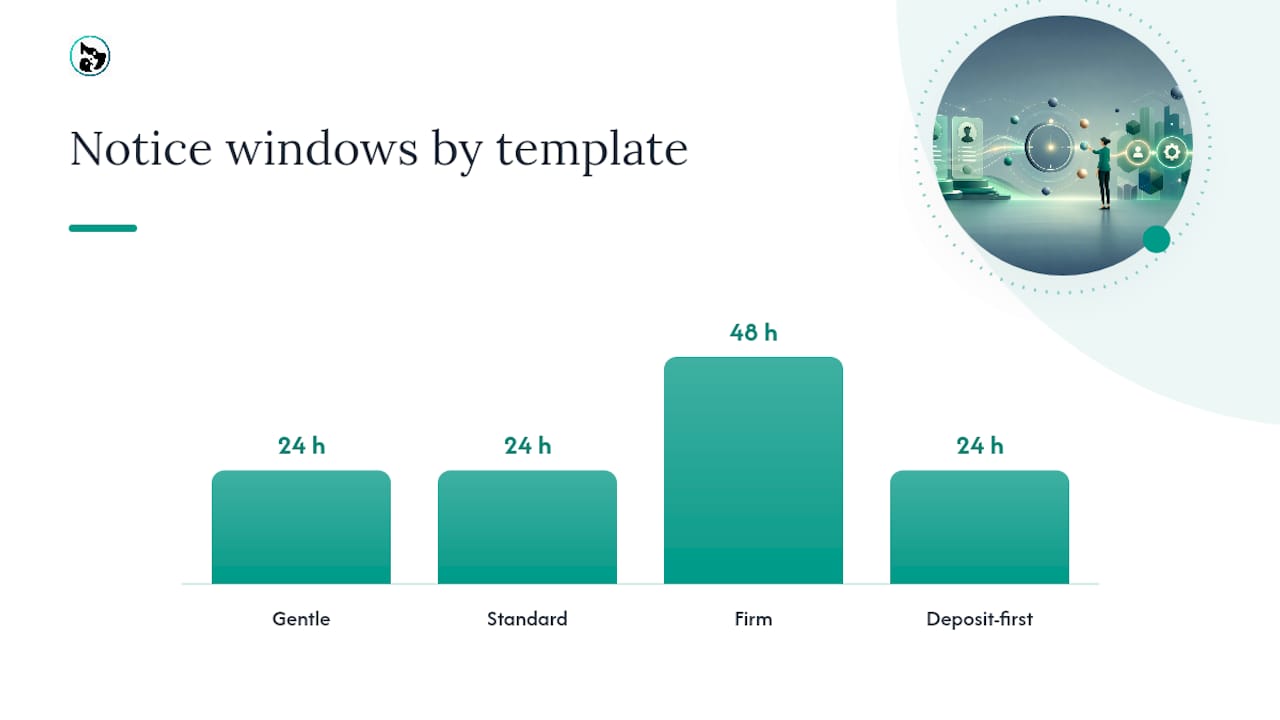
Firm (for busy salons with tight margins) "A valid card is often required to book. Late cancellations with short notice may incur a partial fee. No-shows are commonly charged the full service price to the card on file."
Deposit-first (for high-value services like de-shedding, hand-stripping, or full spa packages) "Bookings over $80 require a non-refundable-if-no-show deposit of $25 to $30 at the time of booking, deducted from your total on the day. Deposits are refunded in full with 24 hours' notice."
| Template | Notice window | Fee structure | Best for |
|---|---|---|---|
| Gentle | 24 hours | Warning first, fee on repeat | New or growing salons |
| Standard | 24 hours | $20 late cancel, $30 no-show | Most established salons |
| Firm | 48 hours | 50% late cancel, 100% no-show | High-demand, low-slack schedules |
| Deposit-first | 24 hours | $25 to $30 deposit, forfeited same-day | High-value or specialty services |
The three-strike system, with exact wording
Tiered enforcement is what separates a policy that's ignored from one that's respected. Here's how the three strikes should operate:
- First strike: A friendly, no-fee reminder. Log the miss but don't charge.
- Second strike: Apply the standard fee and require a card on file or deposit for the next booking.
- Third strike: Restrict future bookings to deposit-paid or prepaid slots only, or decline to rebook.
Sample scripts for each stage:
- First offence (SMS): "Hi [name], we missed you today! No charge this time, just flagging that a heads-up next time helps us keep slots open for everyone."
- Second offence (email): "Hi [name], this is your second missed appointment. As outlined in our booking terms, a $30 no-show fee has been applied. A deposit will be required to secure your next booking."
- Third offence (SMS): "Hi [name], due to repeated missed appointments, future bookings will require prepayment. Please contact us to discuss rebooking."
Keep every message factual and calm. Disputes escalate when staff sound accusatory, not when the policy itself is firm.
Automated reminders: cadence and channels
Most no-shows aren't defiance, they're forgetfulness. A reminder sent at the right time fixes that before it becomes a billing argument.
- 48 hours before: A confirmation message asking the client to reply "yes" to confirm or "cancel" to release the slot.
- 24 hours before: A shorter follow-up reminder, same confirm/cancel structure.
- 2 hours before (optional): Reserve this for clients with a prior late-cancel or no-show on file.
SMS has the highest open rate for time-sensitive reminders and works even when a client doesn't check email. Email is a useful backup for the original confirmation and receipt trail. Some salons add WhatsApp appointment reminders for clients who prefer messaging apps over standard texts, particularly for mobile grooming services with international or younger clientele.
Pro Tip: Set your 24-hour reminder to double as the last chance to cancel without penalty. It saves you the awkward conversation of charging someone who genuinely forgot to reply to the 48-hour message.
Deposits, card on file, and how fees actually get collected
A policy is only as strong as your ability to collect on it. That means deciding upfront who needs to pay before they book, not after they miss.
- Require a deposit or card on file for: new clients with no booking history, services over $80, and anyone with a prior late cancellation or no-show.
- Refund rules: return the deposit in full if the client cancels 24 hours or more ahead; forfeit it for same-day cancellations or no-shows.
- Collection method: a validated card through a secure payment processor is the only version of this that actually holds up. Business guidance consistently points to card validation at booking as the foundation that makes fee enforcement realistic rather than theoretical.
Skip the deposit step for long-standing clients with a clean record. Reserving it for higher-risk bookings keeps the policy feeling fair rather than blanket punitive, and it's easier to enforce through a system like Animalbooking's payment tools than by chasing invoices manually.
Getting clients to actually see and accept the policy
A policy nobody reads is a policy nobody follows. Put it in front of clients at every touchpoint, not buried in a footer somewhere.
- Booking confirmation: include a one-line summary of the notice window and fee.
- Website page: a dedicated policy page linked from your booking button.
- Booking checkbox: "I understand that cancellations under 24 hours or no-shows may incur a fee as outlined in the salon's cancellation policy."
- Reception signage: a short, visible reminder near the front desk or check-in table.
If a client disputes a charge in person, stay calm and point to the exact wording they agreed to at booking. That single sentence in the checkbox does more legal and practical heavy lifting than a long paragraph nobody reads.
Fair enforcement, exceptions, and what the law expects
Genuine emergencies deserve discretion. Waiving a fee for a client with a documented vet emergency or a family crisis costs you less than the client relationship is worth, and most salons apply this rule sparingly rather than as a default.
- Keep records: timestamps on reminders sent, message logs showing confirmation replies, and card-validation receipts.
- Apply the policy consistently across similar situations so no client can reasonably claim unfair treatment.
- Communicate before charging, not after, whenever discretion is involved.
On the legal side, the ACCC's guidance on customer service makes clear that fair contract terms need to be transparent and agreed upfront. A no-show fee is far more defensible when it was clearly stated and accepted at the time of booking than when it's sprung on a client after the fact. That single principle, agreement before service, is the backbone of every enforceable grooming booking terms document.
Turning the policy into a working system
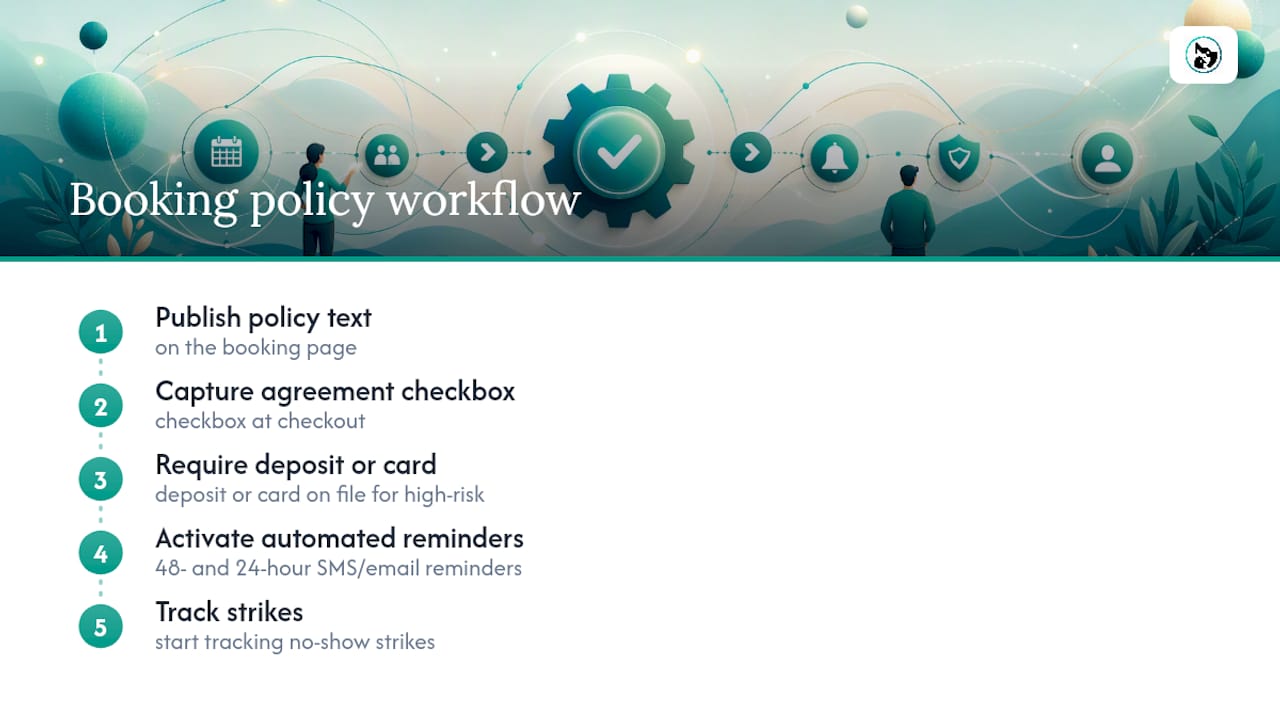
A policy on paper does nothing until it's built into how bookings actually happen. The sequence that works: publish the policy text on your booking page, capture agreement through a checkbox at checkout, require a deposit or card on file for higher-risk bookings, switch on automated 48 and 24 hour reminders, then start tracking strikes.
Groomers using Animalbooking's dog grooming tools typically set this up in one sitting rather than across weeks of manual admin. The platform's automated reminder feature handles the SMS and email cadence without you touching a spreadsheet.
If you're documenting intake alongside your cancellation terms, a grooming release form covers the other half of client agreement, health disclosures and service consent, worth pairing with your no-show wording at first booking.
What actually separates a working policy from a wasted one
Most grooming businesses already have a cancellation policy of some kind. The problem isn't the wording, it's that it lives in a PDF nobody looks at and gets enforced only when someone's frustrated enough to bring it up. That's backwards. The policy should do its work silently, through reminders and booking-flow checkboxes, long before a fee conversation ever needs to happen.
The conventional advice tends to over-focus on the fee amount, as though picking between $25 and $35 is the decision that matters. It isn't. The real lever is the reminder cadence and whether the policy is visible at the exact moment someone books. A salon charging $30 with no reminder system will always underperform one charging $20 with automated 48 and 24 hour texts, because most no-shows are forgetfulness, not defiance.
If you take one thing from this, prioritise the confirm-or-cancel reminder flow before you touch fee structure. Get that right, and you'll find you rarely need to enforce the fee at all, which is really the whole point of having one.
— AnimalBooking
Put your policy on autopilot
A written policy only earns its keep once it's built into your booking flow, not sitting in a document clients never open. Animalbooking connects each piece discussed here directly to your calendar: automated reminders reduce the accidental no-shows, card-on-file and deposit tools give you a real way to collect the fees you've set, and a branded booking website captures client agreement to your terms the moment they book.
Setting it up doesn't require a developer or a week of admin. Groomers typically go live with online booking and auto reminders in a single sitting, checkbox, deposit rules, and reminder cadence included. If you're ready to stop chasing no-shows manually, start a free trial and have your policy enforcing itself by the end of the week.
Where these figures and templates come from
- Woof Spark's grooming no-show policy guide, including the three-strike enforcement model
- Square's salon cancellation policy templates
- Acuity Scheduling's cancellation policy templates
Sources
- Dog Grooming No-Show Policy: Templates + How to Actually Enforce It – Woof Spark
- Salon booking and cancellation policy templates and examples | Square
- Cancellation policy templates | Acuity Scheduling
FAQ
What Is a Good Cancellation Policy for Pet Grooming?
A good policy requires 24 to 48 hours' notice, charges a flat fee ($20 to $30) or a percentage for late cancellations and no-shows, and applies consequences through a tiered system rather than a blanket fee for every miss.
Is Not Getting Your Dog Groomed Neglect?
No. Skipping or rescheduling a grooming appointment isn't neglect on its own, though prolonged lack of grooming can lead to matting, skin issues, or overgrown nails that affect welfare, which is a separate concern from a missed booking.
Can You Give an Example of a Salon Cancellation Policy?
Yes: "Cancellations under 24 hours incur a $20 fee. Repeat no-shows require a deposit or card on file for future bookings."
What Are the Guidelines for a Grooming No-Show Policy?
Set a clear notice window, put the fee and terms in writing at booking, use automated reminders to reduce accidental misses, and apply enforcement consistently through a tiered warning system rather than an immediate maximum fee.