
The fastest way to raise grooming revenue is to combine a confident price review with strategies that lift the average ticket, such as add-ons, retail and memberships, then plug the leaks caused by no-shows and slow scheduling. A $10 price increase across 20 dogs a week adds up over a year, and small per-appointment uplifts compound into large annual gains. The rest of this guide breaks each lever down into steps you can run this month.
TL;DR:
- Raising prices confidently by assessing true cost and structuring communication can generate significant annual revenue increases from just a $10 per-appointment hike.
- Implementing a three-touch approach for add-ons and upsells, combined with staff training, boosts average order value without adding much time per dog.
- Retail sales, if strategically placed and tied to the groom, can add up to 60% profit margins with minimal effort during checkout.
- Subscription memberships and prepaid packs help stabilize income and improve cash flow, especially when launched with simple terms and pilot testing.
- Optimizing workflow through batching, equipment upgrades, and automation can increase daily dog capacity without extra staff hours, improving hourly revenue.
Table of Contents
- Review your prices and raise them with confidence
- Increase revenue per appointment with add-ons, upsells and premium packages
- Turn checkout into a retail opportunity
- Build recurring revenue with memberships and prepaid packs
- Tighten your workflow so more dogs fit in the same day
- Stop no-shows and last-minute cancellations from eating your day
- Price fairly for matted coats and difficult handling
- Track the numbers that tell you if it's working
- Why offers and operations have to move together
- How Animal Booking helps you capture this without extra admin
- Sources
- FAQ
Review your prices and raise them with confidence
Most groomers underprice because they set fees once, early on, and never revisit them as costs rise. Start by working out your true cost per groom: add up your time (including drying and prep, not just clipping), consumables like shampoo and blades, and a share of fixed overheads such as rent, insurance and equipment depreciation. Divide that by the number of grooms you complete in a week to get a per-dog cost, then set your price to leave a margin that actually covers slow weeks and equipment replacement, not just today's takings.

Inflation doesn't skip grooming. Consumable costs, wages and rent move with the broader economy, and Australia's Consumer Price Index is the reference point most business owners use to judge whether their prices have kept pace. If you haven't reviewed prices in over a year, you're very likely under the market rate already.
When you do raise prices, structure the conversation instead of apologising for it:
- Give existing clients four to six weeks' notice by text or email before the new price takes effect.
- Frame the increase around quality and consistency, not cost pressure: "we're updating our pricing to reflect the time and care each groom takes."
- Offer tiered pricing by coat type, size and condition rather than one flat fee, so heavier work is priced fairly without penalising easy bookings.
- Keep a published price list for standard services and reserve quotes for anything with matting, aggression risk or unusual coat length.
A $10 uplift across common per-appointment price increases compounds fast: at 20 dogs a week, that's an extra $200 a week, or roughly $10,400 a year, from a single price adjustment with no extra labour.
Increase revenue per appointment with add-ons, upsells and premium packages
Raising average ticket is usually easier than chasing new clients, because you're selling to someone who's already in the chair. The trick is presenting extras as improvements to the dog's experience, not as a sales pitch tacked onto checkout.
Good add-ons take little extra time but carry solid margin: teeth cleaning, nail grinding instead of clipping, de-shedding treatments, paw balm, blueberry facials and flea and tick treatments. None of these add more than a few minutes per dog, and most clients will say yes when the benefit is explained clearly.
A three-touch sequence gets the best take-up:
- At booking, ask if the dog has any specific needs (itchy skin, matting, long nails) and suggest the relevant add-on as a solution, not an upsell.
- Mid-groom, if you spot something (ear wax, early matting, dry skin), message or call the owner and offer a fix before you finish the job.
- At checkout, recommend a retail product tied to what you just treated, and offer to pre-book the next appointment at a small discount.
Pro Tip: Train staff to say "I noticed" rather than "would you like", since observations read as care while offers read as sales.
A three-touch upsell framework that's scripted, measured and practised consistently lifts take rates, and staff training tends to be the biggest multiplier. Track two numbers weekly: take rate (the percentage of appointments that include at least one add-on) and average order value.
Turn checkout into a retail opportunity
Retail is one of the simplest ways to add margin to a visit you're already running, because the client is standing at the counter with their dog looking and smelling fantastic.
Stock a tight range rather than a wide one: a shampoo and conditioner matched to coat type, a detangling spray, a paw balm, dental chews and a couple of seasonal items like flea guards in warmer months. Markups of 40 to 60% are typical for pet retail, so a $15 bottle of shampoo bought at $9 wholesale still leaves healthy margin without pricing out the client.
- Place products where the client collects the dog, not buried on a shelf near the door.
- Tie every recommendation to what you just did: "his coat was quite dry, this conditioner is what I used today."
- Rotate seasonal stock (cooling sprays in summer, moisturising balms in winter) to keep the display feeling current.
- Keep a simple reorder trigger, such as restocking when a line drops to two units, so you're never caught out at pickup.
Suggest, don't push. A single sentence tied to an observed problem outsells a shelf full of products nobody explains.
Build recurring revenue with memberships and prepaid packs
One-off bookings are unpredictable. Memberships and prepaid packs smooth that out and give you cash in the bank before the work happens.
A few structures work well for grooming businesses:
- Monthly VIP membership: a flat monthly fee that includes one groom plus priority booking and a small retail discount.
- 5 or 6-pack prepaid bundles: sold at a small discount to the per-visit price, paid upfront, which improves cashflow and locks in repeat visits.
- Priority booking tiers: clients pay a premium to get first access to preferred time slots, which is valuable for owners who groom around work schedules.
A simple example: if a single groom is $70 and you sell a six-pack for $390 (a $30 discount), you've collected $390 upfront instead of waiting for six separate visits, and the client is committed to coming back six times instead of shopping around after one.
Launch memberships as a pilot with a capped number of slots, a plain one-page terms sheet, and a simple sign-up form rather than a complicated portal. Once the model proves itself with a small group, proven retention tactics such as loyalty perks and renewal reminders help keep the pack renewing instead of lapsing. Memberships also flatten seasonality, since members keep booking through slow months when walk-in demand drops.
Tighten your workflow so more dogs fit in the same day
Revenue per hour matters as much as revenue per dog. If your schedule has gaps between appointments, or your equipment is slowing you down, you're leaving money on the table every single day.
Start with the calendar. Batch similar-sized dogs or similar services together to reduce the mental and physical switching between a quick nail trim and a full de-shed. Build buffer time only where you actually need it (heavy coats, anxious dogs), not as a blanket rule that wastes capacity on easy jobs.

Equipment upgrades pay for themselves faster than most owners expect. A high-velocity dryer that cuts drying time from 40 minutes to 15 minutes on a medium coat effectively frees up nearly half an hour per dog, which over a full day can mean one or two extra bookings. A hydraulic table that reduces strain and setup time contributes the same way over months rather than days. Work out payback with a simple calculation: cost of the equipment divided by the extra revenue it enables per week.
Automation removes admin load without cutting corners. Booking software that handles automated reminders, intake forms and prepayment collection saves the hours otherwise spent on phone tag and chasing no-shows.
- Set short SOPs for each service so any staff member delivers a consistent result, protecting quality as volume increases.
- Track a simple KPI: dogs completed per groomer per day, and watch it rise as batching and equipment fixes take hold.
Faster drying and tighter batching can meaningfully lift the number of dogs completed per day without adding staff hours, according to industry guidance on scheduling and software efficiency, which points to scheduling and software improvements as some of the more sustainable profit levers available to salons.
Stop no-shows and last-minute cancellations from eating your day
A no-show doesn't just cost the missed booking, it costs the slot you could have filled with someone else. Deposits and reminders are the two most direct fixes.
- Require a deposit or card-on-file for new clients and any booking over a set value, typically 20 to 50% of the service price, since new clients are the highest no-show risk.
- Send automated reminders on a fixed schedule, such as 48 hours and again 3 hours before the appointment, by text and email, so clients have no excuse to forget.
- Set a clear cancellation window, commonly 24 to 48 hours, after which a fee applies, and state it plainly at booking rather than burying it in fine print.
- Charge a no-show fee equal to a meaningful portion of the service price, communicated at the time of booking so it never feels like a surprise.
- Handle disputes calmly: offer a partial refund or credit for genuine emergencies, and keep a simple written record of the policy the client agreed to.
Comparing deposits against full prepayments is worth doing early, since prepayment removes almost all no-show risk but suits recurring clients better than first-time bookers.
Price fairly for matted coats and difficult handling
Not every dog costs the same to groom, and pretending otherwise means your easy bookings are subsidising your hardest ones. Condition surcharges protect your time and your body.
- Charge a de-matting surcharge, typically $20 to $80 depending on severity, rather than absorbing hours of extra brushing into a standard price.
- Add a handling surcharge for dogs that need extra restraint, breaks or a second groomer present.
- Use intake photos and a simple consent form so the client sees the coat condition before work starts, avoiding disputes at pickup.
- State surcharges clearly at booking and confirm them again at drop-off, so nothing is a surprise on the invoice.
- Refuse work that risks injury to the dog or the groomer, such as severe matting close to the skin or aggressive behaviour beyond what your team can safely manage.
Clear, published surcharge ranges are a standard part of professional service terms in the pet care industry, and stating them upfront avoids the awkward pricing conversation happening after the work is already done.
Track the numbers that tell you if it's working
None of the above matters if you can't see whether it's moving the needle. A handful of numbers, checked weekly, tell you almost everything.
- Revenue per visit: total takings divided by number of appointments, tracked weekly to spot the effect of price changes or upsells.
- Average ticket: base groom price plus add-ons and retail, per appointment.
- Utilisation: dogs completed per groomer per day against your practical daily capacity.
- Gross and net margin: what's left after consumables and overheads, checked monthly rather than daily.
A simple spreadsheet with one row per day and columns for bookings, revenue, add-on sales and no-shows is enough to start. Move to dedicated accounting software or a bookkeeper once you're tracking payroll, GST and multiple staff, since manual reconciliation at that stage becomes a bigger time cost than the fee.
Testing a price change on a small group of bookings before rolling it out salon-wide is standard practice among groomers watching margins closely, and it's a cheap way to confirm a change works before committing to it across every client, an approach industry guides point to repeatedly when discussing sustainable revenue growth.
Why offers and operations have to move together
Chasing more bookings without fixing pricing, upsells or no-shows just means working harder for the same margin. The groomers who see real revenue growth pair a price review with an average-ticket strategy, then protect both with fewer no-shows and tighter scheduling. One lever alone stalls, but stacked together they compound.
A rough 90-day plan: in month one, review pricing and launch one add-on sequence. In month two, add a retail line and pilot a small membership group. In month three, tighten your booking policies and start tracking the KPIs above weekly. Each step should build on the last, not replace it.
Profit-first grooming isn't about doing more, it's about capturing the value you're already creating.
— AnimalBooking
How Animal Booking helps you capture this without extra admin
Every strategy above works better when the admin behind it runs itself. A booking platform built specifically for pet service providers, including dog groomers, can handle the operational side of revenue growth: deposits and prepayments, automated reminders, a customer CRM to track repeat clients, and a branded booking website you can launch on your own domain in minutes.
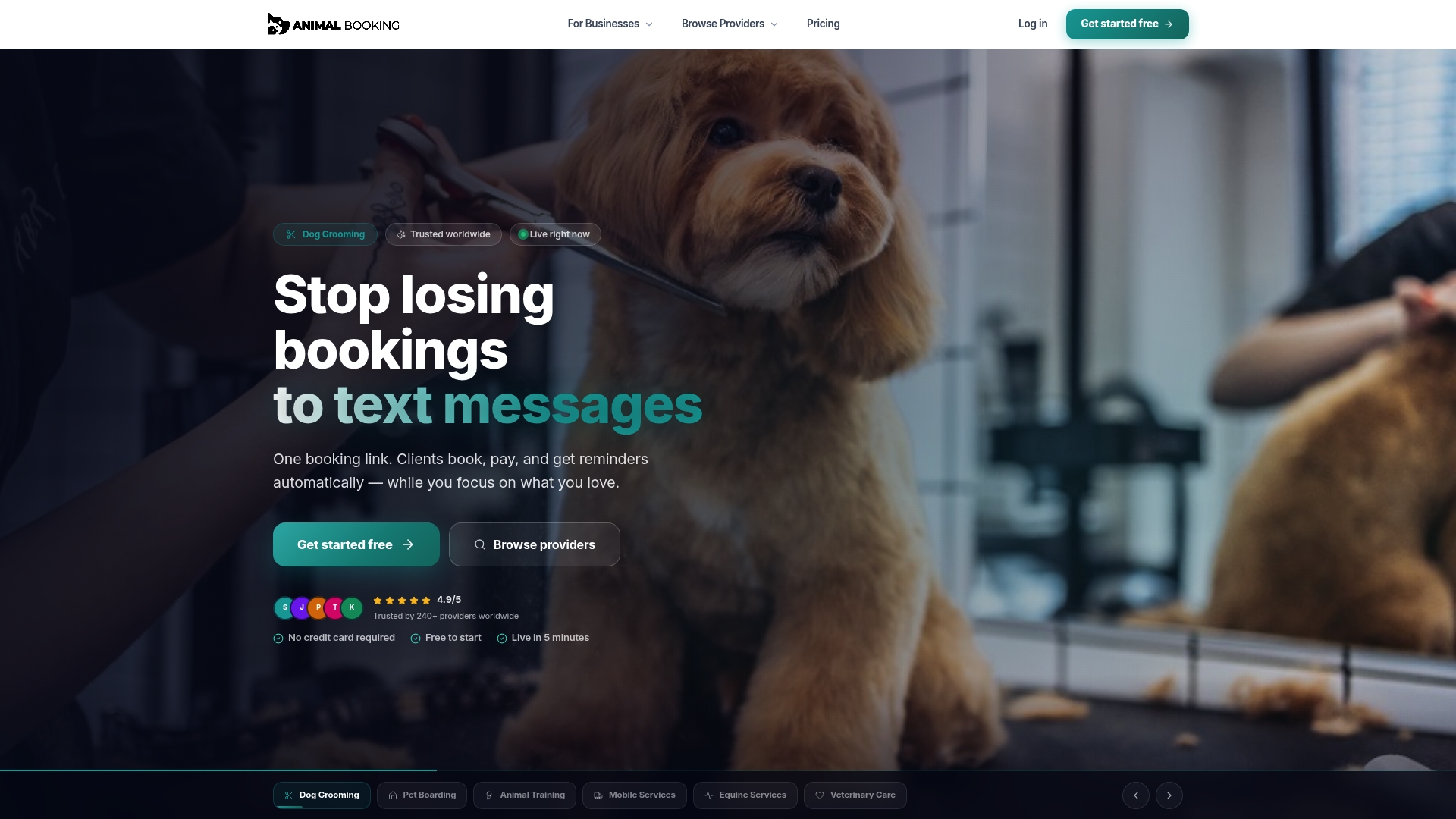
- Deposits and payments: collect deposits or full prepayment at booking to remove no-show risk before it happens.
- Automated reminders: reduce missed appointments without anyone on your team chasing a phone.
- Customer CRM: keep notes on coat condition, add-on history and preferences so upsells feel personal, not scripted.
- Booking website: give clients a simple way to book, pay deposits and rebook after checkout.
Plans start with a free Starter tier, with Independent, Teams and Pro tiers available on the pricing page from $49 a month. If deposits, reminders and prepayment sound like the missing piece in your revenue plan, the pricing page is the place to start.
Sources
- Australian Bureau of Statistics — Consumer price index, Australia: latest release
- Is a dog grooming business profitable in Australia? — WoofSpark
- How to increase grooming salon revenue — Groomica
FAQ
Are grooming shops profitable?
Grooming businesses can be profitable, with margins varying widely by model. Home-based groomers often see 60 to 75% margins, mobile groomers 45 to 65%, and salons with staff 15 to 30% net margins, largely because overheads scale up with each model.
How do I get more clients for dog grooming?
Consistent add-on and retail offers, a strong referral ask at checkout, and reliable online booking all help attract and keep clients. Local search visibility, before-and-after photos on social media, and a simple referral discount for existing clients tend to bring in steady new bookings without heavy ad spend.
How much does a dog groomer make in Australia?
Groomer earnings vary by business model, location and client volume, and there is no single published figure that applies across the industry. Margins differ significantly between home-based, mobile and salon setups, so income depends heavily on which model a groomer runs and how many dogs they see per week.
Which pet business is most profitable?
Profitability depends on overheads as much as service type, with home-based grooming often showing the highest margins because it avoids the rent and staffing costs of a salon. Margins in Australia typically range from 60 to 75% for home-based setups down to 15 to 30% for staffed salons, so the leaner the overhead, the higher the margin tends to be.