

A client retention strategy is a deliberate set of actions that keeps existing clients buying by making your value obvious, before they ever start weighing up whether to leave. It is not a loyalty card or a discount code. It is a system of visible, repeated proof that working with you still beats the alternative.
If you only take three things from this article, take these. First, tier your clients this week by revenue and risk, not by how much you like them. Second, book a first 90-day onboarding sequence for every new client so the relationship starts on rails, not on hope. Third, pick one measurable KPI, retention rate is the simplest, and start tracking it before you touch a single tactic.
- Tier your active client list into three groups: high-value, growth-potential and at-risk, before Friday.
- Draft a 90-day onboarding sequence with three checkpoints: week one, day 30, day 90.
- Choose one KPI (retention rate or churn rate) and log this month's baseline number today.
Pro Tip: Book a 15-minute "value review" call with your highest-revenue client this week. Ask one question: "What's the single result you'd point to from working with us?" Their answer tells you exactly what to make more visible to everyone else.
Businesses that improve retention even slightly tend to see outsized profit gains, because retained customers cost less to serve and buy more over time. That single fact is the entire business case for everything below.
Table of Contents
- Why client retention matters to your profit, growth and predictability
- Core principles that underpin every effective client retention strategy
- Proven client retention strategies with practical how-to steps
- A six-step framework to design and roll out your client retention plan
- How to measure retention: KPIs, formulas and tools you can use
- Example: how automated bookings and reminders reduce churn for appointment businesses
- Common retention mistakes and early red flags to watch for
- Why systems and rituals beat ad hoc goodwill
- How Animal Booking helps appointment-based businesses keep clients
- Key takeaways: what to start, measure and review this quarter
- Frequently asked questions
- Sources
Why client retention matters to your profit, growth and predictability
Retention rate measures the percentage of clients you keep over a set period. The formula is straightforward: (clients at end of period minus new clients acquired) divided by clients at start of period, multiplied by 100. Churn rate is the mirror image, the percentage of clients who left in that same window. If you started the quarter with 100 clients, gained 15, and ended with 105, you lost 10, giving you a churn rate of 10% and a retention rate of 90%.
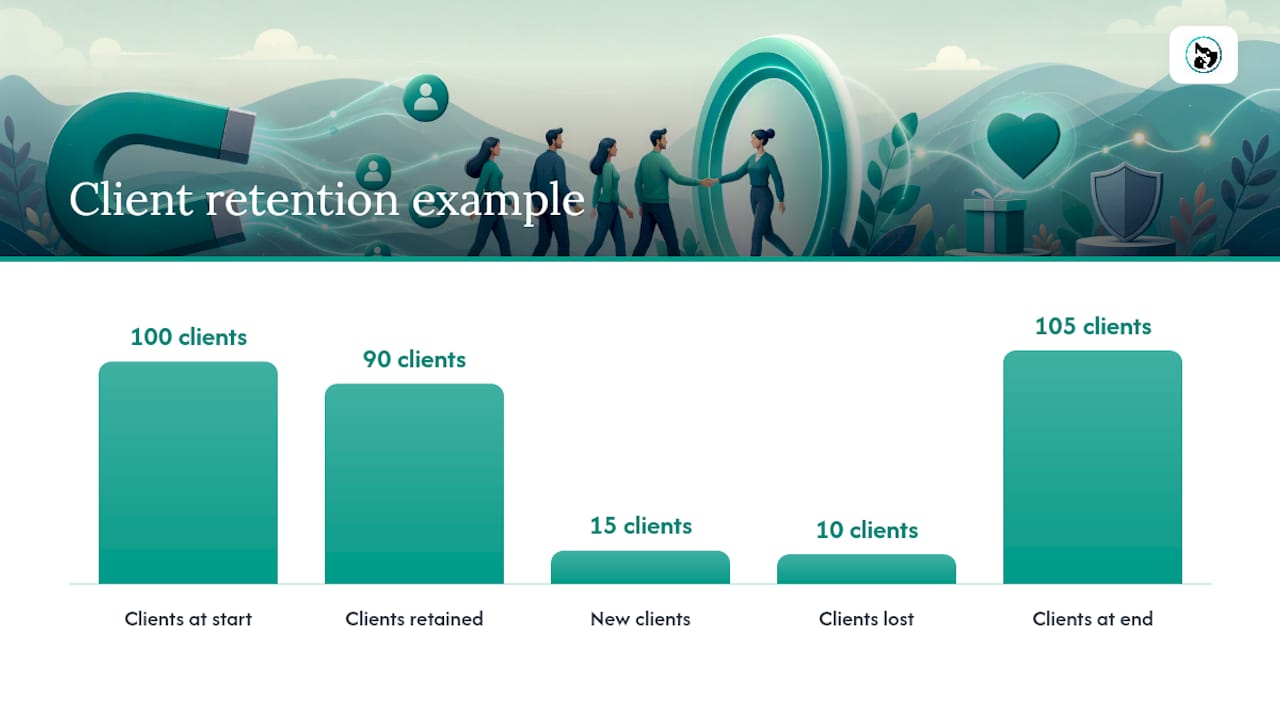
Customer lifetime value (CLV) is what makes those percentages matter financially. CLV estimates the total revenue a client generates over the life of the relationship, typically calculated as average purchase value multiplied by purchase frequency multiplied by average client lifespan. A grooming business charging $70 per visit, seeing a client eight times a year, over an average three-year relationship, has a CLV of $1,680 per client. Lose that client in year one instead of year three, and you have destroyed two thirds of that value before you even had a chance to earn it back through referrals.
Here's the calculation that should worry every business owner more than it does: acquiring a new client typically costs far more than keeping an existing one, so a small lift in retention has a disproportionate effect on profit. Improving retention by a few percentage points on a base of 200 clients worth $1,680 each in lifetime value protects a substantial amount of revenue that would otherwise have walked out the door, without spending a cent on new-client marketing to replace it.
| Metric | What it tells you |
|---|---|
| Retention rate | Percentage of clients kept over a period; the headline health check. |
| Churn rate | Percentage of clients lost; the inverse of retention, useful for spotting trends early. |
| Customer lifetime value | Total revenue expected from one client over the full relationship. |
| Referral rate | Share of new business coming from existing clients, a proxy for satisfaction. |
Beyond the direct maths, retained clients bring second-order benefits that rarely make it into a spreadsheet:
- Higher margin, because you spend less on marketing and sales per dollar of revenue.
- Easier scaling, because a predictable client base makes staffing and cash flow forecasting simpler.
- More referrals, because satisfied long-term clients talk about you unprompted.
- Lower revenue volatility, because you are not rebuilding your client base from zero every quarter.
Core principles that underpin every effective client retention strategy
Every tactic in this article rests on four principles. Skip them, and the tactics become busywork.
Make value visible. Clients rarely leave because your work got worse. They leave because they stopped noticing it was good. Value drift, the slow fade of a client's awareness of your results, happens quietly, and by the time you notice, the client has already mentally started shopping around.

Be proactive, not reactive. Contacting a client only when something goes wrong trains them to associate you with problems. Proactive contact and visible outcomes are core levers for small service businesses, and they cost almost nothing beyond a calendar reminder.
Segment by value and behaviour, not gut feel. A client spending $200 a month and one spending $2,000 a month need different levels of attention. Client segmentation grouping your service tiers around revenue and engagement patterns, rather than treating everyone identically, is what makes the rest of this framework affordable to run.
Instrument the relationship with measurable rituals. A quarterly business review isn't a nice-to-have meeting, it's a scheduled checkpoint that forces both sides to confront the data. Structured conversations like QBRs and value reviews are the highest-leverage retention rituals for services firms.
One‑size‑fits‑all communication fails for a simple reason: in most B2B and professional-service relationships, you're not managing one contact, you're managing several stakeholders with different priorities. Losing your one champion inside an account can trigger fast, unexpected churn, so spreading relationship-building across two or three people in the account is cheap insurance against a single resignation letter costing you the contract.
Pro Tip: Value drift is easier to prevent than to reverse. A one-page, five-minute value recap sent every fortnight, three bullet points of what you delivered and the result it produced, keeps outcomes front of mind between the big formal reviews, and it costs you almost nothing to produce.
Proven client retention strategies with practical how-to steps
These are ranked roughly by impact-to-effort ratio, not alphabetically. Start at the top.
-
Structured onboarding. What it does: sets expectations and delivers an early win before doubt has a chance to creep in. When to use it: every new client, no exceptions. First step: build a three-touchpoint sequence (welcome call, day-30 check-in, day-90 review). KPI to watch: 90-day retention rate for new clients versus your overall rate.
-
Quarterly business reviews (or value reviews for smaller accounts). What it does: forces a documented conversation about outcomes, not just deliverables. When to use it: any relationship worth more than a token slice of your revenue. First step: draft a one-page template covering results, upcoming priorities, and one open question for the client. KPI to watch: percentage of high-value accounts with a completed review each quarter.
-
Proactive outreach triggered by behaviour. What it does: catches disengagement while it's still reversible. When to use it: anywhere you can observe booking frequency, login activity, or response times slipping. First step: set a rule, no contact in 45 days triggers a check-in call. KPI to watch: reactivation rate after outreach.
-
Loyalty and perks that drive behaviour, not just discounts. What it does: rewards the actions you actually want repeated. Newer loyalty programs lean on gamified mechanics and exclusive access rather than pure discounting, because a badge or early-access perk changes behaviour without eroding your margin the way a permanent 15% discount does. When to use it: high-frequency service businesses (grooming, boarding, recurring bookings). First step: pick one behaviour to reward, like booking three weeks in advance, and build a simple perk around it. KPI to watch: repeat booking frequency.
-
Personalised re-engagement sequences. What it does: nudges lapsed clients back with context, not generic blasts. When to use it: any client past their usual rebooking window. First step: segment lapsed clients by service type and send a message referencing their last visit specifically. KPI to watch: reactivation rate by segment.
-
Community and content. What it does: keeps your brand present between transactions. When to use it: consumer-facing services with a broad client base. First step: a simple monthly email with one genuinely useful tip, not a sales pitch. KPI to watch: open and click rates as a proxy for engagement.
-
Friction-free billing and payments. What it does: removes one of the most common, and most avoidable, reasons clients quietly disengage. When to use it: always. First step: audit your current payment process for steps that could be removed. KPI to watch: late-payment rate and payment-related support tickets.
-
AI-enabled early-warning systems. What it does: flags hesitation before a client consciously decides to leave. Real-time AI agents can read behavioural signals, like a booking abandoned halfway or a delayed response, and trigger a context-aware intervention while the decision is still reversible. When to use it: businesses with enough transaction volume to generate meaningful behavioural data. First step: identify one behavioural signal (missed rebooking, unopened reminder) worth automating a response to. KPI to watch: intervention success rate.
A quick word on discounting: it works once. Clients trained to expect a discount to stay will ask for one every time renewal comes up, and you'll have taught them that your price is negotiable rather than that your value is real. Use perks and access, not price cuts, as your default lever.
A six-step framework to design and roll out your client retention plan
Turning the list above into a functioning system takes structure. Here is the sequence that works, in order.
- Baseline your metrics. Calculate your current retention rate, churn rate and CLV before changing anything. You cannot prove improvement without a starting point.
- Segment your client base. Split clients into tiers by revenue and engagement, high-value, growth-potential, and at-risk, so you know where to spend limited attention.
- Design retention rituals per tier. High-value clients get quarterly reviews and a named point of contact. Mid-tier clients get automated check-ins and a lighter-touch value recap. Lower-tier clients get reliable service and a good re-engagement sequence when they lapse.
- Run quick pilots. Test one ritual with a small group, say ten high-value clients, before rolling it out to your entire book. Four to six weeks is usually enough to see a signal.
- Build the measurement loop. Review your KPIs monthly for the first quarter, then quarterly once the system stabilises.
- Assign governance and resourcing. Decide who owns retention as a job, not an afterthought squeezed between other tasks.
For your first 30 to 90 days, keep the checklist simple:
- Days 1 to 30: baseline metrics, build client tiers, draft your onboarding sequence.
- Days 31 to 60: pilot the QBR or value-review template with five to ten top accounts.
- Days 61 to 90: review pilot results, refine the template, extend it to the next tier down.
Prioritise tactics by cost and impact rather than novelty. Friction-free billing and structured onboarding are cheap and high-impact, do those first. AI-enabled early-warning systems are higher-impact but need volume and data maturity, so they belong later on the roadmap. For high-touch clients, budget real staff time, a named account owner spending even 30 minutes a week per top account, rather than assuming automation alone will hold the relationship together. A small business operations kit can help standardise how onboarding and check-ins get delegated once you're managing this across more than a handful of staff.
How to measure retention: KPIs, formulas and tools you can use
You need a small, consistent set of numbers, reported on a rhythm you'll actually stick to.
| Metric | Formula | Typical use case | Reporting frequency |
|---|---|---|---|
| Retention rate | (Clients at end minus new clients) ÷ clients at start × 100 | Overall health check across the whole book | Monthly or quarterly |
| Churn rate | Clients lost ÷ clients at start × 100 | Early warning trend, inverse of retention | Monthly |
| Customer lifetime value | Average purchase value × purchase frequency × average lifespan | Prioritising which accounts deserve high-touch attention | Quarterly or annually |
| Net revenue retention | (Starting revenue + expansions − contractions − churn) ÷ starting revenue × 100 | Tracking whether existing clients are spending more or less over time | Quarterly |
| Logo retention | Number of clients retained ÷ number of clients at start × 100 | Distinguishing client-count churn from revenue churn | Quarterly |
| NPS / CSAT | Survey-based score, typically a numeric scale | Gauging sentiment before it shows up in the numbers | Quarterly or after major milestones |
For tools, you don't need an enterprise stack to start. A CRM (client relationship management) system captures contact history and segmentation. Booking and payments platforms give you behavioural data, missed appointments, late payments, rebooking gaps, that double as early-warning signals. Analytics tools track engagement trends over time, and dedicated customer success platforms exist for larger B2B operations managing dozens of enterprise accounts. For appointment-based businesses specifically, a customer CRM built into your booking system means you're not maintaining retention data in one place and booking data in another.
Example: how automated bookings and reminders reduce churn for appointment businesses
Picture a mobile dog grooming business running on text messages and a paper diary. Roughly one in five appointments either no-shows or gets cancelled at the last minute, and the owner has no systematic way of knowing which clients are drifting toward leaving until they've already booked with someone else.
The measurable outcomes to expect from this kind of setup:
- Appointment recovery. Fewer no-shows because clients are reminded at the moment they're most likely to forget, not the morning of.
- Rebooking rate. A higher share of clients book their next appointment before they leave the premises, rather than "when I get around to it."
- Revenue per client. Fewer gaps between visits means more visits per client per year, which compounds directly into CLV.
| Checkpoint | What to measure | Where to look |
|---|---|---|
| Week 1 | No-show rate before and after reminders go live | Booking system reports |
| Day 30 | Rebooking rate at point of checkout | Calendar and CRM data |
| Day 90 | Revenue per client, quarter over quarter | Payments history |
An implementation checklist for a rollout like this: turn on automated reminders for every booked appointment, add a rebooking prompt to your post-appointment message, identify your top-spending clients, and schedule a recurring quarterly recap for that group only, don't try to do it for everyone at once. Businesses running this kind of grooming or boarding workflow tend to find the rebooking prompt alone closes a meaningful share of the gap between visits, simply because the client never has to remember to pick up the phone.
Common retention mistakes and early red flags to watch for
The mistakes that undo retention efforts are rarely dramatic. They're small, repeated failures of attention.
Treating all clients the same. Spending equal time on a $50-a-month client and a $2,000-a-month client means under-serving your best accounts while over-servicing your smallest ones. Fix: revisit your tiering every quarter, not just once at setup.
Reactive contact only after something breaks. If the only time a client hears from you is when there's a billing problem or a scheduling clash, you've trained them to expect bad news from your name in their inbox. Fix: schedule proactive check-ins on a calendar, independent of whether anything's gone wrong.
Confusing retention with lock-in. Long contracts and cancellation fees might keep a client on paper, but they build resentment, and resentful clients leave the moment the contract ends and tell others why. Fix: earn renewal through visible value, not contractual friction.
Letting billing be a pain point. A confusing invoice or a clunky payment process is a completely avoidable reason to lose a client. Fix: audit the payment experience from the client's side, not yours, and simplify it with frictionless payment processing.
Watch for these red flags, and act on them immediately rather than waiting for a formal review cycle:
- Declining engagement (fewer opens, shorter calls, skipped optional touchpoints): schedule a direct check-in within the week.
- Slower responses to your outreach: ask directly whether priorities have shifted on their end.
- Late payments, even small ones: resolve the billing friction before it becomes a symbol of a bigger disengagement.
- Single-champion dependency (only one contact at the account knows you): actively build a second relationship inside the organisation now, not after that person leaves.
Triage matters here. Spend your limited attention on accounts showing early red flags with real revenue at stake, not on the client who's already decided to leave or the client who was never going to churn anyway.
Why systems and rituals beat ad hoc goodwill
Retention doesn't fail because businesses don't care about their clients. It fails because caring, on its own, isn't a system. A well-meaning check-in call made when someone happens to remember is not the same as a scheduled quarterly review that happens whether you remember or not.
The businesses that hold onto clients longest are the ones that turned goodwill into a habit: a fixed onboarding sequence, a repeatable value-review template, a calendar trigger that fires regardless of how busy the week gets. That's the real difference between a business that retains clients by accident and one that retains them by design. Structured rituals also do something less obvious: they free up leadership. Once onboarding runs on a checklist and reminders send themselves, the owner's time goes to the handful of relationships that genuinely need a human judgement call, not to remembering which client hasn't been called in three months.
None of this requires more effort than the ad hoc version. It just requires deciding, once, what the system looks like, and then letting it run.
How Animal Booking helps appointment-based businesses keep clients
Animalbooking is the practical way to run the rituals this article just described, without hiring someone whose whole job is remembering to send reminders. Every retention tactic above, structured onboarding, proactive outreach, friction-free billing, needs a system behind it, and that's exactly what the platform is built for.
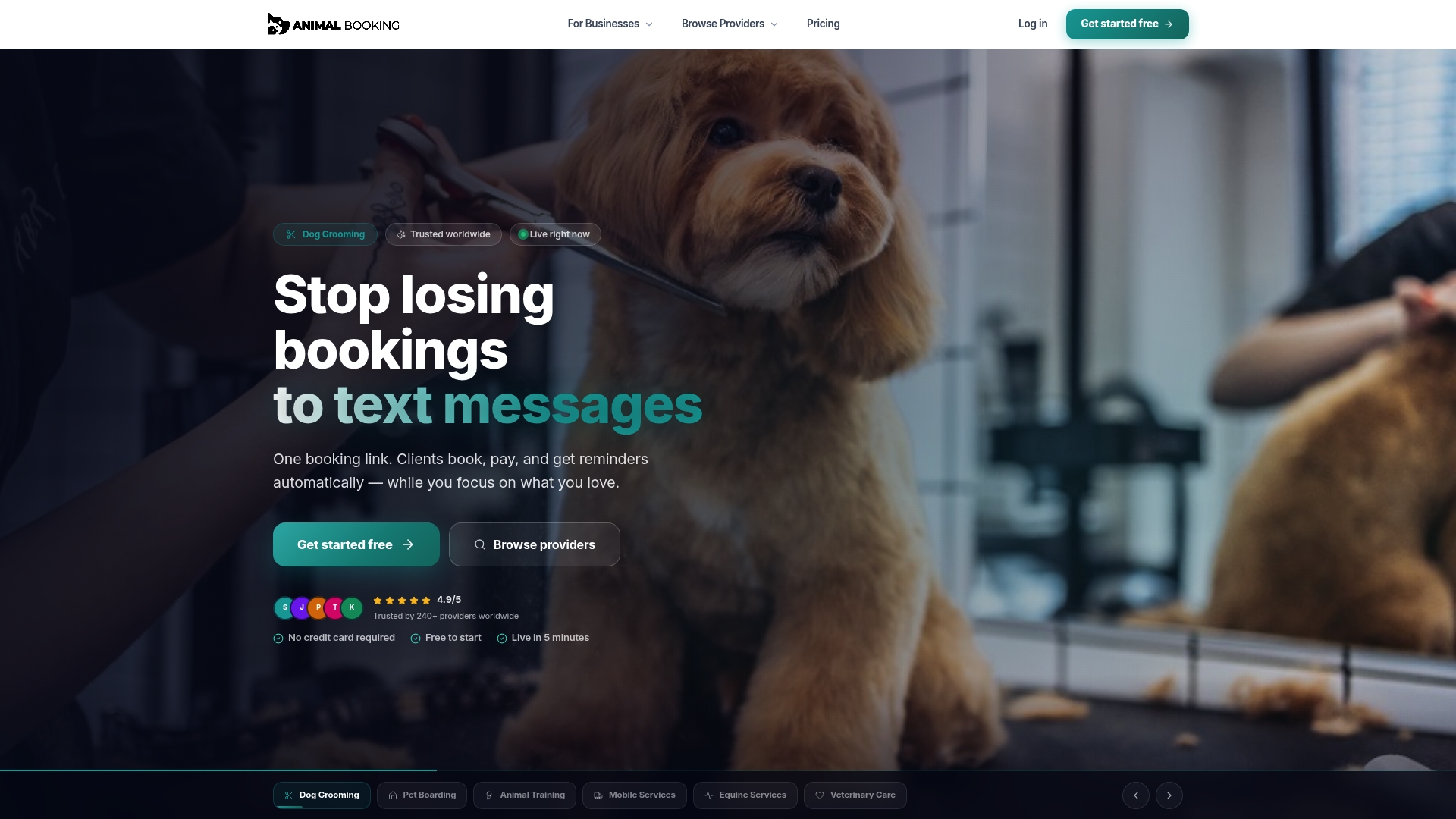
The core features map directly onto retention, not as an afterthought but as the actual product: automated reminders sent ahead of every appointment to cut no-shows, a smart calendar that makes rebooking a one-tap action instead of a phone call, a built-in customer CRM that lets you segment clients by value and visit history the way this article recommends, and frictionless payment collection so billing stops being the reason a client quietly disengages. Setup takes minutes, not weeks, through simple onboarding, which matters because a retention system you never launch protects nobody.
For dog groomers, pet boarders, vets and mobile pet businesses, that combination means fewer no-shows, easier rebooking, and cleaner client records to build your tiering on. If you're running appointments on texts and a paper diary right now, the fastest next step is to see current pricing plans and get your booking system live before your next busy week.

Key takeaways: what to start, measure and review this quarter
A client retention strategy succeeds when it makes your value continuously visible through structured rituals, not when it relies on goodwill or discounting to hold clients in place.
- Tier clients by revenue and risk this week, and give your top tier a scheduled quarterly review.
- Build a 90-day onboarding sequence for every new client, with checkpoints at week one, day 30 and day 90.
- Track one KPI (retention rate or churn rate) monthly, and add CLV once your baseline is stable.
- Fix billing friction and set up automated reminders before investing in anything more advanced.
- This week's single first step: book that 15-minute value review with your highest-revenue client.
| Point | Details |
|---|---|
| Make value visible | Send short, regular recaps of results so clients never have to guess what they're paying for. |
| Segment before you act | Tier clients by revenue and engagement so effort goes where it protects the most value. |
| Automate the predictable stuff | Reminders, rebooking prompts and billing should run without manual follow-up. |
| Watch for early red flags | Declining engagement, late payments and single-champion accounts need action within the week. |
| Animalbooking runs the system | Automated reminders, smart scheduling and a built-in CRM handle the retention rituals this article recommends. |
Frequently asked questions
What is the difference between client retention and customer loyalty? Retention measures whether a client keeps buying from you, expressed as a rate or percentage. Loyalty is the emotional driver behind that behaviour, the trust and preference that make a client choose you even when a competitor is cheaper. You can retain a client through contractual lock-in without loyalty, but that retention tends to be fragile.
How often should I run a value review with clients? For high-value clients, quarterly is the standard cadence recommended by services-firm retention research. Between those formal reviews, a shorter fortnightly or monthly recap keeps outcomes visible without demanding a full meeting.
What is a good retention rate for a small service business? It varies heavily by industry, so compare your own rate against your own baseline first. What matters more than hitting a specific number is the trend, a retention rate improving quarter over quarter signals your system is working; a declining one needs immediate attention to segmentation and outreach.
Do loyalty discounts actually improve retention? Discounts can prompt a short-term rebooking, but relying on them trains clients to expect a lower price at renewal. Programs built around gamified perks and exclusive access tend to shift behaviour more sustainably than pure price cuts.
Can I run an effective retention strategy without dedicated software? Yes, at a small scale, spreadsheets and manual reminders can work. Once you're managing dozens of clients across multiple tiers, though, automated reminders and a CRM become the difference between a retention system that runs reliably and one that quietly falls apart the first busy week.
Sources
For deeper reading on the ideas covered above, Harvard Business School Online's breakdown of engagement strategies covers personalisation, value delivery and support as the three pillars of retention. Salesforce's guide to the new loyalty landscape explains why convenience and responsiveness now matter as much as rewards programs, and its piece on AI in customer service goes deeper on real-time behavioural intervention.
For services-specific tactics, Perspective AI's guide to agency and B2B retention is the best read on structuring QBRs and value reviews. Aviy's small business retention guide is more relevant if you're running a smaller service operation without a dedicated account management function. Shopify's research on retail loyalty triggers is worth a look if perks and gamified loyalty mechanics are part of your plan, alongside Lucintel's data on gamification trends.
To implement any of this inside an appointment-based business, start with Animalbooking's provider overview for a full feature rundown, and its pet boarding industry page or dog grooming industry page for sector-specific examples of how tiering and automation work in practice.
- Client retention strategies for agencies and B2B services in 2026 | Perspective AI
- Client retention strategies for small businesses | Aviy
- Retail loyalty program: customer triggers that work (2026) - Shopify