
The fastest way to run reliable house-call appointments is a purpose-built booking platform configured for time windows, route planning and automated reminders, not a mix of texts and spreadsheets. A scheduler built for mobile veterinary work cuts no-shows, simplifies daily route planning and takes payments automatically. Platforms such as AnimalBooking claim setup takes as little as 10 to 15 minutes, which matters when the alternative is weeks of manual reconfiguration.
TL;DR:
- Proper route planning features, including GPS pins for properties without addresses and rerouting during emergencies, are essential for efficient fieldwork.
- Automated reminders, deposits, and payment support can reduce no-shows and increase revenue, with some practices claiming up to 80% no-show reduction.
- Testing the platform with difficult, same-day, and emergency bookings before going live helps ensure reliability in real-world scenarios.
- Setting service buffers and customizing intake forms for GPS data, access notes, and biosecurity details streamline daily scheduling and client communication.
- The platform should support quick onboarding, integration with existing records, and offer flexible, purpose-built features for mobile veterinary practices.
Table of Contents
- Checklist: features to insist on for house-call vet scheduling
- Step-by-step setup checklist for a house-call practice
- Daily scheduling workflows and route optimisation for mobile vets
- Teletriage and after-hours handling: when to switch to a remote consult and how to document it
- Payments, reminders and strategies that reduce no-shows
- A week-one perspective on switching to a purpose-built scheduler
- AnimalBooking: how it maps to the checklist and where to start
- Sources
- FAQ
Checklist: features to insist on for house-call vet scheduling
Before you commit to any platform, run it against the realities of fieldwork. A scheduler designed for a fixed clinic will fight you on almost every point below.
- Time-window bookings and buffer times that account for travel and the inevitable overrun at a difficult appointment.
- Multi-stop, multi-staff scheduling with calendar sync to Google or Outlook so nobody double-books a vehicle or a vet.
- Route planning with GPS pins, since many rural and acreage properties do not have a usable street address.
- Custom intake forms that capture access notes, animal behaviour, biosecurity requirements and herd details before you arrive.
- Deposit and payment support, with automatic invoicing and the option to apply surcharges for after-hours or long-distance visits.
- Automated reminders and rescheduling workflows that reduce the number of missed appointments.
- Clear onboarding and data export, including whether the platform integrates with your existing practice records.
Route planning tailored to fieldwork should also allow GPS pins for no-address properties and let you recalculate a route when an emergency call comes in mid-morning, a capability RationalGo describes for Australian mobile vet operations.
Pro Tip: Test any shortlisted platform with a genuinely awkward booking, a farm with no street address and a same-day emergency insertion, before you trust it with a full week's diary.
Step-by-step setup checklist for a house-call practice
Getting a mobile scheduling system live does not need to be a long project. Work through these steps in order and you should be bookable within a day or two.
- Define your service types with realistic durations, then add a travel buffer to each so back-to-back bookings do not collapse the moment one visit runs long.
- Set your service area and lead times, including a minimum notice period and any extra fee for properties beyond your normal radius.
- Build intake forms that collect the property's GPS location, gate codes, animal behaviour alerts and any biosecurity notes relevant to farm visits.
- Turn on online payments or deposits and write a plain-language cancellation policy that clients see at the point of booking.
- Run three test bookings, a standard appointment, a same-day request and an emergency inserted into an already-full day, before you open the diary to real clients.
Platforms such as AnimalBooking's online booking tools are built around these intake and setup steps, so most of this can be configured without technical help.
Daily scheduling workflows and route optimisation for mobile vets
A day plan for a mobile vet is really a routing problem wearing a clinical hat. Cluster appointments geographically first, then fit them inside the time windows clients actually agreed to, not the other way around.
- Cluster by geography, then by time window, so you are not crossing the same stretch of road three times in one morning.
- Use GPS coordinates for farms and remote properties and store access notes on the client record so they surface automatically when the visit is scheduled, an approach RationalGo recommends for properties without a usable street address.
- Recalculate the route when an emergency lands mid-day, and notify every affected client of the new estimated time rather than leaving them guessing.
- Track kilometres travelled for logbook purposes and apply a travel fee once a visit sits outside your standard service radius.
A solo practitioner's day usually looks like four or five tightly clustered visits with a lunch buffer built in for the inevitable delay. A two-vet, two-vehicle team can split by suburb or by species, running two independent routes that only intersect if an emergency needs a second set of hands.
Teletriage and after-hours handling: when to switch to a remote consult and how to document it
Not every call needs a vehicle. A short teletriage conversation can resolve many after-hours queries without eating into tomorrow's route.
- Collect essential triage details first: species, symptoms, when they started, and whether breathing, bleeding or consciousness is affected.
- Sort the outcome into three paths: an immediate house call, a priority slot at the next available booking, or a remote consult with a follow-up scheduled.
- Record every teleconsult in the patient file and note the outcome in the booking system so the next staff member sees the full picture.
Telehealth works best when it is built into your regular workflow rather than treated as a separate channel, a point the AVMA's telehealth guidance makes for veterinary practices generally.
Pro Tip: Keep a simple equipment checklist by the phone: stable internet, a charged device with camera, and a private space, so a triage call never gets derailed by technical setup.

Payments, reminders and strategies that reduce no-shows
Money and messaging do more to protect your calendar than most vets expect.
- Take a deposit or hold a card on file for new clients and for any booking outside your usual radius.
- Send reminders on a cadence: at booking, 48 hours out, 24 hours out and again an hour before arrival, each one restating the time window and any access notes.
- State cancellation fees and after-hours surcharges at the point of booking, not after the fact.
This kind of deposit and reminder structure can significantly reduce no-shows and increase revenue per booking through this kind of deposit and reminder structure, according to its vet practices page. That is the platform's own claim rather than an independent measurement, but it lines up with the logic: a client who has paid something and been reminded twice is far less likely to simply not be home.
A week-one perspective on switching to a purpose-built scheduler
The first week on a new scheduler is rarely smooth, and it does not need to be. Expect fewer phone rebooks and fewer double bookings within days, mostly because the diary is doing arithmetic you used to do in your head. The common snag is importing existing clients and standardising intake notes that used to live in three different notebooks. Give that job a single afternoon rather than trying to do it appointment by appointment. Measure progress with three numbers: your no-show rate, kilometres driven per day and time spent on admin. If all three move in the right direction inside a month, the switch has paid for itself.
— AnimalBooking
AnimalBooking: how it maps to the checklist and where to start
Everything on the checklist above is easier when the platform was built for fieldwork rather than adapted from a walk-in clinic model.
- Smart calendar and multi-staff scheduling through AnimalBooking's smart calendar tools.
- Automated reminders configured through auto reminders to cut the no-show rate described above.
- Online payments and deposits handled at booking, plus a branded booking website on your own domain via AnimalBooking's booking website feature.
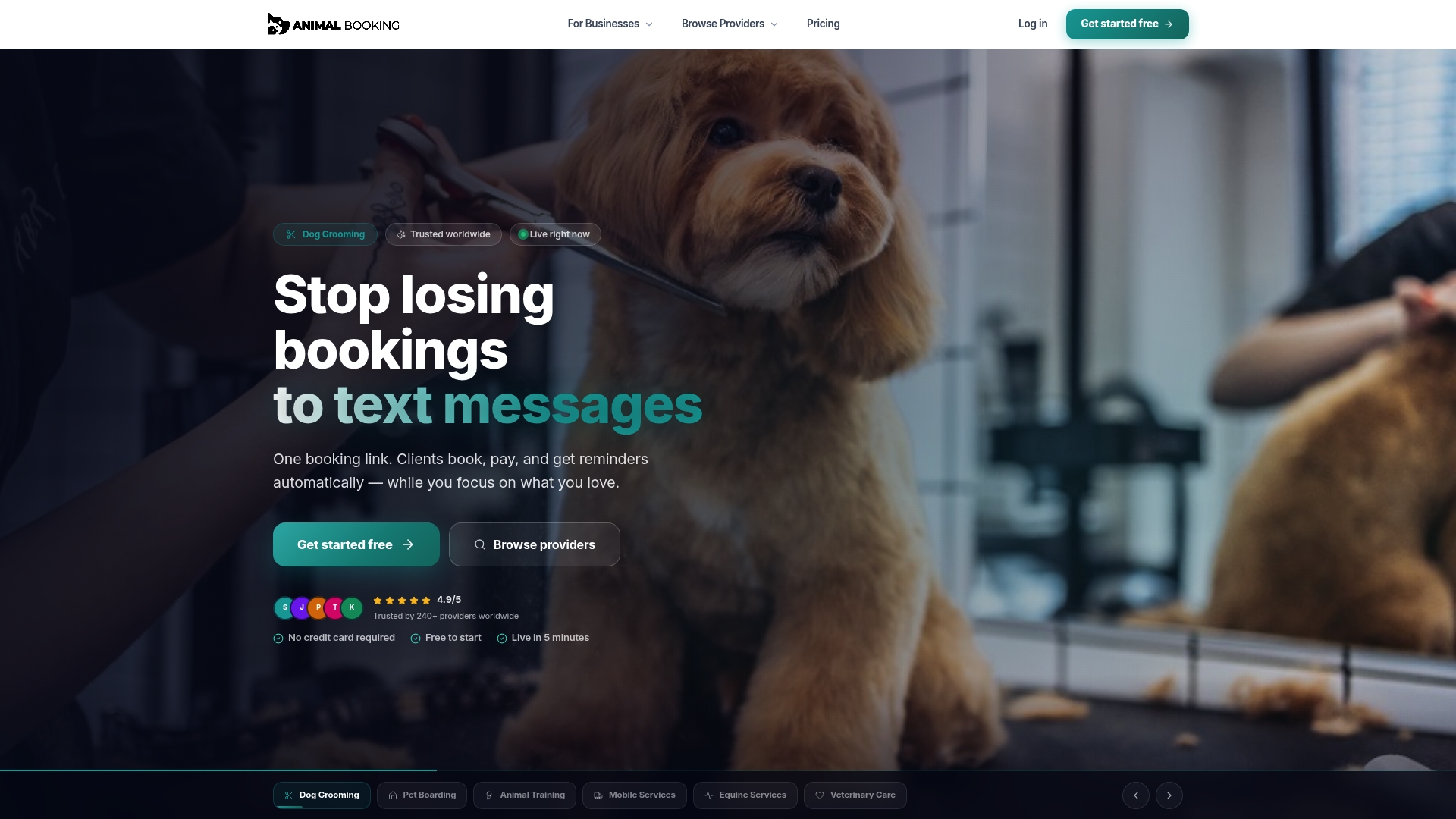
AnimalBooking states it takes 10 to 15 minutes to go live, which matters if you are running a full diary and cannot spare a week for a platform migration. Pricing runs across four plans: Starter, Independent at $49 per month, Teams at $149 per month and Pro at $299 per month, alongside platform fees of 3%, 2%, 1.5% or 1% depending on tier, all detailed on the pricing page. If you are ready to see how it fits your route, check current plans and platform fees and start your setup today.
Sources
- Connected care: Telehealth in veterinary practice | American Veterinary Medical Association
- AI App Builder for Australian Mobile Vets — Route Planning, Farm Calls & Telemedicine — RationalGo
FAQ
How long does booking usually take from request to confirmation?
With an online scheduler, most clients get a confirmed time window within minutes of submitting a request, since the system checks your calendar and travel buffers automatically. Manual booking by phone or text typically takes longer because it depends on someone being available to reply.
What should a house-call scheduling platform cost?
AnimalBooking's plans run from Independent at $49 per month up to Pro at $299 per month, plus a platform fee on processed payments that ranges from 1% to 3% depending on tier, as listed on its pricing page. Costs on other platforms vary by feature set, so compare the fee structure alongside the monthly price.
How do I reduce no-shows for house-call appointments?
Deposits or card-on-file bookings, combined with a reminder sent at booking, 48 hours, 24 hours and one hour before the visit, address most missed appointments. AnimalBooking states this combination can reduce no-shows by up to 80%, according to its vet practices page.
When should a call become a teleconsult instead of a house visit?
Use a short triage conversation covering symptoms, onset and breathing or bleeding indicators to decide whether the case needs an immediate visit, a priority next slot, or can be managed remotely with a follow-up booked. The AVMA's telehealth guidance recommends documenting the outcome in the patient record regardless of the path chosen.
Are there legal considerations specific to house-call scheduling platforms?
Platforms handling client payments and health records should support secure documentation and clear privacy practices, in line with general telehealth guidance from veterinary professional bodies. Requirements for patient records and payment handling can vary by jurisdiction, so check the rules that apply to your own practice before relying on any platform's default settings.