
The simplest way to accept pet payments online is to take them at the moment the client books, inside the booking itself, rather than sending a bank detail by text and chasing it later. A booking system with built-in payments, like Animalbooking's payments feature, collects a deposit or full payment by card as part of the appointment, so the slot is only held once money has moved. That one change fixes most of what groomers, boarders, mobile vets, trainers, behaviourists and dog walkers complain about: no-shows, manual invoicing and awkward conversations about money.
This guide covers what you can accept, what it costs, what changed for card surcharging on 1 October 2026, and how to set it all up in a way that is fair to clients and legal under Australian consumer law.
TL;DR
- Take payment at booking: a deposit for most services, full prepayment for boarding peak periods or long appointments.
- Cards and wallets are the baseline. Direct debit and buy-now-pay-later options exist but suit bigger-ticket work such as vet treatment.
- Typical domestic online card fees in Australia sit around 1.5% to 2.6% plus a fixed cent amount, so build them into your prices.
- Since 1 October 2026, card surcharging on debit and credit cards has ended, so the processing cost has to live inside your advertised prices.
- Cancellation and no-show fees must be disclosed upfront and tied to your real loss, not set as a penalty.
Table of Contents
- What "accepting payments online" actually means for a pet business
- Which payment methods suit which pet services
- What online payments cost in Australia
- The 1 October 2026 surcharging change
- How to set up online payments, step by step
- Deposits, cancellation fees and the law
- Security and privacy basics
- Online payments for each kind of pet business
- Putting it together with Animalbooking
- Our view: payment is part of the booking, not a chore after it
- FAQ
- Sources
What "accepting payments online" actually means for a pet business
There are three separate jobs, and many small businesses only solve one of them.
- Collecting the money. A card, wallet or bank payment is taken from the client and settled into your bank account.
- Linking it to the booking. The payment is attached to a specific pet, service, time and staff member, so you never wonder whether Bella's 10 am clip has been paid.
- Handling the follow-up. Reminders, balances after a deposit, refunds and cancellation terms.
A payment link in a text message does job one. A booking platform with payments does all three. That matters most for solo and small-team operators, because every minute spent reconciling bank transfers against a diary is a minute not spent with animals.
The official business.gov.au guide to payment methods lists the main options for Australian businesses: credit and debit cards online or through EFTPOS, direct debit set up through your bank or a provider, and online payment platforms. It also says payment information should be encrypted to protect customers, which is the minimum you should expect from anything that touches your clients' card details.
Which payment methods suit which pet services
The payment methods available through a major Australian processor are broad. Stripe's features page lists major debit and credit cards, wallets such as Apple Pay, Google Pay and PayPal, Australian BECS Direct Debit, PayTo, and buy-now-pay-later options including Afterpay and Zip. You rarely need all of them. Match the method to the job.
| Service | Typical payment moment | What works best |
|---|---|---|
| Dog grooming | Deposit at booking, balance at pick-up or automatically | Card or wallet deposit |
| Mobile grooming and mobile vet | Deposit or full payment at booking, because travel time is lost if the client cancels | Card or wallet, full prepayment for long travel |
| Boarding and pet sitting | Deposit at booking, balance before check-in | Card deposit, staged payments for holiday periods |
| Dog walking | Recurring weekly or monthly payment | Saved card with recurring bookings |
| Training and behaviour consults | Full payment up front for a block or an initial consult | Card, full prepayment |
| Equine trainers and farriers | Deposit for travel days, balance after the session | Card or direct debit for regulars |
Cards and wallets cover the overwhelming majority of everyday pet bookings. Clients already have them on their phones, and they confirm in seconds, which is what you want at the moment someone is deciding whether to commit to a slot. Buy-now-pay-later and instalment options mostly appear around larger vet bills, so for groomers, walkers and trainers they are a nice extra rather than a need.
What online payments cost in Australia
There are usually two layers of cost: what the card processor takes, and what your booking software charges on top.
Processor fees
Stripe's Australian pricing page charges 1.65% + A$0.30 per domestic card transaction and 3.5% + A$0.30 for international cards. It states that card and wallet fees include GST and that there are no setup or monthly fees. Standard scheduled payouts are free, while Instant Payouts cost 1.5% of volume with a A$0.50 minimum.
Other processors price in the same band. A June 2026 comparison by Masters of Digital lists domestic online card fees from about 1.5% + 25c at the low end to 2.6% at the high end, with payouts ranging from next day to about two business days. Rates and payout speeds change, so treat those as the published figures for that month and check the provider's own page before you commit.
A worked example
Say a groomer takes a $90 deposit-and-balance booking and the processor charges 1.65% + 30c. The fee on $90 is $1.49 plus $0.30, about $1.79, or just under 2% of the booking. On a $120 full groom it is about $2.28. Across 100 bookings a month at $100 average, that is roughly $195 in processing costs. It is a real number, but compare it with one lost slot: a missed $100 groom costs more than half of that month's fees on its own.
Platform fees
Our own pricing is published openly. Plans are Starter (see the pricing page for its details), Independent at $49 per month, Teams at $149 per month and Pro at $299 per month, and platform fees on payments processed through the system are listed as 3%, 2%, 1.5% and 1% on our provider pricing page. You can see the plan tiers on the main pricing page. Work out your expected monthly booking volume first, then compare the subscription and fee combination, because the right plan depends on how many payments you process.

For a deeper look at the numbers, our guide to Australian payment fees for pet services walks through them.
The 1 October 2026 surcharging change
If you used to add a card surcharge at checkout, that has changed. The Reserve Bank of Australia's review concluded that card surcharging on debit and credit cards should end on 1 October 2026, alongside lower caps on the interchange fees businesses pay. The RBA's own summary notes that a business may now choose to include the cost of card payments in its advertised prices.
What that means in practice:
- Do not add a "card fee" line. Price it into your services instead. A $2 rise on a $100 groom covers a typical processing cost.
- Update your booking page and terms. Remove old surcharge wording so clients are not shown a fee you can no longer charge.
- Review your margins by service. Low-priced add-ons such as nail clips feel the fixed per-transaction cent amount most, so bundle them into the main service.
We have separate write-ups on the EFTPOS surcharge rules from 1 October 2026 if you take payments in person as well.
How to set up online payments, step by step
1. Decide what you are charging for
Write down, per service, whether you want a deposit, full prepayment or payment on the day. A deposit suits routine grooming and training sessions. Full prepayment suits boarding in school holidays, long mobile trips and behaviour consults where an empty hour is hard to refill. Our comparison of deposits versus prepayments sets out when each fits.
Where it goes wrong: a flat deposit for every service. A $20 deposit on a four-hour boarding stay does little to protect you, and a 50% deposit on a quick tidy-up puts clients off.
2. Get your business details in order
You need an ABN, and if you are registered for GST, your prices and receipts should reflect it. Have a business bank account ready for payouts. Expect that a new processing account can take days to a couple of weeks before the first payout while checks are completed, and that regular payouts then land on a schedule of roughly one to two business days.
We have a walk-through for Australian groomers with an ABN and GST that covers this on the booking side. Our platform is designed so you can go live in 10 to 15 minutes.
3. Connect payments to your online booking
This is the step where most do-it-yourself setups fall apart. A separate payment link means someone has to match the payment to the booking by hand. When payment is part of the online booking flow, the client chooses the service, picks a time and pays in one go, and the booking is confirmed only when the payment succeeds. In Animalbooking, that includes deposits, instant, manual and recurring bookings, with the payment attached to the booking record in your bookings dashboard.
If you want to send clients to a page that looks like your own business, a branded booking website on your own domain keeps the checkout under your name.
4. Set your cancellation and no-show terms
Put your terms on the booking page, before the client pays. Include the cancellation window (for example, 24 or 48 hours), what happens to the deposit, and what you charge for a no-show. The legal side is covered below.
5. Turn on automated reminders
A deposit reduces the chance of a no-show. A reminder reduces the chance of a forgotten booking. Automated reminders go out without you lifting a finger, and clients can use online rescheduling to move a slot rather than skipping it. Our platform is built to cut no-shows by up to 80%, and the combination of a paid deposit, a reminder and an easy way to change the time is what drives it.
6. Do a test booking and check the payout
Book yourself in, pay, and check that the confirmation, the receipt and the payout into your account match what you expect. Then you are ready to publish the link on your website, Instagram bio and Google Business Profile.
Deposits, cancellation fees and the law
Taking money upfront puts you in the territory of the Australian Consumer Law (ACL). You do not need to be a lawyer, but there are four rules of thumb worth knowing.
- Disclose first. Cancellation fees should be shown clearly before the client commits, not introduced after a missed appointment.
- Keep fees proportionate. Sprintlaw's overview of Australian cancellation fee law frames the test as whether the fee reflects the reasonable costs you incur from the cancellation. A $150 fee for a $60 groom you could easily refill looks like a penalty, while a fee reflecting a lost two-hour slot with no chance of rebooking looks like a cost. Our guide to grooming no-show fees shows how to tie the figure to real loss.
- Avoid blanket no-refund terms. The Legal Shop explains that under the ACL a no-refunds clause is invalid where a consumer guarantee has been breached. If you did not deliver the service properly, a refund may be due whatever your terms say.
- Be careful with unfair terms. Sprintlaw also notes that unfair contract term reforms took effect in November 2023, so one-sided small print is riskier than it used to be.
For a fuller walk-through, read our guide on whether a cancellation fee is legal in Australia. If you are unsure how your terms apply to your situation, an Australian small-business lawyer is the right person to check them.
Security and privacy basics
You do not need to build security yourself, but you should know what good looks like.
- Never store card numbers on your own device or spreadsheet. Card details should go straight to a payment processor, not through your inbox or messages.
- Offer clear payment information. The Australian Government's Guidelines for Electronic Commerce say businesses should provide reliable, easy-to-use payment mechanisms with appropriate security, and explain the available payment methods, their security, how to cancel regular payments and any costs.
- Publish a privacy policy. Sprintlaw's PCI guide notes the Privacy Act 1988 generally applies to organisations with annual turnover above $3 million, plus some smaller ones such as health service providers (relevant to vets), and that even exempt small businesses should have a clear privacy policy if they collect personal information at checkout.
Mobile vets and clinics in particular should check whether the Privacy Act applies to them as health service providers.
Online payments for each kind of pet business
Groomers. Take a deposit when the booking is made, then collect the balance at pick-up. For multi-pet households, avoid overbooking with our guide on booking multiple pets, and read about how to prevent double booking.
Mobile groomers and vets. Travel time is the cost you cannot recover, so full prepayment or a larger deposit is reasonable. Our page for mobile pet groomers and mobile services covers how this works in practice.
Boarders and pet sitters. Staged payments work well: a deposit on booking and the balance before check-in. See the pet sitters page.
Dog walkers. Recurring bookings let regular clients pay on a set rhythm without a monthly invoice.
Trainers, behaviourists and equine professionals. Prepaid blocks or an upfront consult fee signal professionalism and filter out casual enquiries. A clear online payment also builds trust, because the client sees exactly what they are paying for before they confirm.

Putting it together with Animalbooking
Animalbooking brings the booking, the payment, the reminders and the client record into one place. Our platform supports payments processing, online payment deposits, automated customer reminders, recurring, instant and manual bookings, a customer CRM, analytics and multi-staff support. Pricing is published: you can start with the Starter plan, or choose Independent at $49 per month, Teams at $149 per month or Pro at $299 per month, with platform fees on payments listed on the pricing page.
If you want to see how it fits your business, start at the Animalbooking site or go straight to pricing.
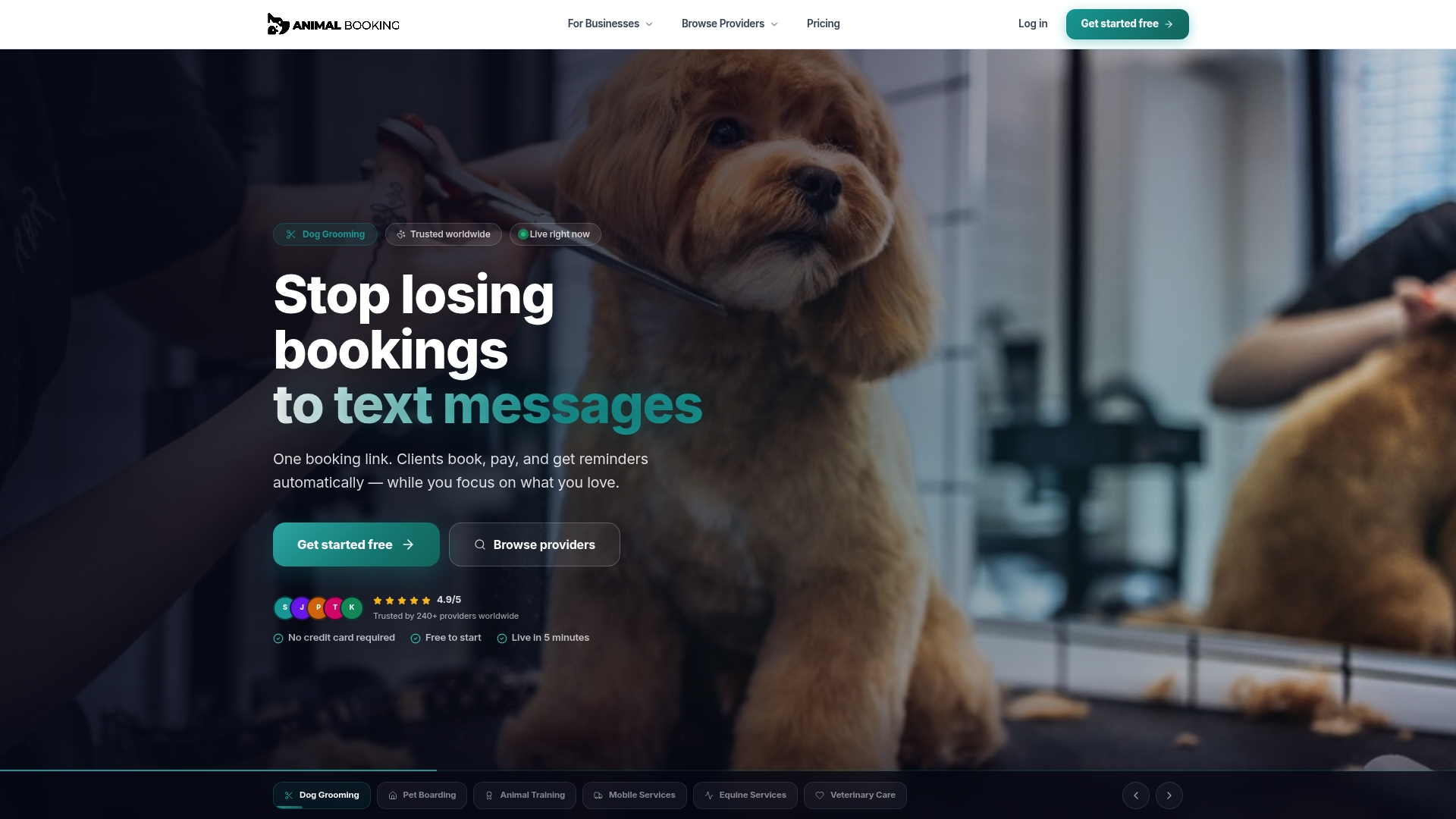
Clients who still owe you money from an earlier booking can settle it through our unpaid booking payment page, so you do not have to chase by text.
Our view: payment is part of the booking, not a chore after it
We built Animalbooking for people who spend their days with animals, not spreadsheets. In our experience of how pet businesses are run, the missed appointment is rarely about a client being careless. It happens because nothing in the booking asked for a commitment.
That is why we put payments inside the booking itself. When a client pays a deposit as they choose a time, the slot becomes a real commitment, and the reminder that follows has something to protect. Our platform is designed to reduce no-shows by up to 80% and lift revenue by around 30% per booking.
We also think pricing should be plain. The plans and platform fees are published, so you can calculate your own cost before you start. With surcharging ending on 1 October 2026, the businesses that do best will be those who price clearly, explain their terms upfront and make paying effortless.
Set-up is designed to take 10 to 15 minutes, which means you can be taking deposits this week rather than next quarter.
AnimalBooking
FAQ
Can I just send clients a bank account number instead?
You can, but it leaves you matching transfers to bookings by hand, and the client has no confirmation at the moment of booking. Payments inside the booking confirm the slot instantly and record who has paid. That saves time and prevents the "I thought I paid" conversation.
How much should a deposit be for a groomer?
There is no set rule. Many groomers choose a deposit that covers a meaningful share of the appointment, with the full amount for long or hard-to-refill slots. Whatever you choose, state it before the client pays and make sure a no-show fee reflects your real loss, as described in the ACL guidance above.
Can I still add a card surcharge?
No, not on debit and credit cards. The RBA concluded that surcharging on these should end on 1 October 2026, so the cost needs to be included in your advertised prices. Update your booking page and terms so no surcharge wording remains.
Do I have to refund a deposit if the client cancels?
It depends on your disclosed terms and the circumstances. A clearly stated, proportionate cancellation policy is generally safer than a blanket no-refund clause, which can be invalid where a consumer guarantee is breached. For specific cases, speak to a small-business lawyer.
How quickly do I get paid?
Payout timing depends on the processor and your account. Published Australian figures range from next-day to about two business days for regular payouts, and new accounts may wait longer for the first one. Check the current schedule on the provider's page.
Sources
- Choose payment methods, business.gov.au
- Stripe Payments features, Australia
- Stripe pricing and fees, Australia
- 7 Best PayPal Alternatives in Australia, Masters of Digital
- Review of Retail Payments Regulation, Reserve Bank of Australia
- Australian Laws on Cancellation Fees, Sprintlaw
- Website Terms and Conditions Australia, The Legal Shop
- Australian Guidelines for Electronic Commerce, Treasury
- PCI Compliance: Practical Steps, Sprintlaw