

From 1 October 2026, merchants can no longer recover covered card payment costs through a separate surcharge. The Reserve Bank of Australia has ended surcharging on eftpos, Mastercard and Visa, but the underlying fees don't disappear. Merchants need to calculate their true cost of acceptance now and decide whether to absorb it, adjust pricing, or route payments more cheaply. AnimalBooking can help pet service businesses manage that shift through deposits and integrated payments.
TL;DR:
- Merchants must now accurately calculate their true card acceptance costs and adjust pricing or routing strategies before the October 2026 deadline.
- Payment processing fees consist of interchange, scheme, and acquirer margins, with only the acquirer margin being negotiable.
- Small and micro businesses typically pay higher average fees than large retailers due to less negotiating leverage and higher risk pricing.
- Removing surcharges shifts cost visibility to merchants, emphasizing the need to review statements, renegotiate provider margins, and reprice services proactively.
- Incorporating deposits and prepaid policies can significantly reduce revenue loss from no-shows and last-minute cancellations in pet service businesses.
Table of Contents
- What are payment processing fees in Australia?
- How much do card payments actually cost merchants in Australia?
- What changes under the October 2026 surcharging reforms?
- How do you calculate your all-in cost of accepting payments?
- Which pricing model actually saves you money?
- How can you cut payment costs right now?
- How AnimalBooking helps pet businesses manage payments
- What to do this month to prepare for October 2026
- Does business size change how much you pay in card fees?
- How do Australia's major payment providers compare?
- What happens to the payments market after October 2026?
- Does removing surcharges change how customers pay?
- What Australian merchants get wrong about this reform
- Get your pricing and deposits sorted with AnimalBooking
- Sources
What are payment processing fees in Australia?
A card transaction fee isn't one charge. It's three stacked together, and only one of them is negotiable.
Interchange fees go to the cardholder's bank and are set largely by the card networks, with the RBA capping the average. Scheme fees go to Mastercard, Visa or eftpos for running the network. Acquirer or provider margin is what your payment processor keeps for taking on the risk, handling settlement and running the terminal or gateway. That third component is the only one you can actually negotiate.
The mix changes depending on the card and channel. A tap-and-go eftpos debit transaction at your counter costs less than a card-not-present online payment on a rewards credit card, because online transactions carry more fraud risk and rewards cards attract higher interchange to fund their point schemes. Smaller merchants also tend to pay more per transaction than large retailers, because acquirers price in risk and volume.
Most providers show fees as a percentage plus a flat cents-per-transaction charge, and GST applies to the provider's margin component (interchange and scheme fees are typically GST-free, but check your statement). Your monthly merchant statement should break this down. If it doesn't, that's the first thing to ask for.
- Interchange: paid to the card-issuing bank, largely fixed by regulation
- Scheme fees: paid to Mastercard, Visa or eftpos for network access
- Acquirer margin: the processor's cut, and the only negotiable piece
- GST: usually applies to the margin component, not interchange
How much do card payments actually cost merchants in Australia?
Benchmarks vary by network, card type and channel, but the pattern is consistent: eftpos is cheapest, credit is dearer, and online is dearer again.
RBA Bulletin analysis shows eftpos is generally the least expensive network for in-person, device-present debit transactions. Mastercard and Visa debit sit a little higher, and premium or rewards credit cards attract the highest interchange of the lot. Provider-published rate pages, such as Square's Australian fee schedule, give a real-world anchor: in-person tap rates commonly sit below online card-not-present rates for the same provider, because online transactions carry more fraud risk.
The spread is wide. Industry comparisons put typical merchant service fees anywhere from roughly 0.3% to 2.5% per transaction, depending on the provider, the card scheme and whether the sale happened in person or online.
A few patterns worth knowing before you compare your own statement:
- Eftpos in-person debit is usually the cheapest option available to Australian merchants.
- Online transactions typically cost more than in-person ones on the same card, due to fraud risk.
- Foreign-issued cards and premium rewards cards usually cost more than standard domestic debit.
- Small businesses tend to pay higher average fees than larger merchants with more negotiating leverage.
If your current rate sits well above these ranges for the equivalent card and channel, that's a signal to renegotiate, not just a cost of doing business.
What changes under the October 2026 surcharging reforms?
The RBA's conclusions paper settled a debate that's run for years: surcharging on eftpos, Mastercard and Visa transactions ends from 1 October 2026, alongside proposed caps on interchange fees to keep underlying costs down for merchants. Treasury's announcement frames this as a cost-of-living measure, projecting significant savings for consumers and small businesses in reduced surcharge friction and administration.
Here's what merchants need to actually do before the deadline:
- Confirm coverage. The change applies to eftpos, Mastercard and Visa surcharges. Check with your provider whether any niche card types remain outside scope by the time the rule takes effect.
- Rebuild your checkout. Remove surcharge line items from your point-of-sale, online checkout and invoicing templates well before October.
- Update signage and terms. Physical surcharge notices at the counter and surcharge clauses in your online terms need to go, along with any booking confirmation wording that mentions a card fee.
- Recalculate your pricing. If surcharging was covering your acceptance costs, that margin has to come from somewhere else, either baked into prices or absorbed as a cost of doing business.
- Brief your staff. Front-of-house and phone staff need a consistent answer when customers ask why the surcharge disappeared.
Until the deadline arrives, current ACCC guidance still applies: any surcharge charged today must not exceed your actual cost of acceptance, and it must be clearly disclosed before payment.
How do you calculate your all-in cost of accepting payments?
The percentage rate on your merchant agreement is only part of the story. Your real cost per transaction includes every fixed and variable charge stacked on top.
Add these together to find your effective rate:
- The percentage fee per transaction (varies by card type and channel)
- The flat cents-per-transaction fee, if your provider charges one
- Monthly account or gateway fees, divided across your transaction volume
- Terminal rental, if you lease rather than own your hardware
- Chargeback fees, which hit even when you win a dispute in some agreements
The higher-volume business negotiated a lower blended rate because of scale, but still carries a monthly platform fee on top. Once you know your effective rate, you can decide whether to fold it into service prices, treat it as a fixed overhead, or push harder on routing and provider negotiation.
Pro Tip: Pull twelve months of merchant statements and calculate your actual blended rate, not the headline rate your provider quoted when you signed up. The two numbers are rarely the same.
Which pricing model actually saves you money?
Providers offer three main structures, and the difference between them can be the gap between a fair deal and a quiet margin grab.
Flat-rate pricing charges one percentage regardless of card type, which is simple but usually means you're overpaying on cheaper eftpos transactions to subsidise the provider's risk on expensive ones. Tiered pricing buckets cards into categories (qualified, mid-qualified, non-qualified) with different rates, which is harder to audit and often obscures where your money goes. Interchange-plus pricing separates the fixed network cost from the provider's margin, showing exactly what you pay for interchange and what the provider keeps.
NAB's merchant guidance recommends interchange-plus specifically because it's transparent, and it tends to reward higher-volume merchants with a genuinely lower blended rate as their business grows.
Before renewing or switching providers, ask for:
- Interchange-plus pricing instead of a blended flat rate
- Confirmation that least-cost routing is enabled for eligible transactions
- Itemised monthly statements broken down by interchange, scheme fee and margin
- A written cap or ceiling on how much the provider's margin can move without notice
If your monthly card turnover has grown significantly since you last negotiated, you likely have more leverage than you think, particularly with providers competing for volume.
How can you cut payment costs right now?
You don't have to wait for October 2026 to start reducing what you pay. Three levers work today.
- Turn on least-cost routing (LCR). Many Australian debit cards carry both an eftpos and a Mastercard or Visa network mark. LCR automatically sends the transaction down whichever network is cheaper for that sale. The RBA has flagged stronger expectations around LCR availability for mobile wallet transactions too, so ask your provider directly whether it's switched on for your terminal and your tap-to-pay wallet transactions.
- Add lower-cost rails at checkout. PayID and PayTo transfers move money directly between bank accounts and skip card network fees entirely, which suits deposit payments and invoicing particularly well.
- Rework your checkout flow. Encourage debit over credit where it's genuinely no worse for the customer, and use deposits and stored card-on-file details to cut no-shows rather than relying on surcharges to cover the risk of a wasted booking slot.
Pro Tip: If you take recurring bookings, card-on-file with a deposit does more for your margin than any rate negotiation. A no-show costs you the entire booking value, not just a percentage point on a fee.
How AnimalBooking helps pet businesses manage payments
Pet service businesses face a specific version of this problem: no-shows and last-minute cancellations hurt more than a slightly high processing rate does. AnimalBooking is built around reducing that exposure directly.
- Card-on-file and deposit collection at the time of booking, so you're not chasing payment after the fact
- Integrated payments with transparent processing built into the booking flow, rather than a separate, opaque merchant terminal contract
- Automated reminders that cut no-shows by up to 80%, which protects revenue far more than shaving a few basis points off a card rate
- Reports of roughly 30% revenue uplift per booking among providers using deposits and prepaid services consistently
- Setup that takes minutes, not weeks, with no separate merchant account application to manage
For groomers, boarders, trainers and mobile services, requiring a deposit or prepaid package on booking shifts risk off your card statement and onto a policy you control.
What to do this month to prepare for October 2026
A short, ordered list gets you ready without derailing your week.
- Download the last twelve months of merchant statements and calculate your actual blended processing rate.
- Ask your provider for an itemised statement showing interchange, scheme fees and margin separately.
- Confirm least-cost routing is switched on for your terminal and mobile wallet transactions.
- Draft new checkout and signage wording that removes surcharge references, ready to go live before October.
- Brief front-of-house and phone staff on the new wording so customer questions get a consistent answer.
- Talk to your accountant about GST treatment on your revised pricing and to a legal adviser if you're unsure how to reprice services that previously carried a surcharge.
Businesses that treat this as a one-off compliance chore usually miss the bigger opportunity: renegotiating provider margin while everyone's contracts are already under review.
Does business size change how much you pay in card fees?
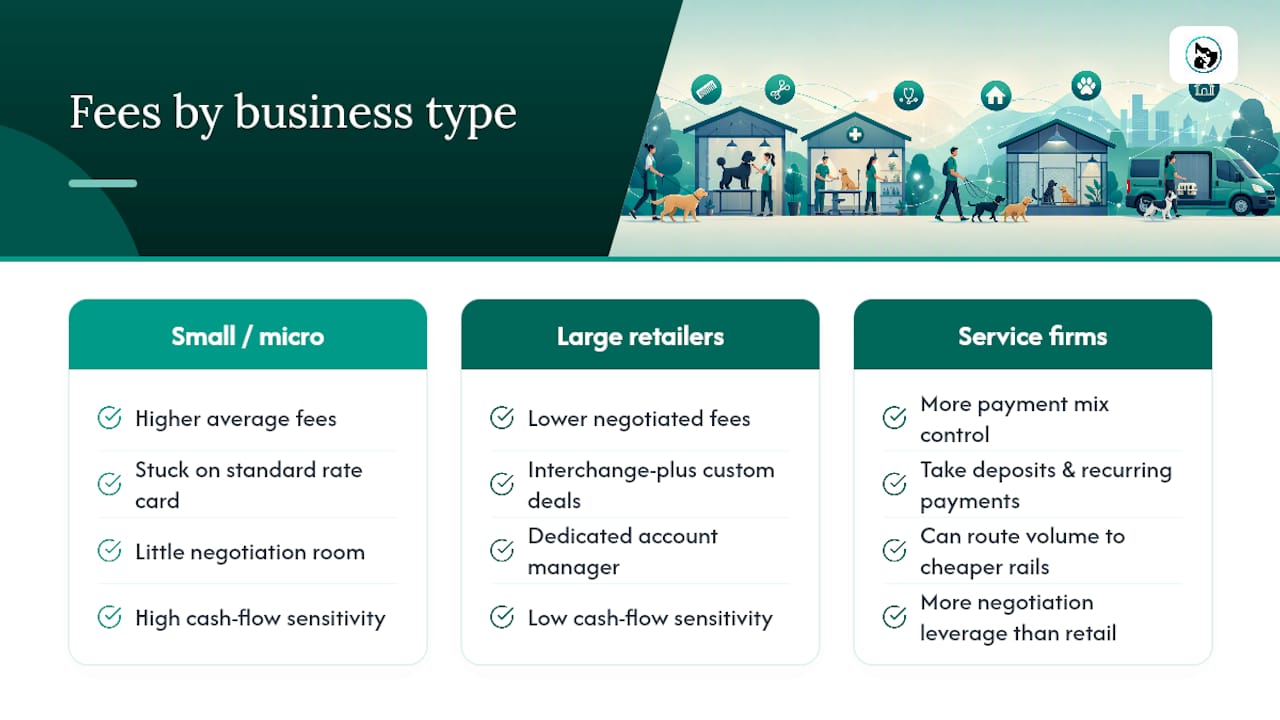
Fee exposure isn't even across the economy. A mobile dog groomer taking six card payments a day sits in a completely different cost bracket to a multi-location boarding franchise processing hundreds of transactions.
Small and micro businesses generally pay higher average fees than large retailers because acquirers price risk and overhead into every account regardless of volume, and low-volume merchants have less room to negotiate a better blended rate. A single-operator pet sitter processing a few thousand dollars a month is often stuck on a provider's standard rate card, while a national retail chain negotiates a custom interchange-plus deal with a dedicated account manager.
Sector matters too. Service businesses that take deposits and recurring payments, such as grooming, boarding and veterinary practices, tend to have more control over their payment mix than retail businesses processing unpredictable walk-in sales. A pet boarding facility that requires a deposit at booking and settles the balance on pickup can route more of its volume through cheaper rails deliberately, rather than accepting whatever card a customer happens to tap.
The gap matters most for cash flow. A high-volume café absorbing a fraction of a percentage point across thousands of transactions barely notices it. A mobile groomer running fifteen appointments a week feels every basis point directly in take-home margin, which is exactly why reviewing your provider agreement matters more the smaller your business is, not less.
How do Australia's major payment providers compare?
Rather than naming specific providers and their current rate cards, which shift regularly and vary by negotiated deal, it's more useful to understand the categories on offer and what each trades off.
Entry-level app-based processors suit low-volume or mobile businesses that want a tap-and-go card reader with no monthly fee and a flat percentage rate. They're fast to set up but usually price everything as flat-rate, meaning you overpay on eftpos transactions to subsidise the provider's risk on premium cards.
Traditional bank merchant facilities suit established businesses with predictable volume. They typically offer interchange-plus pricing once you negotiate, along with dedicated account support, but come with longer contract terms and sometimes terminal rental costs on top of the transaction fee.
Software-integrated payment platforms bundle processing into a booking, invoicing or point-of-sale system, so the fee sits inside a broader subscription rather than a standalone merchant account. This suits service businesses that value one consolidated bill over the lowest possible per-transaction rate.
Contract terms vary just as widely: some processors run month-to-month with no lock-in, others tie you into 12 or 24-month terminal leases with early exit fees. Before signing anything, ask specifically whether the contract has a minimum term, what the early termination cost is, and whether the quoted rate is guaranteed or reviewable at the provider's discretion.
What happens to the payments market after October 2026?
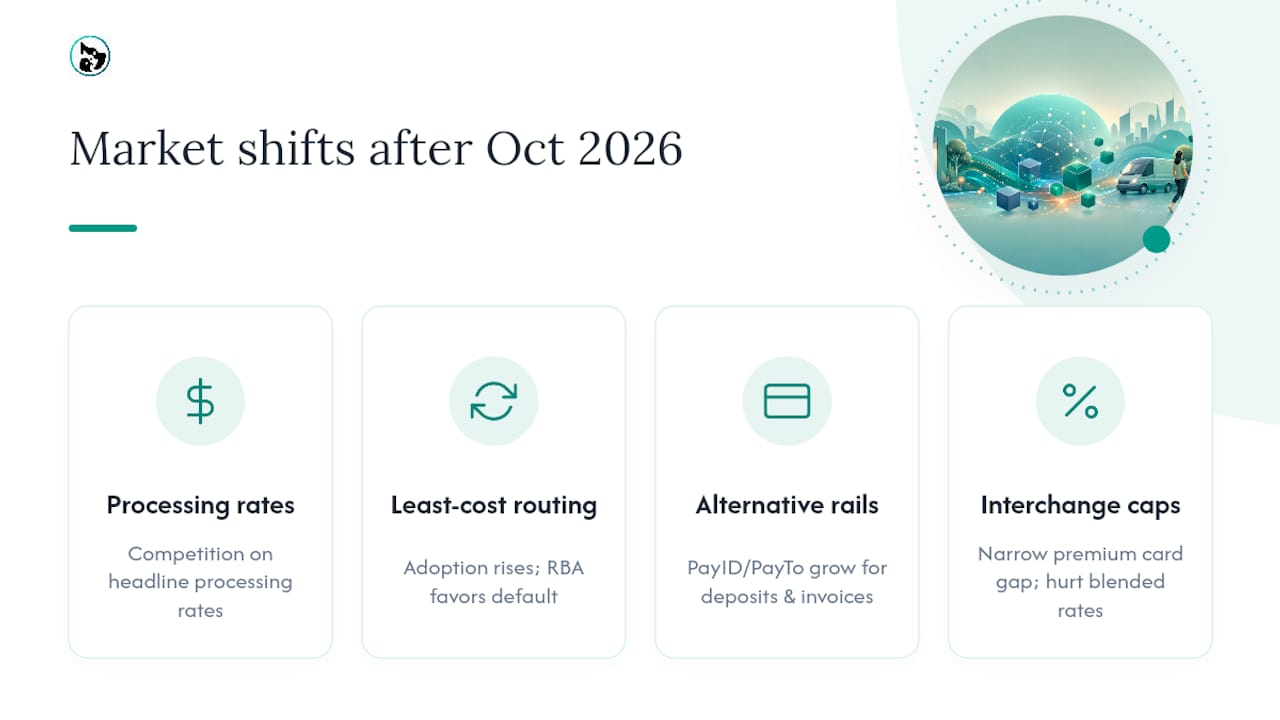
Removing surcharging doesn't remove the underlying cost of accepting cards. It just changes who visibly carries it, and that's likely to reshape how providers compete for merchant business over the next few years.
Expect providers to compete harder on headline processing rates once surcharging can no longer mask a high margin behind a customer-facing fee. Treasury's own framing of the reform suggests cost recovery shifts from surcharging toward operational choices: smarter routing, alternative rails and pricing built into the service itself rather than tacked on at checkout.
Least-cost routing adoption should climb, particularly for mobile wallet transactions, as the RBA pushes providers to make it a default rather than an opt-in feature. Expect more merchants asking for it by name once word spreads that it's a free rate cut sitting unused on most terminals.
Alternative rails like PayID and PayTo are likely to gain ground for deposits, invoicing and recurring payments, precisely because they sidestep card network fees entirely. For service businesses that already collect deposits, that's a meaningful shift in how bookings get paid for, not just a compliance footnote.
Expect interchange caps to bite the hardest on premium and rewards credit cards, narrowing the gap between the cheapest and most expensive cards to accept. Over time, that should make blended flat-rate pricing less attractive relative to interchange-plus, because the spread it's built to profit from gets smaller.
Does removing surcharges change how customers pay?
Surcharges shaped behaviour more than most merchants realised. A visible card fee nudged some customers toward cash or debit, and gave others a small reason to hesitate at checkout on a borderline purchase.
Once that visible fee disappears, expect card usage, including credit card usage, to edge up slightly, particularly for services where customers previously switched to cash specifically to dodge a surcharge. For pet service businesses, that's a meaningful shift: fewer customers asking "does that include the card fee?" and fewer awkward conversations at pickup.
It also changes how you should talk about pricing. Where a surcharge line used to signal "this is the extra cost of your card," your headline price now needs to already reflect your true cost of doing business. That means reviewing service pricing at the same time you remove surcharge wording, not months later once margin has already quietly eroded.
Deposits and prepaid packages become more attractive as a sales tactic in this environment. Removing the friction of card fees, a groomer or boarding facility can lean harder into "book now, pay a deposit" flows without customers feeling nickel-and-dimed, since the deposit isn't competing against a visible surcharge for their attention.
What Australian merchants get wrong about this reform
Most of the commentary on the October 2026 change treats it as a compliance formality: strip the surcharge line, update the signage, move on. That misses the actual opportunity sitting inside it.
The reform forces every merchant to open their merchant statement and actually read it, probably for the first time since they signed up. That's the valuable part. Providers have relied for years on merchants not scrutinising blended rates too closely, because a surcharge line quietly covered the gap between what a provider charged and what interchange actually cost. Once that cover disappears, the pressure to negotiate interchange-plus pricing and confirm least-cost routing becomes obvious rather than optional.
The mistake most small businesses will make is repricing once and assuming the job's done. It isn't. Provider margins drift upward over time when nobody's watching, and the merchants who benefit most from this reform will be the ones who treat their statement as something to review quarterly, not something to file. For pet service businesses specifically, pairing that discipline with deposit policies that reduce no-shows matters more than chasing another 0.1% off a card rate.
— AnimalBooking
Get your pricing and deposits sorted with AnimalBooking
Managing the fallout of this reform means getting two things right: knowing your real processing cost, and reducing how much of your revenue is exposed to card fees and no-shows in the first place. AnimalBooking is built for pet service providers who'd rather solve both at once than juggle a separate merchant terminal contract on top of their booking system.

Groomers, boarders, trainers and mobile pet professionals use AnimalBooking to take deposits at the point of booking, store card details securely for repeat clients, and send automated reminders that cut no-shows by up to 80%. That means less revenue sitting exposed to card fees on wasted appointment slots, and a simpler, transparent pricing structure than negotiating a standalone merchant account.
If you're reviewing your payment setup ahead of October 2026, it's worth checking how much of your current card exposure comes from no-shows and last-minute cancellations rather than the processing rate itself. Set up your integrated payments and start taking deposits on new bookings today.
Sources
For anyone who wants to verify the rules directly rather than take a summary on faith, these are the primary sources this article draws from:
- In brief: Merchant card payment costs and surcharging — RBA (March 2026)
- Card surcharges — ACCC
- Ending card surcharges to help with the cost of living — Treasury media release
- Merchant services fees and charges guide — NAB