

Yes, you can store client waivers online in Australia, provided you capture proper consent and secure the records to standards set by the Electronic Transactions Act 1999 and the Privacy Act's Australian Privacy Principles. The OAIC sets the security bar; your booking system, whether that's AnimalBooking or another platform, needs to meet it. Start by picking a storage method that links each waiver to its booking record and writing down how long you'll keep it.
TL;DR:
- Storing client waivers online in Australia is compliant if you select secure platforms that encrypt data, log access, and link waivers directly to booking records.
- Electronic signatures are legally valid as long as they reliably identify the signer, show their intent, and you maintain an audit trail suitable for enforcement.
- Waivers containing health or behavioral data require full privacy compliance, including encryption and strict access controls, especially for sensitive information.
- Using booking system attachments with automated reminders reduces administrative overhead and improves linkage and retrieval during check-in or disputes.
- Regular testing of backups, role-based access controls, and a documented retention schedule are essential for lawful, secure, and efficient waiver management.
Table of Contents
- Legal basis and privacy obligations for online waivers
- Practical online storage methods and their pros and cons
- Step-by-step workflow: collect, link, secure, retain and delete
- Integrating waiver capture with your booking system
- Quick security and compliance checklist you can implement today
- Privacy Act obligations you can't outsource to a provider
- Vetting your cloud storage provider before you commit
- Beyond encryption: access controls and regular audits
- Compliance beyond privacy law: industry-specific waiver requirements
- Making waiver signing easy for clients, not just compliant for you
- Handling waiver version control and updates
- Disaster recovery planning specific to waiver data
- Does storing a waiver online affect its enforceability?
- Why booking-linked waiver storage cuts risk and admin time
- How AnimalBooking helps with waiver capture and secure storage
- Sources
- FAQ
Legal basis and privacy obligations for online waivers
Electronic signatures aren't a grey area in Australia. Under the Electronic Transactions Act 1999, an electronic document satisfies a legal writing or signature requirement as long as the method reliably identifies the signer and shows their intent to be bound, and the signer consents to signing electronically. That covers a typed name, a tick box, or a stylus signature captured through a booking app.
Privacy compliance is the part most pet businesses underestimate. APP 11, part of the Australian Privacy Principles, requires you to take reasonable steps to protect personal and sensitive information from misuse, loss, and unauthorised access. In practice, that means:
- Encrypting waiver files both at rest and in transit
- Restricting access to staff who genuinely need it
- Publishing a privacy policy that discloses how you store and use client data
- Keeping the storage system patched and access logged
If a breach happens, either yours or your cloud provider's, you remain the party responsible for notifying affected clients under the Notifiable Data Breaches scheme. That's a critical detail: outsourcing storage doesn't outsource liability.
One in-industry nuance often missed: small business exemptions under the Privacy Act don't automatically cover health-type data, and many waivers collect exactly that (behavioural notes, medication details, vet history). Guidance for medical-type practices treats this data as sensitive information requiring full APP compliance, and pet businesses collecting similar detail should apply the same caution.
Practical online storage methods and their pros and cons
Three realistic categories exist for storing pet service waivers online, and they perform very differently once you factor in audit trails and booking linkage.
Purpose-built waiver and e-sign platforms capture signatures, timestamp them, and generate a per-record audit trail automatically. This is the strongest option for compliance because every document carries evidence of who signed, when, and from what device. The trade-off is that a standalone platform doesn't know which booking the waiver belongs to unless you manually cross-reference it.
General cloud drives, think encrypted folders on mainstream storage services, are cheap and familiar. The problem is weak auditability: most don't log individual file access by default, and linking a PDF to a specific appointment relies on your naming convention holding up over years of client turnover.
Booking system attachments store the waiver directly against the client's booking record inside your scheduling and CRM platform. This is the best operational fit for pet services specifically, because staff checking someone in can see the waiver status without hunting through a separate system.
Whichever category you choose, verify:
- Encryption at rest and in transit, with the provider willing to state the standard used
- Access logs showing who opened or edited a record
- A genuine deletion function, not just "archive"
- The ability to export records in bulk if you switch providers
Watch for overseas data storage. If your provider's servers sit outside Australia, the OAIC requires you to disclose that in your privacy policy and confirm the provider can still delete or retrieve data on request.
Step-by-step workflow: collect, link, secure, retain and delete
A defensible waiver process follows the same five steps regardless of business size.
- Decide what data you actually need. Collect only the fields required for the service, such as vaccination status, behavioural notes, and emergency contact. Extra fields just create extra liability.
- Capture consent at the point of booking. Send the waiver as part of the booking flow or via a pre-appointment email, and make completion a condition of confirming the appointment for anything higher-risk (grooming near clippers, boarding, training with unfamiliar dogs).
- Attach the signed waiver to the booking record automatically. Manual filing is where waivers go missing. An automated attachment also creates the access log you'll need if a dispute arises.
- Set a retention period and document it. Under APP 11.2, you must destroy or de-identify personal information once it's no longer needed. A common approach: mark waivers "beyond use" once a client goes inactive for a set period, then delete after a grace window.
- Test your backups. Recovery matters as much as capture. Confirm you can actually restore a waiver file, not just that a backup job ran, and keep a written incident response plan ready in case NDB notification obligations kick in.
Pro Tip: Run a "can we find it" test quarterly. Pick a random client from six months ago and see how long it takes staff to locate their signed waiver. If it takes more than a minute, your linking system needs work.
Integrating waiver capture with your booking system
The most efficient waiver setups aren't separate from booking software, they're built into it. Three integration patterns cover most pet service workflows: an embedded waiver step inside the booking widget itself, a mandatory pre-appointment signature sent by email or SMS before confirmation, and a staff-facing attachment panel where groomers or vets can see waiver status at a glance during check-in.
For this to actually work operationally, your booking platform needs:
- Per-booking attachments, so the waiver sits with the appointment, not in a separate folder
- Audit logs recording who viewed or modified a record
- Role-based access controls so casual staff can't see sensitive medical notes
- Automated reminders that chase incomplete waivers before the appointment date
Some booking platforms support attaching waivers directly to the booking record and sending automated reminders when a client hasn't completed one, which cuts down on the awkward moment at drop-off when a signature is still missing. For groomers specifically, a ready-made release form template speeds up setup considerably compared with drafting one from scratch.
Quick security and compliance checklist you can implement today
Most of the security gap in small pet businesses comes down to five settings nobody got around to enabling.
- Turn on multi-factor authentication for every account with waiver access, not just the admin login
- Ask your storage provider to name their encryption standard for data at rest and in transit, don't accept a vague "we're secure"
- Update your privacy policy to disclose exactly how waivers are stored, including any overseas hosting
- Set a retention period in writing and automate deletion once it lapses
- Test backups and review access logs quarterly, and document who can see waivers and why
| Setting | Why it matters | Frequency |
|---|---|---|
| Multi-factor authentication | Blocks account takeover even if a password leaks | Enable once, review annually |
| Encryption standard confirmed | Meets APP 11 reasonable steps requirement | Check at provider onboarding |
| Privacy policy updated | Legal disclosure obligation under the Privacy Act | Review yearly or on change |
| Retention and deletion schedule | Required under APP 11.2 destruction obligations | Automate, audit quarterly |
| Backup and access log test | Confirms recoverability and traceability | Quarterly |
Privacy Act obligations you can't outsource to a provider
Choosing a secure platform doesn't transfer your legal responsibility to that platform. Under the Privacy Act 1988, the business that collected the client's information is the one accountable for how it's protected, retained, and eventually destroyed, regardless of whose servers it sits on.
APP 11 covers two distinct duties: securing the information while you hold it, and destroying or de-identifying it once it's no longer needed. Most pet businesses handle the first reasonably well by picking an encrypted platform. Far fewer handle the second, because "no longer needed" isn't a date most software tracks automatically.
A workable approach ties destruction to an event rather than a calendar reminder you'll forget. When a client's account goes inactive for a defined period, say two years without a booking, their waivers move to a "pending deletion" state and are purged after a further grace window. This satisfies the OAIC's expectation that organisations take active, reasonable steps toward destruction rather than simply keeping everything indefinitely because deleting felt riskier than retaining.
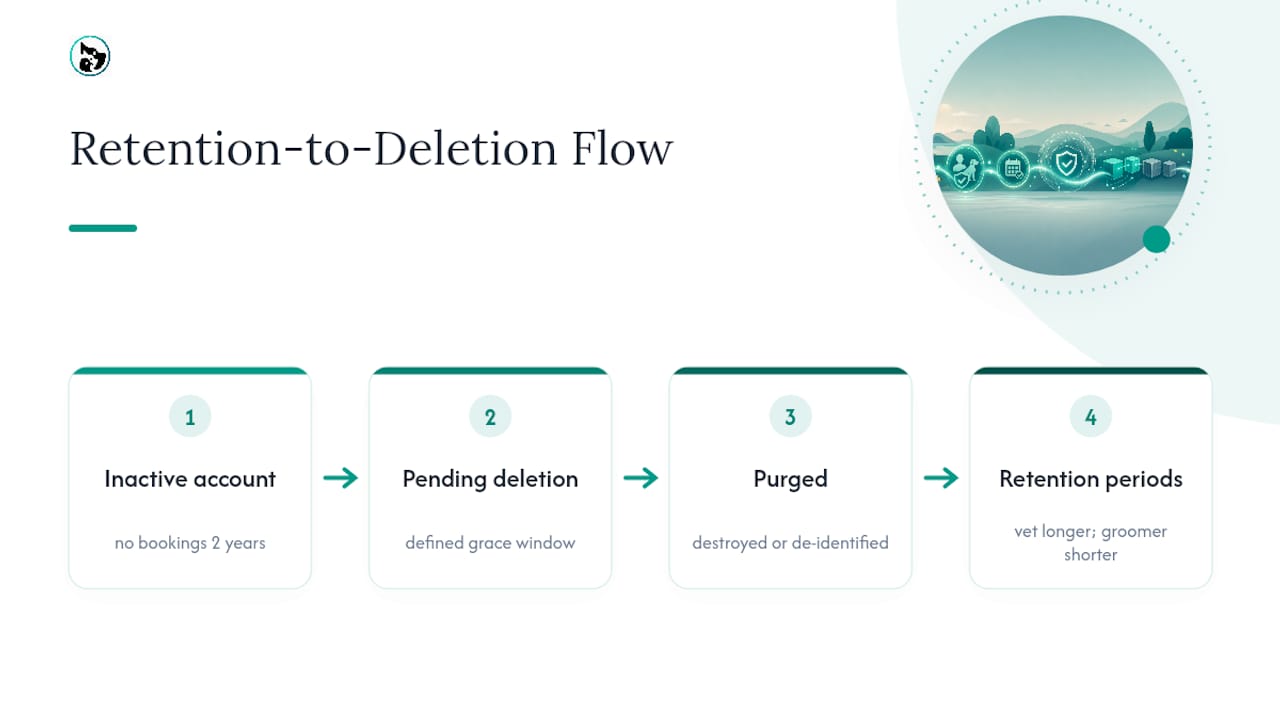
Retention periods aren't one-size-fits-all. A vet practice may need to keep certain records longer for medico-legal reasons, while a mobile groomer's waiver has a much shorter useful life. Set the period to match the actual risk profile of your service, then write it down. An undocumented retention practice is functionally the same as having none, if you're ever asked to demonstrate compliance.
Vetting your cloud storage provider before you commit
Not every "secure cloud storage" claim holds up under scrutiny, and the OAIC makes clear that the data holder, not the provider, carries the consequences if it doesn't. Before signing up with any storage or booking platform, ask four direct questions.
First, what encryption standard applies to data at rest and in transit? A provider that can't name a specific standard is a red flag, not a technicality.
Second, does the system generate access logs showing who viewed or edited a waiver, and can you review them? Technical guidance from the OAIC recommends restricting non-public content to authorised users and disabling directory browsing, both basic checks worth asking a provider to confirm rather than assume.
Third, is multi-factor authentication available, and is it enforced for all accounts or just optional? Optional MFA on a shared admin login is close to no MFA at all.
Fourth, can the provider actually delete data on request, and can staff physically access the servers? The Notifiable Data Breaches guidance is explicit that if a third-party provider is breached, you're still the party who has to notify affected clients. Due diligence upfront is cheaper than that conversation later.
Beyond encryption: access controls and regular audits
Encryption and MFA stop the obvious attacks, but the more common failure in small businesses is internal, not external, someone with more access than their role needs, or an old staff account nobody deactivated.
Role-based access control solves this by limiting what each staff member can see based on their function. A casual groomer checking a dog in for a wash doesn't need to see the client's full medical history; they need to know whether a waiver is signed and whether there are any handling notes. Splitting access by role reduces the blast radius if one account is compromised, and it's far easier to set up at the start than to retrofit once ten staff members share one login.
Regular audits matter just as much as the initial setup. A quarterly review of who has access to waiver records, and whether that access still matches their current role, catches the departed staff member whose account was never deactivated. Pair this with periodic checks of access logs for unusual patterns, like a login at 3am from an unfamiliar location.
The OAIC's guide to securing personal information frames these controls as part of "reasonable steps" under APP 11, not optional extras. For a business handling dozens or hundreds of client waivers, an access review that takes fifteen minutes a quarter is a small cost against the risk of a breach involving sensitive health-type data.
Compliance beyond privacy law: industry-specific waiver requirements
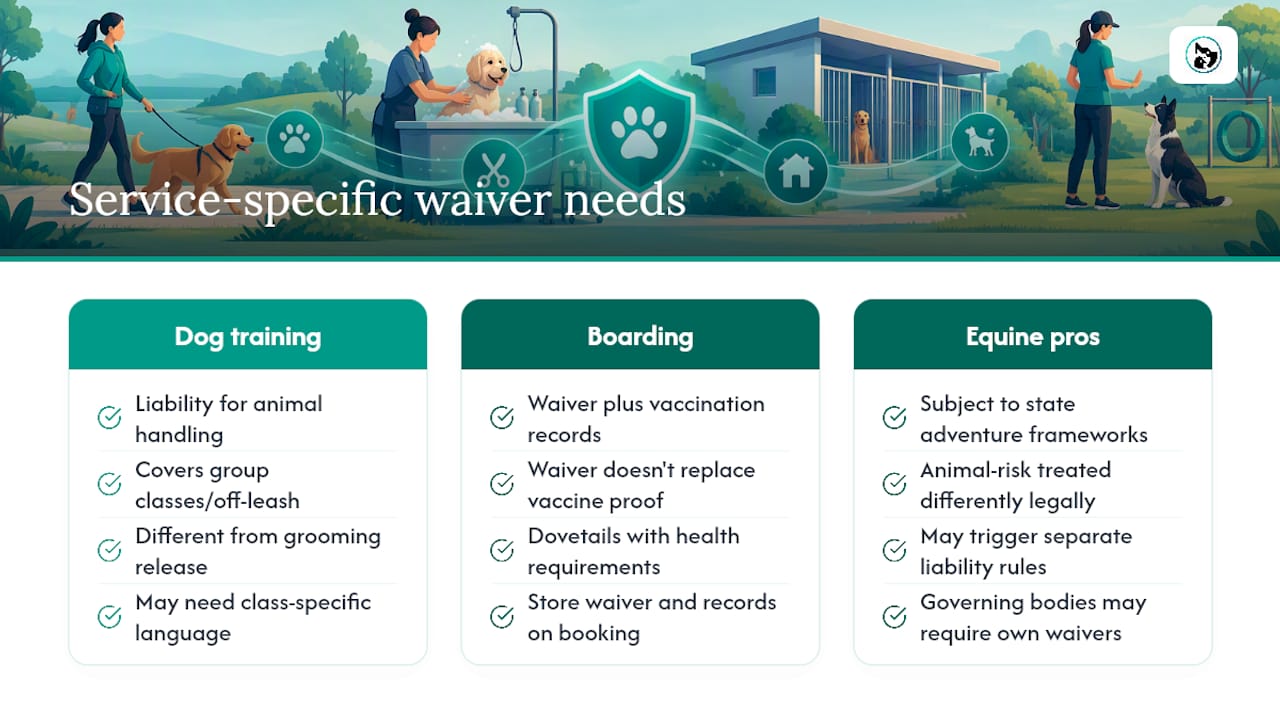
Privacy law sets the floor, but some pet services face additional requirements layered on top. Dog training businesses that run group classes or off-leash activities may need waivers that address liability standards specific to animal handling, distinct from a straightforward grooming release. Boarding facilities often need waivers that dovetail with vaccination and health record requirements, since a waiver alone doesn't substitute for verified proof of vaccination status.
Equine professionals face a different layer again, given that horse-related activities frequently fall under specific state adventure activity or liability frameworks that treat animal-related risk differently from routine pet care. If your service overlaps with organised sport, agility trials, or public events, check whether the relevant governing body has its own waiver or insurance requirements that your online storage process needs to accommodate alongside the standard privacy obligations.
The practical takeaway is that your waiver storage system needs to be flexible enough to hold different waiver types for different services, not one generic template reused everywhere. A boarding facility might combine a liability waiver with a vaccination record process, storing both against the same booking so staff see a complete compliance picture at check-in rather than two disconnected documents.
Making waiver signing easy for clients, not just compliant for you
A waiver that's legally sound but painful to complete will get skipped, rushed, or filled in with false information just to get past it. User experience matters here as much as the legal wording.
Electronic delivery works best when it meets clients where they already are, a link sent by SMS or email ahead of the appointment, rather than a paper form handed over at a busy front desk. Mobile-friendly forms matter more than most businesses realise: a waiver that requires pinching and zooming on a phone screen is a waiver that gets abandoned halfway through.
Timing also affects completion rates. Sending the waiver immediately at booking, with a gentle reminder closer to the appointment, gives clients time to read it properly rather than scrawling a signature under pressure while their dog pulls at the lead in reception. This is also where automated reminders earn their place, chasing an incomplete waiver without needing a staff member to remember to do it manually.
Clarity beats legal thoroughness for readability. A waiver written in dense legal language that a client skims without reading isn't doing its job, even if it's technically compliant. Plain language describing the actual risks (a dog may react unpredictably during grooming, a boarding facility isn't liable for pre-existing conditions) tends to hold up better in a dispute than boilerplate nobody understood.
Handling waiver version control and updates
Waivers aren't static documents. Service offerings change, legal advice gets updated, and a waiver written two years ago may no longer reflect what you actually do. Without version control, you risk a situation where different clients have signed materially different versions of your terms, and you can't easily tell which version applied at the time of an incident.
The fix is straightforward but often skipped: timestamp every waiver version, and store which version each client signed against their record permanently, even after you update the template. When you revise a waiver, don't overwrite old signed copies, archive them and require existing active clients to re-sign the updated version before their next booking if the change is material.
Immutable file storage, where the signed PDF can't be altered after the fact and carries signature metadata and a timestamp, supports this. If a dispute arises eighteen months later, you can produce the exact document the client signed, not a current template that may have since changed. Keep a simple log of what changed between versions and when, so staff aren't left guessing which clause applied to which booking.
Disaster recovery planning specific to waiver data
A backup that's never been tested is a hope, not a plan. Waiver data deserves its own disaster recovery thinking separate from general business continuity, because losing it doesn't just cost you time, it remove your legal evidence of consent for every affected booking.
At minimum, confirm your storage provider or booking platform runs automated backups on a defined schedule, and actually test restoring a file rather than assuming the backup job succeeded because no error appeared. Ask what happens if the provider itself experiences an outage or shuts down: can you export your full waiver history in a usable format, or would you lose access entirely?
Document a simple incident response plan covering who to contact, how quickly you need to restore access, and what you'll tell affected clients if data is temporarily inaccessible. This overlaps with your Notifiable Data Breaches obligations. If a breach or loss event is likely to result in serious harm, you have a legal duty to notify, and having a plan ready before it happens is far less stressful than drafting one during a crisis.
Does storing a waiver online affect its enforceability?
Storage method doesn't weaken a waiver's legal standing, but poor storage can undermine your ability to prove it existed. The Electronic Transactions Act confirms electronic signatures carry the same weight as ink on paper, provided the method reliably identifies the signer and the signer consented to that method. That's settled law, not a grey area businesses need to work around.
Where enforceability actually gets tested is evidentiary: if a dispute ends up in a tribunal or court, you need to demonstrate the waiver existed, who signed it, and when. This is why an audit trail matters more than the storage location itself. A signed PDF sitting in a generic cloud folder with no access log or timestamp metadata is weaker evidence than the same document stored with a verified signature timestamp and a record of who accessed it and when.
State-based rules add a further layer in some contexts. NSW electronic transactions legislation, for instance, explicitly recognises electronic records for statutory retention purposes, reinforcing that a properly stored digital waiver satisfies requirements that once assumed paper. The practical rule: enforceability depends less on whether the waiver is digital, and more on whether you can prove, with evidence, exactly what the client agreed to and when.
Why booking-linked waiver storage cuts risk and admin time
Waivers stored separately from bookings create friction exactly when you can least afford it, at check-in, during a dispute, or when a regulator asks for evidence. Centralising waivers against the booking record they belong to removes the guesswork: staff see instantly whether a client is covered, and there's no scramble through old emails when something goes wrong months later.
The bigger, less obvious win is operational discipline. A documented retention and deletion schedule doesn't just satisfy APP 11, it forces you to actually decide how long you're keeping sensitive client data, rather than defaulting to "forever" out of inertia. That reduces your long-term liability exposure more than any single security setting.
Automation is where the daily admin burden actually drops. When reminders chase incomplete waivers automatically, staff stop having to track down signatures manually, and incomplete records at drop-off become rare rather than routine.
— AnimalBooking
How AnimalBooking helps with waiver capture and secure storage
Certain booking software offers a single place to capture, store, and track waivers against the exact booking they belong to, instead of juggling a separate e-sign tool and a separate calendar. Users can embed a waiver step directly into a booking widget, attach signed forms to each client's record, and have automated reminders chase anyone who hasn't completed one before their appointment.
For groomers and boarders in particular, the platform pairs with ready-made templates like the dog training waiver guide to shortcut the setup process rather than drafting a waiver from a blank page. Access controls mean only the staff who need to see a client's waiver can, and every booking carries its own attachment history. AnimalBooking states that businesses using its automated reminders see significantly fewer incomplete waivers and may reduce no-shows substantially overall. If you're ready to see how it fits your setup, check the pricing plans, which start with a Starter tier and scale up to Independent at $49 per month, Teams at $149, and Pro at $299, and set up your first booking-linked waiver in minutes.
Sources
FAQ
Are electronic pet service waivers legally binding in Australia?
Yes, provided the signing method reliably identifies the signer and the signer consented to signing electronically, as set out in the Electronic Transactions Act 1999. Enforceability in a dispute then depends on the quality of your audit trail, not just the signature itself.
How long should I keep client waivers on file?
There's no single fixed period in the Privacy Act, but APP 11.2 requires you to destroy or de-identify personal information once it's no longer needed. A common practical approach is retaining waivers while a client is active, then marking them for deletion after a defined inactivity period you document in your privacy policy.
What happens if my cloud storage provider is breached?
You remain responsible for notifying affected clients under the Notifiable Data Breaches scheme, even though the breach happened on the provider's systems. This is why vetting a provider's encryption, access logs, and MFA before signing up matters more than reacting after an incident.
Can I attach waivers directly to a client's booking?
Yes, and it's the most efficient setup for pet services specifically. AnimalBooking links signed waivers to the exact booking record, so staff can see completion status at check-in without searching a separate storage system.
Do I need a written privacy policy just for storing waivers?
Yes. APP 11 and related guidance from the OAIC expect a publicly available privacy policy disclosing how you collect, store, and eventually destroy personal information, including waivers containing health-related pet details.