

Yes, a business can legally add a public holiday surcharge in Australia, provided it tells you clearly before you pay. That's the whole test. Get the disclosure right and the surcharge is lawful. Hide it, downplay it, or spring it on customers at checkout, and you're looking at a breach of the Australian Consumer Law.
Here's what both sides of the counter need to know:
- Disclosure beats percentage. There's no legal cap on how much a public holiday surcharge can be, but it must be disclosed prominently before the customer orders or books.
- The magic words matter. Consumer Affairs Victoria requires wording like "a surcharge of [percentage] applies on [the specified day or days]," shown as prominently as the main price.
- Daily surcharges are different. If a surcharge applies every single day, it stops being an exempt add-on and must be folded into the displayed price.
- Penalty rates drive the cost. Surcharges typically exist to cover Fair Work award penalty rates, not to pad margins.
For pricing disclosure disputes, the ACCC is your first stop. For questions about whether the underlying wage rates are correct, that's a Fair Work Ombudsman matter.
Key Takeaways
Public holiday surcharges are legal in Australia provided they're disclosed prominently before payment, with daily or unavoidable surcharges required to sit inside the displayed price rather than added separately.
| Point | Details |
|---|---|
| Disclosure beats amount | There's no cap on surcharge size, but it must use clear wording and appear before the customer pays. |
| Daily surcharges must be included | A surcharge applied every day counts as part of the minimum displayed price, not an exempt add-on. |
| Use the exact wording | State "a surcharge of [percentage] applies on [day or days]" as prominently as your main price. |
| Card and holiday surcharges differ | Card fees are capped at processing cost; public holiday surcharges cover wage costs and need disclosure, not a cap. |
| Keep your evidence trail | Retain payslips, signage screenshots, and booking confirmations to justify your surcharge if challenged. |
| Automate the disclosure step | Animalbooking lets pet-service providers add surcharge fields to bookings and receipts, though compliant wording is still the operator's job. |
Table of Contents
- What is a public holiday surcharge and how does the law treat it?
- How do you display a public holiday surcharge correctly?
- What should businesses never do with surcharge pricing?
- Card surcharges vs public holiday surcharges: what's the difference?
- How do you calculate a fair public holiday surcharge?
- How should staff communicate surcharges on the day?
- How should pet-service bookings handle public holiday surcharges?
- Who enforces surcharge rules and how do you complain?
- Should your business even charge a public holiday surcharge?
- Let Animalbooking handle the surcharge paperwork for you
- Where to check the official rules
- Sources
What is a public holiday surcharge and how does the law treat it?
A public holiday surcharge is a percentage or flat-fee addition applied to a bill only on gazetted public holidays (and often weekends), separate from the everyday menu or service price. It's not a tax, not a tip, and not optional once it's disclosed. It's simply the mechanism a business uses to pass on the extra cost of trading on an expensive day.
The legal test sits squarely inside the Australian Consumer Law, enforced through ACCC guidance on price displays. Businesses must normally show a single minimum total price a consumer could pay. Weekend and public-holiday surcharges get a specific exemption from that rule, but only if the business uses the required disclosure wording and displays it prominently, before the customer commits.
Why do surcharges exist in the first place? Mostly because of penalty rates. Fair Work Ombudsman guidance confirms that public holiday pay depends on the applicable award or enterprise agreement, and these rates vary widely between hospitality, retail, and other sectors. A café paying casual staff 2.5 times their normal rate on Christmas Day faces a real cost spike, and the surcharge is how that gets recovered.
Here's where it gets tricky. Only the extra public-holiday portion qualifies for the display exemption, and only with proper wording attached.
How do you display a public holiday surcharge correctly?
Prominence is the whole game. The ACCC and Consumer Affairs Victoria both require the surcharge notice to be at least as visible as the price it modifies, not buried in fine print at the bottom of a laminated menu nobody reads.
The exact formula Consumer Affairs Victoria recommends is: "A surcharge of [percentage] applies on [the specified day or days]." Use that structure, adapt the day and percentage, and you've met the core wording requirement across most contexts.
Where you place it depends on how customers interact with your business:
- Printed menus: the surcharge line should sit near the top or bottom in a font size comparable to your prices, not tucked into a footnote.
- Price boards and counter signage: a clearly visible sign at the entrance or till, ideally at eye level where customers order.
- Online menus and ordering apps: the same wording needs to appear before the customer adds items to their cart, not just on a separate terms page.
- Booking platforms and checkout flows: disclose the surcharge before payment is confirmed, ideally as a line item the customer sees and accepts.
- Receipts: show the surcharge as its own line so customers can see exactly what they paid and why.
Pro Tip: Check your font size and colour contrast against your actual price text, not just against the background. A grey 8-point disclaimer next to a bold black price fails the prominence test even if the words are technically correct, and it's the fastest way to end up with a consumer complaint.
Don't forget third-party booking platforms. If your surcharge notice lives on your website but your Deliveroo listing or booking widget doesn't carry it, you're still exposed.
What should businesses never do with surcharge pricing?
Some pricing habits look harmless but cross straight into ACL territory. Regulators treat these as red flags:
- Adding a surcharge at checkout that wasn't disclosed anywhere earlier in the customer journey (classic drip pricing).
- Labelling a surcharge as a "government fee," "public holiday tax," or anything implying it's a mandatory charge outside the business's control.
- Applying a surcharge every day of the week while still marketing it as a special "weekend or holiday only" add-on and leaving it out of the displayed price.
- Using surcharge wording that's technically present but so small or poorly placed it fails the prominence test.
- Changing the surcharge percentage without updating every display point, including third-party booking sites and printed menus still in circulation.
The recurring-surcharge trap catches out plenty of operators.
The 5% daily surcharge, because it's unavoidable and constant, must be included in the minimum displayed price under ACCC guidance. Only the additional public-holiday component qualifies for separate disclosure. Treating both as "surcharges" and leaving the whole 15% off the menu is a common and costly mistake.
Credit card surcharges sit under a different rulebook entirely. Those are capped at the merchant's actual cost of accepting that payment method, a rule the Reserve Bank enforces separately from ACL pricing disclosure, and SMH reporting notes card surcharges are being phased down under RBA reform while public holiday surcharges remain a separate, ongoing practice.
Card surcharges vs public holiday surcharges: what's the difference?
These two fees often appear on the same bill, but they recover completely different costs and answer to different rules. A card surcharge covers the merchant's payment processing fee and is capped by RBA rules at the actual cost of accepting that card. A public holiday surcharge covers higher staff wages and operating costs on a specific trading day, with no fixed percentage cap, only a disclosure requirement.
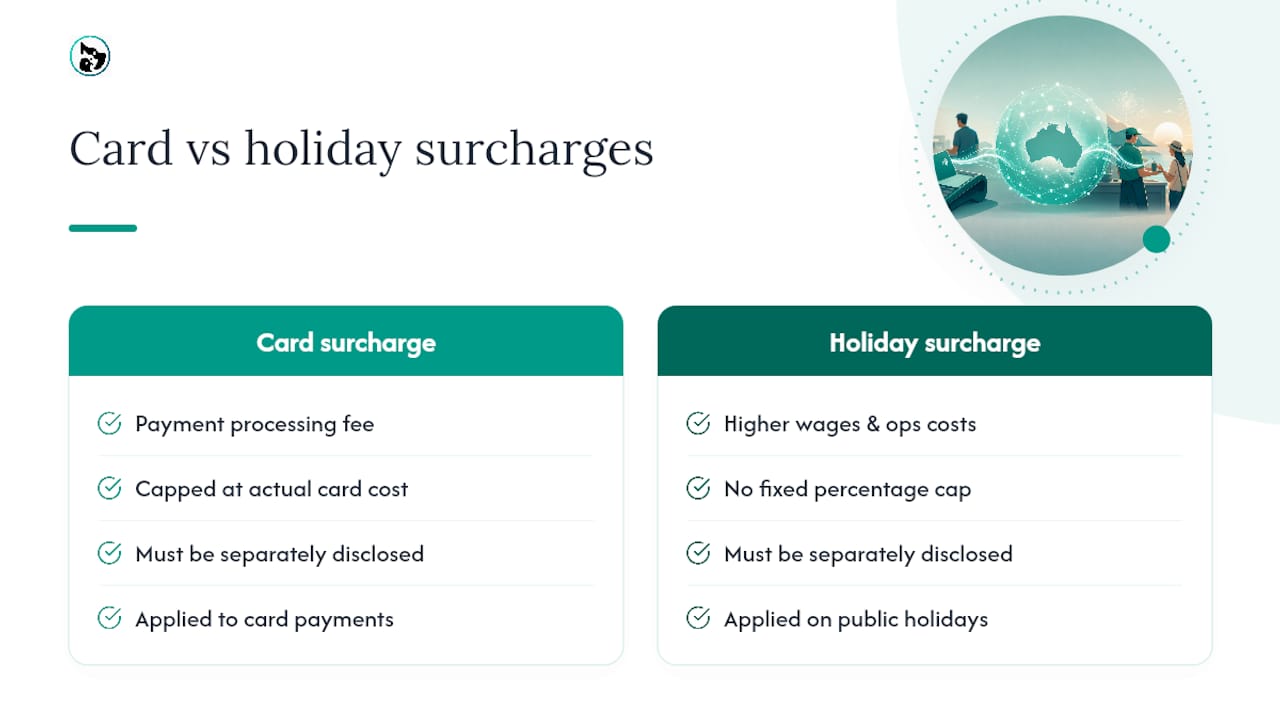
The risk is stacking both without transparency, sometimes called a double surcharge. A customer paying by card on Christmas Day might see a public holiday surcharge and a card surcharge on the same transaction, and that's legitimate as long as both are separately disclosed and neither exceeds its own legal limit.
How do you calculate a fair public holiday surcharge?
A defensible surcharge starts with real numbers, not a round figure picked because it sounds reasonable. Here's a practical method:
- Calculate your actual extra wage cost. Pull the penalty rate from the relevant award (Fair Work's pay tools make this straightforward) and work out the gap between normal and public-holiday pay for your rostered staff.
- Add unavoidable overheads. Factor in anything else that spikes on the day, higher supplier costs, extra insurance, or reduced supplier availability forcing pricier substitutes.
- Convert the total to a percentage of average transaction value. Divide the extra cost by your typical daily revenue to land on a fair, proportionate rate rather than an arbitrary one.
- Round sensibly and document your working. Keep the calculation on file, not just the final number, in case you need to justify it later.
A quick worked example: a café rosters three staff at a $12 per hour penalty loading above normal rates, for six hours each, on a public holiday. That's $216 in extra wage cost.
Keep payslips showing the penalty rate paid, your written surcharge policy, screenshots of signage and menus at the time, and copies of booking confirmations. Review the calculation whenever award rates change or at least once a year, since penalty rates and overhead costs both shift over time.
How should staff communicate surcharges on the day?
Getting the paperwork right means nothing if the person at the counter fumbles the explanation and a customer feels ambushed. Your point-of-sale system should show the surcharge as its own labelled line, not folded silently into the total, and your online booking page needs to display it before the customer enters payment details, not after.
Pro Tip: Run a quick screenshot audit of your online menu and booking confirmation pages the night before every public holiday. It takes two minutes and gives you dated proof of disclosure if a dispute ever lands on a regulator's desk.
How should pet-service bookings handle public holiday surcharges?
Dog groomers, boarding kennels, mobile vets, and trainers face the same disclosure obligations as any hospitality business, but the booking-first nature of pet services means the compliance moment happens earlier, at the point of booking rather than at a walk-in till.

Your booking flow needs a visible surcharge notice before the customer confirms their appointment, ideally with an explicit acknowledgement step rather than fine print they can scroll past. Confirmation emails and receipts should repeat the surcharge line so there's no gap between what was agreed and what gets charged.
This will be added at checkout. Booking platforms should let you flag specific dates in advance so the surcharge triggers automatically rather than relying on someone remembering to add it manually, and cancellation or refund policies need to account for the surcharge amount too.
Pro Tip: Store a timestamped record of the customer's acceptance at the moment they confirm the booking, not just the final invoice. It's the single most useful piece of evidence if a customer disputes the charge weeks later.
Who enforces surcharge rules and how do you complain?
Three bodies split the enforcement work, and knowing which one to contact saves everyone time:
- ACCC: handles pricing disclosure, misleading conduct, and drip pricing complaints under the ACL.
- Fair Work Ombudsman: covers whether the underlying penalty rates and award pay were calculated correctly, not the surcharge disclosure itself.
- State and territory consumer protection agencies (such as Consumer Protection WA and Consumer Affairs Victoria): handle local enforcement and take direct complaints about undisclosed surcharges.
If you've been hit with a surprise surcharge, start by raising it with the business directly, most disputes resolve at this stage. If that goes nowhere, gather your evidence: photos of menus or signage, screenshots of the booking page, and your dated receipt. Then lodge a complaint with your state consumer protection office or the ACCC. Regulators generally respond faster when you supply dated, specific evidence rather than a general complaint about feeling overcharged.
Should your business even charge a public holiday surcharge?
Surcharging protects margins on the year's most expensive trading days, but it carries real reputational risk if customers feel blindsided, and some operators use "no surcharge" as a deliberate point of difference rather than a cost they eat quietly. The businesses that get this right treat disclosure as marketing, not just compliance, telling customers upfront why the surcharge exists rather than hoping nobody notices.
Let Animalbooking handle the surcharge paperwork for you
Animalbooking is the alternative to chasing signage updates and manual receipt edits every time a public holiday rolls around. Your booking pages can carry a surcharge field tied to specific dates, so the disclosure appears automatically before a client confirms, and the same line flows straight through to their receipt without you touching a spreadsheet.
That said, no booking software replaces your legal obligation to get the wording right and keep your public-facing signage current. Automation handles the mechanics, timestamped acceptance records, consistent receipt formatting, calendar-linked pricing, but you still need to write compliant disclosure text and check it against ACCC and state guidance.
Groomers, boarders, and mobile vets can set this up directly through the provider pricing page, where surcharge fields sit alongside the existing payment and booking tools. If you're already running bookings through Animalbooking, log into your bookings dashboard and add a surcharge date before the next public holiday catches you out.
Where to check the official rules
- ACCC price displays: the primary source on disclosure exemptions and minimum price rules.
- Fair Work Ombudsman: confirms award-specific penalty rates behind most surcharges.
- Consumer Affairs Victoria: sets out the exact menu wording and prominence test.
- Sprintlaw's compliance guide: a practical legal explainer for hospitality operators.
This article is general information, not a substitute for advice from a qualified lawyer. Consult a qualified legal professional about your own circumstances before acting on anything here.
Sources
- Price displays | ACCC
- Pricing - Consumer Affairs Victoria
- Public holiday penalty rates - Fair Work Ombudsman
- Public Holiday Surcharges: Legal Rules for Cafes