

Booking lead time is the number of days between a confirmed reservation and the guest's arrival date. It is your single best forward-demand signal, and it should drive your pricing cadence, staffing roster and supplier bookings.
- Definition: check-in date minus booking date, measured in days
- Shortening window: often signals softening demand or a shift toward spontaneous bookers
- Lengthening window: usually points to strong forward demand and room to hold rates
- Next checks: pull your rolling 12-month median lead time and compare it against current pacing before you touch a single rate
Key Takeaways
Booking lead time works as a revenue and operations tool only when measured with medians and segments, not a single blended average.
| Point | Details |
|---|---|
| Use median, not average | A single skewed booking can distort your average; medians and trimmed averages give a truer picture. |
| Segment before deciding | Split lead time by channel, guest persona and length of stay to avoid misreading normal variation as a problem. |
| Compare benchmarks directionally | Urban leisure runs 21–40 days and resort stays 40–75 days, but always compare against your own market and season. |
| Match tactics to the curve | Hold rates early, apply early-bird and last-minute rules based on where your bookings actually cluster. |
| Automate the enforcement | Smart calendar rules and reminders keep lead-time strategies running without manual daily oversight. |
Table of Contents
- How to calculate booking lead time correctly
- Why booking lead time matters for revenue and operations
- What's a typical booking lead time by market type?
- What factors influence how far ahead guests book?
- How do you measure and segment booking lead time?
- What tactics actually shift your booking window?
- Which reports and tools actually surface lead-time insight?
- Your 30 to 90-day action checklist
- How lead time variability affects inventory and overbooking risk
- How holidays, local events and disruptions shift lead time
- What does booking lead time optimisation actually look like in practice?
- Get your booking rules working automatically
- What actually works vs. what sounds good in theory
- Sources
How to calculate booking lead time correctly
The formula is simple: check-in date minus the date the booking was confirmed, expressed in days. Run that calculation across every reservation, and you have your dataset. The trap most operators fall into is stopping at a single average, because booking lead time figures are notoriously skewed by a handful of guests who book a year ahead for a wedding or a major event.
A median tells you what a typical guest actually does. An average gets dragged around by outliers. Look at both, and if they diverge sharply, that gap itself is useful information about how lumpy your demand really is.
Before you trust any number, clean the export:
- Strip out cancelled and no-show reservations. They were never real lead time.
- Remove obvious test bookings or internal holds.
- Decide how you'll treat multi-night stays: use the first night's check-in date consistently, not the midpoint or last night.
- Filter by date range so you're comparing like-for-like periods (same season, same year-over-year window).
Pro Tip: Keep a saved filter or export template in your PMS so this calculation takes five minutes each week, not a rebuild every time you want to check pacing.
Why booking lead time matters for revenue and operations
Lead time sets your forecast horizon. If your median guest books 18 days out, you have roughly two and a half weeks to react to pricing and demand signals before arrival, a very different planning window to a resort property working 60 days ahead.
That horizon shapes almost everything downstream:
- Rate decisions: short lead time means faster, more frequent price reviews; long lead time gives you room to hold rates and wait for pickup to confirm demand
- Staffing and rostering: knowing when bookings typically land lets you schedule casual staff and grooming or boarding capacity with more confidence
- Supplier and vendor timing: ordering stock, booking contractors or confirming equine transport becomes predictable once you know your typical booking window
- Cash-flow planning: longer lead times mean deposits land earlier, smoothing revenue recognition across the month
Lead time and pacing move together. Shifts in average lead time often precede occupancy and revenue changes, which makes it a leading indicator rather than a lagging one. Watch it drift before your occupancy numbers do, and you get a head start on pricing corrections.
What's a typical booking lead time by market type?
Benchmarks vary enormously by property type, and treating any single number as universal will mislead you. Directional ranges look like this:
- Urban business travel: 7–21 days, often clustered even tighter (3–7 days) for corporate bookers
- Urban leisure: 21–40 days is the common range for city-break travellers
- Resort and vacation rentals: 40–75 days, reflecting more deliberate holiday planning
- Events and group bookings: tend to have even longer booking windows, often well in advance for weddings and large gatherings
Many urban markets have been trending toward shorter windows, driven by mobile booking habits and last-minute deal-seeking. Rather than anchoring to a fixed threshold, compare your rolling 12-month median against the same period last year to see whether your own market is shortening or holding steady.
Treat every range above as a starting point for comparison, not a target. Your own segment, season and guest mix will always matter more than an industry average.
What factors influence how far ahead guests book?
Several forces push lead time longer or shorter, and diagnosing which one is at play tells you which lever to pull.
- Seasonality and local events: a festival, conference or school holiday period pulls bookings forward; quiet shoulder seasons compress them
- Guest persona and length of stay: a business traveller booking one night behaves nothing like a family booking a two-week resort stay, and blending them into one average hides both patterns
- Price band: higher-value stays tend to get booked further out, since guests plan and budget for them
- Channel and device: mobile bookings skew toward shorter windows; direct website and desktop bookings often skew longer
- Cancellation and payment policy: flexible, fully refundable rates invite earlier, lower-commitment bookings, while non-refundable deposits filter for guests who commit sooner and stick with the date
None of these factors act alone. A short lead time during a normally slow week might just mean weekend spontaneous travellers doing what they always do, while the same short window during your peak season is a genuine warning sign worth investigating.
How do you measure and segment booking lead time?
Start with a full export from your property management system or channel manager, covering at least twelve months of reservations.
- Export and clean. Pull all bookings, then strip cancellations and duplicate test entries.
- Calculate per-booking lead time. Check-in date minus booking date, for every row.
- Bucket the results. Use bands like 90–61 days, 60–31, 30–15, and 14–0, then plot the count in each bucket to build your lead-time curve.
- Calculate median and a trimmed average (dropping the top and bottom 5% of outliers) so a handful of far-out bookers don't distort your read.
- Look for a bimodal shape. Many properties show two humps: early planners and late deciders, rather than one smooth curve.
- Segment further by channel, length of stay and guest persona, then compare each segment to the same period last year.
| Lead-Time Bucket | Typical Guest Behaviour |
|---|---|
| 90–61 days | Early planners, often higher-value or group bookings |
| 60–31 days | Deliberate leisure travellers, resort and vacation stays |
| 30–15 days | Mixed leisure and business, price-sensitive shoppers |
| 14–0 days | Last-minute deciders, mobile-heavy, business travel |
Pro Tip: Run this segmentation quarterly, not once a year. A channel mix shift or a new marketing push can move your curve faster than you'd expect.
What tactics actually shift your booking window?
Once you know your curve, you can design rules around it instead of guessing.
- Match your discount timing to the curve. Hold rates through the early part of the window, then apply measured discounts once you hit the mid-window point where most of your bookings historically land.
- Stagger minimum-stay rules by lead-time band. Require longer minimum stays far out, then relax them as the date approaches and unsold inventory becomes a bigger risk than a short booking.
- Run early-bird offers for long-lead planners. A modest discount for bookings 60-plus days out rewards commitment without giving away margin on dates that would have sold anyway.
- Build last-minute bundles for late deciders. Add value (late checkout, a grooming add-on, a bundled service) rather than just slashing price, which protects your average rate.
- Use staged deposits to pull commitment earlier. A deposit at booking with balance due closer to arrival can nudge hesitant guests to confirm sooner, and it's worth tracking whether it also reduces no-shows.
- Test before rolling out. Apply any new rule to a subset of dates first, watch pacing and pickup over a full booking cycle, and only expand it once you see genuine lift.
Pro Tip: Never launch a pricing change on every date at once. Pick a slow week, test it, measure the pickup, then scale.
Which reports and tools actually surface lead-time insight?
The reports worth building or requesting from your platform: a lead-time distribution chart, a rolling median trend line, pacing by booking window, and pickup trends comparing this week's bookings to the same week last year.
On the feature side, look for a smart calendar that lets you set different minimum-stay and pricing rules by lead-time band, automated reminders that chase incomplete bookings before they lapse, and a dashboard that surfaces booking-window trends without a manual export every time.
An automated booking platform that handles reminders, deposits and calendar rules removes a lot of the friction that causes late cancellations and no-shows, and it means those lead-time rules you design actually get enforced consistently rather than depending on someone remembering to check the calendar.
Animalbooking's smart calendar and automated reminders exist for exactly this reason: turning your lead-time analysis into rules that run themselves, rather than a spreadsheet you have to police manually.
Your 30 to 90-day action checklist
Start with measurement, then move into two live experiments you can assess within a single booking cycle.
- Export the last 12 months of bookings and calculate your median lead time, excluding cancellations.
- Compare your current pacing at the market's typical mid-window point, then decide whether to hold rates or apply a measured discount.
- Build two calendar rules: an early-bird discount for long-lead bookers and a last-minute bundle for close-in dates, and apply both to a limited set of test dates.
- Measure the result after one full booking cycle, then decide whether to expand, adjust or scrap each rule.
How lead time variability affects inventory and overbooking risk
Wide swings in lead time make inventory planning genuinely harder. A property with a scattered distribution, some bookings 90 days out and others walking in same-day, faces a much messier allocation problem, because unsold inventory close to arrival looks different depending on whether it reflects genuine softness or just your normal late-booking pattern.
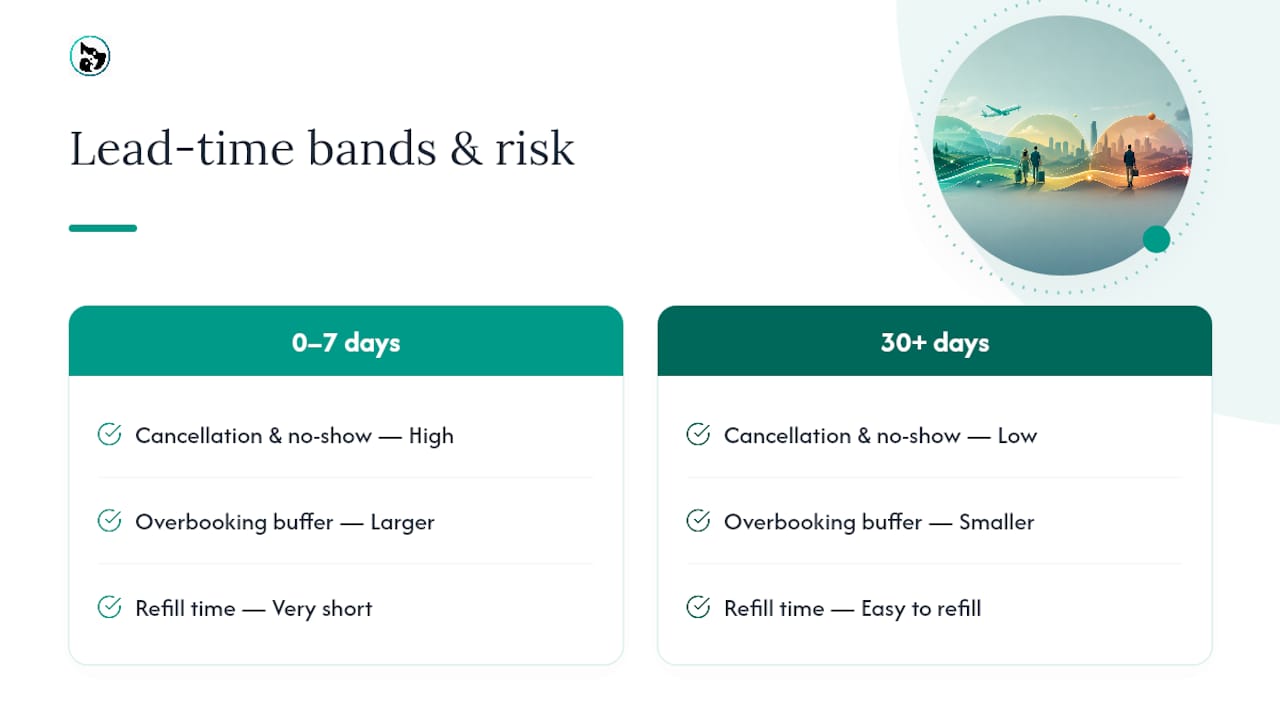
This is where overbooking strategy gets tricky. Overbooking a small percentage of inventory close to arrival makes sense when your historical cancellation rate for that lead-time band is well understood. But if your lead-time curve shifts, say a channel starts sending more last-minute, higher-cancellation traffic, your overbooking buffer calculated on old data suddenly overshoots, and you risk turning away or displacing a confirmed guest.
The practical fix is segmenting your overbooking allowance by lead-time band rather than applying one blanket percentage across your whole calendar. Bookings in the 0–7 day window typically carry different cancellation and no-show risk to bookings made 60 days out, and your buffer should reflect that difference. Boarding and grooming operators juggling multiple pets per slot feel this most acutely: a single late cancellation in a tight same-day window can leave a kennel or grooming table empty with no time to refill it, while the same cancellation 30 days out is easily absorbed.
How holidays, local events and disruptions shift lead time
External events reliably distort booking windows, and recognising the pattern early stops you from misreading a shift as something it isn't. A major local event, a festival, a big sporting fixture, a conference, typically pulls lead time out well beyond your usual median, sometimes months ahead for high-demand dates. That's a demand signal worth acting on with rate increases and tighter minimum stays, not just capacity planning.
Public holidays behave differently depending on the service. Boarding facilities often see lead time compress right before long weekends, because pet owners finalise travel plans late and boarding is an afterthought until the trip is locked in. Grooming, by contrast, often sees a pre-holiday rush booked further out as owners plan ahead for visiting family or events.
Broader disruptions, the kind the industry saw during the pandemic period, compress lead time dramatically and for extended stretches, as travellers and pet owners alike avoid committing until the picture is clearer. Booking windows across the wider travel industry shortened sharply during that period and took time to normalise, a pattern worth remembering any time local conditions turn uncertain, whether that's a weather event, a regional closure or a public health scare.
The operational takeaway is the same regardless of the cause: when lead time compresses suddenly, don't assume it's permanent demand softening. Check whether a specific event or disruption explains it, then adjust your pricing and minimum-stay rules for that window specifically rather than resetting your whole strategy.
What does booking lead time optimisation actually look like in practice?
The clearest wins come from properties that stopped treating lead time as a passive metric and started designing rules around it. A boarding facility that notices its median lead time sitting at 12 days, well inside the urban leisure range, might introduce a staggered minimum-stay rule: three-night minimums for bookings placed 30-plus days out, dropping to one night inside the 7-day mark. That single change fills gaps that would otherwise sit empty while still protecting longer, more valuable stays booked early.
A mobile grooming business working a wider service area might notice its lead-time curve is genuinely bimodal, a cluster of clients booking a week or more ahead for scheduled maintenance grooms, and a second cluster booking within 48 hours for urgent or overdue appointments; you can contact & book a dog groomer in Mobile, AL to illustrate how small operators fill last-minute availability. Building a specific last-minute rate for that close-in cluster, rather than applying one flat price across the board, captures revenue from urgent bookers without discounting the planned segment that would have booked anyway.

Equine professionals often see the longest lead times of any pet-service category, sometimes stretching past 90 days for competition-season bookings. That length gives real room for early-bird incentives tied to deposits, locking in commitment months ahead and smoothing cash flow across a season that would otherwise be lumpy.
The common thread across all three: none of these changes started with a discount. Each started with a measurement, a curve, a bucket, a gap, and only then a rule designed to close it.
Get your booking rules working automatically
Manually tracking lead-time bands, chasing deposits and adjusting minimum stays by hand is exactly the kind of repetitive work that eats a manager's week. Animalbooking's bookings dashboard surfaces your reservation data in one place, so building a lead-time view doesn't mean wrestling with a spreadsheet export every time. Pair that with smart calendar rules that automatically adjust minimum stays and pricing by booking window, and the strategies covered above stop being a quarterly project and start running in the background. Providers using automated reminders and payment tools through the platform report meaningfully fewer no-shows and stronger per-booking revenue, exactly the kind of gain that comes from turning lead-time insight into rules that enforce themselves. Check the pricing plans to see which tier fits a business your size.
What actually works vs. what sounds good in theory
Most advice on booking lead time stops at the benchmark table: here's what urban leisure looks like, here's what resorts look like, go compare yourself. That's a start, not a strategy. The properties that genuinely benefit from tracking this metric are the ones that treat it as an early-warning system and pair it with pacing, not a number they check once a quarter and forget.
The conventional advice also underrates segmentation. A single average lead time across your whole guest base tells you almost nothing useful, because it blends a business traveller booking three days out with a family planning a fortnight ahead. Split those two groups and you get two genuinely different curves, each demanding a different pricing rule.
What we'd prioritise first, ahead of any pricing tactic: get the measurement right. Export twelve months, clean it properly, build the buckets, look for the bimodal shape. Skip that step and every rule you build afterward is guesswork dressed up as strategy. The operators getting real lift from lead-time optimisation aren't the ones with the cleverest discount, they're the ones who actually know their curve before they touch a single rate.
— Animalbooking
Sources
- Booking lead time: Guide for hotels — SiteMinder
- How booking window shifts indicate demand — Mews
- Booking lead time guide for hosts & property managers — Airbtics